SKM145GB128DN: A Technical Review of a High-Performance IGBT Module
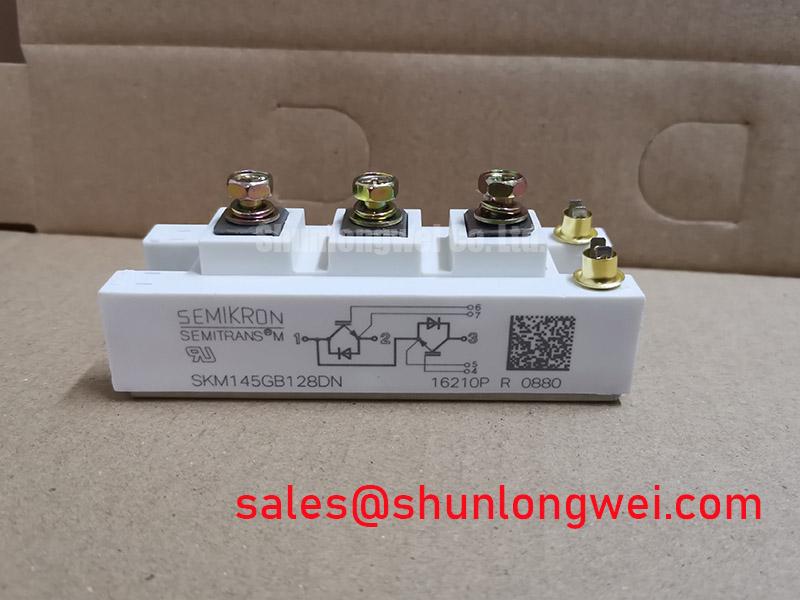
SKM145GB128DN 1200V 145A SPT IGBT Module
Introduction and Core Highlights
The Semikron SKM145GB128DN is a half-bridge IGBT module that integrates Soft-Punch-Through (SPT) technology and fast, soft recovery CAL diodes to deliver a balance of efficiency and electrical ruggedness. This combination results in reduced conduction and switching losses, directly contributing to higher system efficiency and lower operating temperatures. The module’s robust construction and electrical characteristics make it a reliable component for demanding power conversion systems.
- Core Specifications: 1200V | 145A (Tc = 80°C) | VCE(sat) 2.15V (typ)
- Key Advantages: Low conduction losses, controlled switching behavior to reduce EMI.
For detailed electrical and thermal characteristics, download the official datasheet (PDF).

Technical Analysis
The engineering value of the SKM145GB128DN is rooted in its advanced semiconductor technologies. The module’s collector-emitter saturation voltage (VCE(sat)) is specified with a typical value of 2.15V at a nominal current of 145A and a junction temperature of 125°C. This parameter is critical as it directly dictates conduction losses. You can think of thermal resistance (Rth(j-c)) like the width of a pipe for heat; this module’s low junction-to-case thermal resistance of 0.11 °C/W per IGBT ensures that the heat generated can be efficiently transferred to a heatsink, maintaining a lower operating junction temperature.
A standout feature is the integrated CAL (Controlled Axial Lifetime) freewheeling diode. This diode technology is engineered for a “soft” recovery characteristic. This means it minimizes voltage spikes and oscillations during turn-off, which significantly reduces electromagnetic interference (EMI). For engineers, this translates to smaller and less complex snubber circuits and can simplify system-level EMI filtering. Furthermore, the module’s high short-circuit capability, rated for 10 µs, provides a crucial safety margin against fault conditions, enhancing overall system reliability.
Optimized Application Scenarios
- AC Inverter Drives: The module’s low VCE(sat) and efficient thermal performance are ideal for motor drives, where energy efficiency is a primary concern. The integrated CAL diode helps to control EMI, a common challenge in VFD systems.
- Uninterruptible Power Supplies (UPS): The high short-circuit withstand time (10 µs) provides the robustness needed to handle load faults without failure, a critical requirement for reliable UPS operation.
- Welding Power Supplies: The ability to handle high currents (up to 190A at Tc=25°C) and its solid thermal management make it well-suited for the demanding power cycling found in welding applications.
This module’s balanced electrical and thermal specifications make it a strong candidate for power conversion systems requiring high efficiency and proven durability.
Key Specification Parameters
| Electrical & Thermal Characteristics (Tj = 25°C unless otherwise specified) | ||
|---|---|---|
| Parameter | Conditions | Value |
| Collector-Emitter Voltage (VCES) | – | 1200 V |
| Continuous Collector Current (IC) | Tcase = 80°C | 145 A |
| Collector-Emitter Saturation Voltage (VCE(sat)) | IC = 145 A, VGE = 15 V, Tj = 125°C | 2.15 V (typ.) |
| Gate-Emitter Threshold Voltage (VGE(th)) | IC = 5.2 mA | 5.5 V (typ.) |
| Short Circuit Withstand Time (tpsc) | VGE ≤ 20 V, Tj = 150°C | 10 µs |
| Thermal Resistance, Junction-to-Case (Rth(j-c)) | Per IGBT | 0.11 K/W |
| Max. Junction Temperature (Tjmax) | – | 150 °C (175°C in overload) |
Engineer’s FAQ
1. What is the main benefit of the CAL diode in the SKM145GB128DN?
The primary benefit of the CAL freewheeling diode is its soft recovery characteristic. This reduces voltage overshoots and high-frequency oscillations during switching, which minimizes EMI and can simplify the requirements for external snubber circuits, leading to a more robust and reliable system design.
2. What is the specified mounting torque for this module’s terminals and case?
According to the datasheet, the recommended mounting torque for the main terminals (M6) is 3-5 Nm. For mounting the module to a heatsink (M6), the recommended torque is also 3-5 Nm. Applying the correct torque is critical for ensuring proper electrical and thermal contact. For more information, please consult our guide on the critical role of IGBT terminal torque.
3. How does VCE(sat) behave at different temperatures?
The SKM145GB128DN exhibits a positive temperature coefficient for VCE(sat). This means that as the IGBT’s junction temperature increases, its on-state voltage drop also increases slightly. This characteristic is advantageous for paralleling multiple modules, as it helps to ensure natural current sharing between devices without the risk of thermal runaway in one module.
4. What is the maximum isolation voltage of this module?
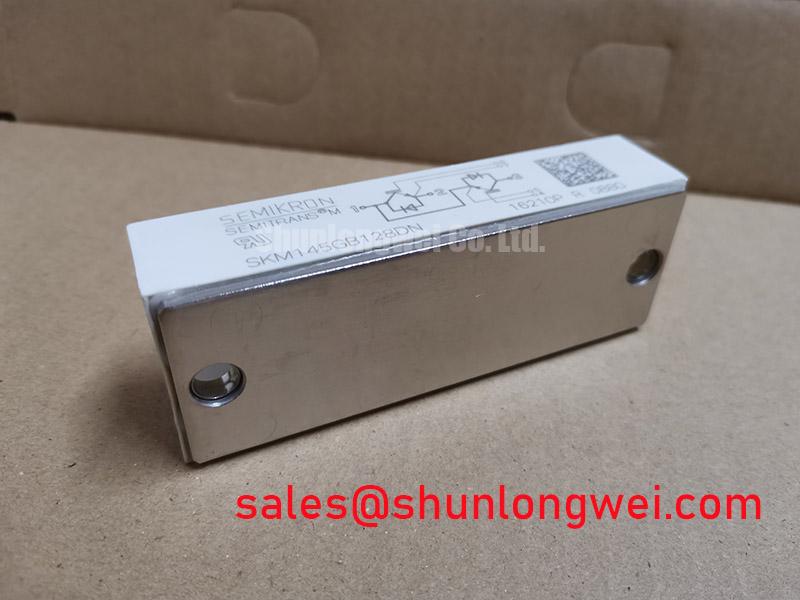
The datasheet specifies an isolation voltage (Visol) of 4000V (AC, 1 minute). This high isolation capability between the terminals and the isolated copper baseplate is essential for safety and reliability in high-power industrial systems, aligning with standards analyzed in our guide to isolated baseplates.
Design Enablement
The SKM145GB128DN provides a robust foundation for power electronics design. Its integration of low-loss SPT IGBTs with soft-recovery CAL diodes offers a pre-optimized solution that helps engineers reduce system complexity and improve overall performance. The module’s proven thermal characteristics and electrical ruggedness enable the development of efficient and durable power conversion systems.