Fuji 7MBP100RA120-05: A Technical Analysis of the 7-in-1 IGBT Power Module
Fuji 7MBP100RA120-05 1200V 100A 7-in-1 IGBT PIM Module
Integrated Power Stage for Compact Drive Systems
The Fuji Electric 7MBP100RA120-05 is a highly integrated Power Integrated Module (PIM) that combines a three-phase converter, a three-phase inverter, and a brake chopper circuit into a single, compact package. This 7-in-1 configuration simplifies the design of motor drives and small industrial inverters by significantly reducing component count and simplifying the power stage layout, which can lower system-level parasitic inductance. An integrated NTC thermistor provides a direct feedback path for thermal management.
Core Specifications:
- Collector-Emitter Voltage (Vces): 1200V
- Collector Current (Ic): 100A (Inverter), 100A (Converter)
- Configuration: 7-in-1 PIM (3-Phase Inverter + 3-Phase Converter + Brake Chopper)
Engineering Advantages:
- Reduces component count and simplifies PCB layout.
- Enables precise over-temperature protection via an integrated NTC thermistor.
Download Official Datasheet (PDF)
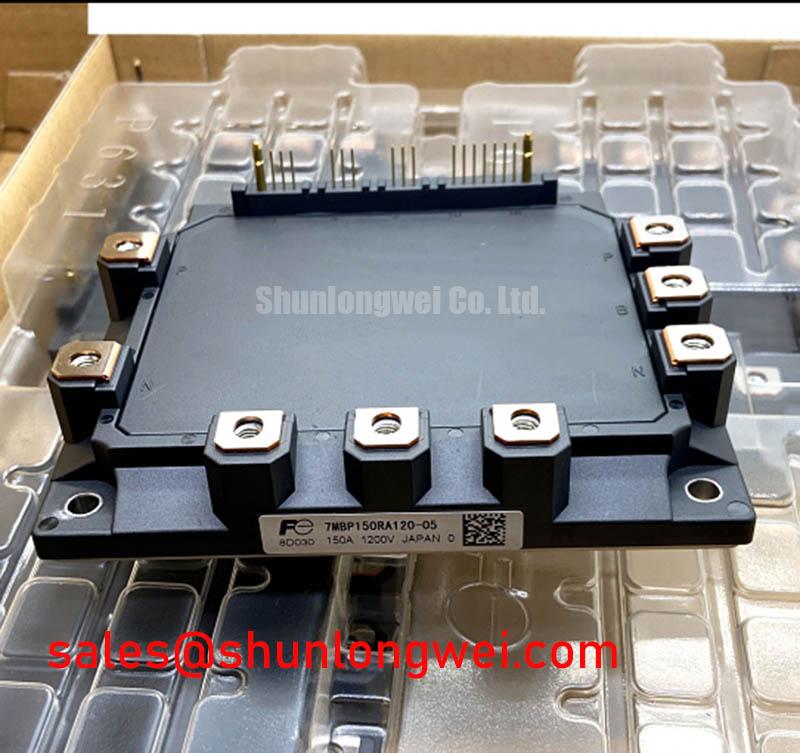

Technical Analysis of the 7-in-1 Integrated Design
The primary value of the 7MBP100RA120-05 lies in its high level of integration. By co-packaging the rectifier diodes for AC-to-DC conversion, the inverter IGBTs for DC-to-AC power delivery, and a brake chopper for managing regenerative energy, this module provides a near-complete power stage. This consolidation minimizes the length of high-current busbar connections between functional blocks, which is critical for reducing stray inductance. Lower parasitic inductance helps to suppress voltage overshoots during high-speed switching events, potentially reducing the need for extensive snubber circuits and improving overall system reliability.
Thermal Monitoring with the Integrated NTC Thermistor
Effective thermal management is fundamental to the reliability of any power system. The 7MBP100RA120-05 incorporates an NTC (Negative Temperature Coefficient) thermistor directly within the module’s structure. This provides a means for real-time temperature feedback that is closely coupled to the semiconductor junctions. Think of the integrated NTC as an internal medical thermometer for the module; it gives an immediate and accurate reading of its core operating condition. This allows the system controller to implement precise over-temperature protection, throttling back power or initiating a safe shutdown before the maximum junction temperature of 150°C is exceeded. This integration is more accurate and responsive than using an external sensor on the heatsink.

Optimized Application Scenarios
The characteristics of this module make it a strong candidate for several applications:
- Compact Variable Frequency Drives (VFDs): The 7-in-1 topology provides all necessary power stages, including regenerative braking control, making it ideal for small motor drives where space is a premium.
- General-Purpose Inverters: The module’s straightforward integration reduces assembly time and complexity for industrial inverter systems up to approximately 30-40 kW.
- Servo Drives: The compact footprint and integrated nature are well-suited for the high-density power requirements of industrial servo systems.
- Uninterruptible Power Supplies (UPS): The onboard converter and inverter sections serve as the core building blocks for the rectification and inversion stages in a double-conversion UPS.
This module is best matched for power conversion systems requiring a complete, reliable power stage with integrated thermal feedback in a small form factor.
Key Specifications of the 7MBP100RA120-05
| Absolute Maximum Ratings (Tc=25°C) | |
|---|---|
| Collector-Emitter Voltage (Vces) | 1200V |
| Gate-Emitter Voltage (Vges) | ±20V |
| Collector Current (Ic) – Inverter Part | 100A |
| Collector Power Dissipation (Pc) – 1 device | 480W |
| Operating Junction Temperature (Tj) | +150°C |
| Electrical Characteristics – Inverter Part (Tj=25°C) | |
| Collector-Emitter Saturation Voltage (Vce(sat)) (Ic=100A) | 2.8V (Max) |
| Forward Voltage Drop (Vf) (If=100A) | 2.6V (Max) |
| Thermal Characteristics | |
| Thermal Resistance (Rth(j-c)) – IGBT per device | 0.26 °C/W |
| Thermal Resistance (Rth(j-c)) – FWD per device | 0.43 °C/W |
| Mounting Torque (M5 screws) | 3.5 – 4.5 Nm |
Engineer’s FAQ
Q: What are the main advantages of using a 7-in-1 PIM like the 7MBP100RA120-05 in a motor drive?
A: The primary advantages are system simplification and size reduction. It integrates the input rectifier, output inverter, and brake chopper, reducing the need for multiple discrete modules. This minimizes assembly labor, saves PCB space, and can reduce parasitic inductance between power stages, leading to better electrical performance and reliability.
Q: What is the recommended mounting torque for this module?
A: According to the datasheet, the recommended mounting torque for the M5 terminal screws is 2.5 to 3.5 Nm, and for the M6 mounting screws, it is 3.5 to 4.5 Nm. Applying the correct torque is critical for ensuring low thermal resistance to the heatsink and preventing mechanical stress on the module.
Q: How should the integrated NTC thermistor be used for over-temperature protection?
A: The NTC thermistor provides a resistance value that changes predictably with temperature (R25 = 5 kΩ ± 3%). This thermistor should be connected to a monitoring circuit, typically using a voltage divider read by a microcontroller’s ADC. The system’s control logic can then translate this resistance value into a temperature and trigger alarms or shutdown procedures if it approaches the maximum junction temperature of 150°C.
Q: What is the maximum repetitive peak reverse voltage for the converter diodes?
A: The converter section’s diodes are rated for a repetitive peak reverse voltage (VRRM) of 1600V, as specified in the datasheet. This provides a substantial safety margin for operation on common industrial AC lines.
Enabling Compact and Reliable Power Conversion
The Fuji 7MBP100RA120-05 provides engineers with a highly integrated power conversion solution. Its 7-in-1 topology offers a direct path to reducing system size and complexity, while the built-in thermal sensor provides the necessary feedback for building a robust and reliable end product, such as a PIM-based motor drive.