SEMiX604GB12E4s Review: Reliability and Efficiency for High-Power Systems
SEMiX604GB12E4s: 1200V IGBT Module for High-Power Systems
Introduction and Core Highlights
The SEMIKRON SEMiX604GB12E4s is a high-power IGBT module that integrates robust electrical performance with a mechanically advanced, solder-free assembly process. It leverages SEMIKRON’s proven spring-contact technology for control signals, which eliminates a common failure point associated with traditional soldering. This design simplifies manufacturing and enhances long-term reliability under thermal and mechanical stress. Inside the SEMiX 4s housing, the module combines efficient 1200V Trench 4 IGBTs with soft-recovery CAL 4 freewheeling diodes. This pairing delivers a balanced performance profile, making it a strong candidate for demanding industrial applications requiring both efficiency and durability.
- Core Specifications: 1200V | 600A (Nominal) | VCE(sat) 2.2V (typ. at 150°C)
- Key Advantages: Solder-free spring contacts for enhanced reliability and simplified assembly; low conduction losses from Trench 4 IGBT technology.
For engineers designing high-power motor drives, the module’s positive VCE(sat) temperature coefficient is a key feature that simplifies the process of paralleling modules for higher current output.
Download Official Datasheet (PDF)

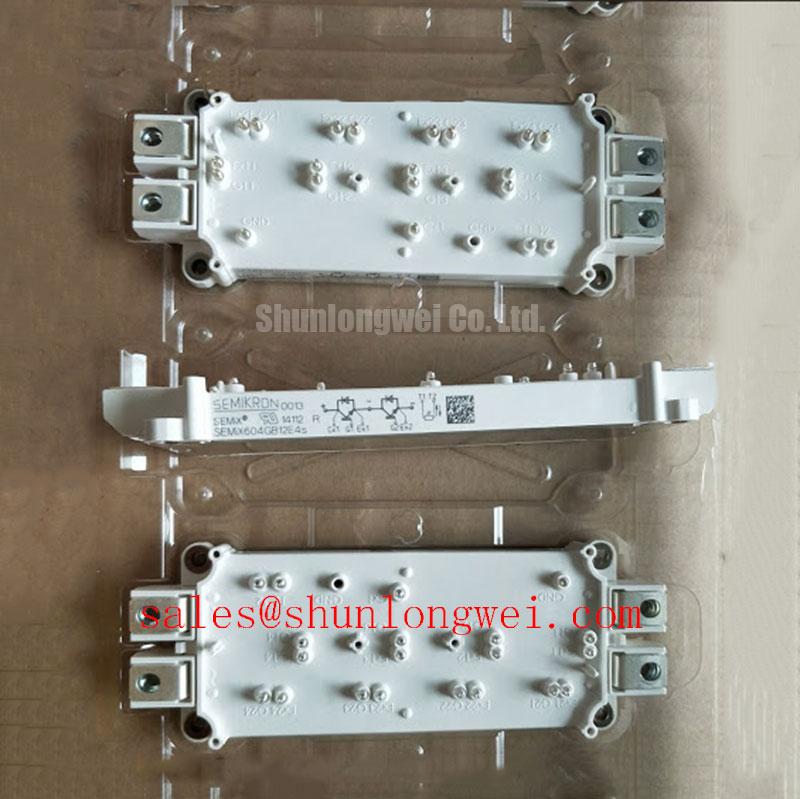
Technical Analysis: Trench 4 Silicon and Solder-Free Interface
The performance of the SEMiX604GB12E4s is defined by two core technologies: its silicon and its packaging. The module employs Trench 4 (T4) IGBTs, an established technology known for achieving a low collector-emitter saturation voltage (VCE(sat)). With a typical VCE(sat) of 2.2V at its nominal current and an operating temperature of 150°C, this module effectively minimizes conduction losses. These reduced losses translate directly to lower heat generation, which can allow for smaller heatsink designs and improved overall system efficiency. The integrated CAL 4 freewheeling diodes are engineered for soft recovery, a characteristic that reduces voltage overshoots and high-frequency emissions (EMI) during switching. This can simplify or even eliminate the need for external snubber circuits.
Mechanically, the standout feature is the use of press-fit spring contacts for the auxiliary connections. Unlike soldered joints, which can develop micro-cracks from repeated thermal expansion and contraction, these springs maintain a constant, gas-tight pressure on the PCB. This makes the connection highly resistant to vibration and thermal cycling fatigue, a critical advantage in applications like industrial motor drives. The module’s thermal resistance from junction to case (Rth(j-c)) is also a crucial parameter for thermal design. Thinking of it like a water pipe, a lower Rth(j-c) value means a wider pipe, allowing heat to escape from the silicon die more easily. This efficient heat transfer is essential for maintaining the junction temperature within its safe operating limit of 175°C.
Optimized Application Scenarios
The electrical and mechanical characteristics of the SEMiX604GB12E4S make it a well-suited component for the following applications:
- Industrial Motor Drives: The module’s high current capability and robust, vibration-resistant press-fit contacts are ideal for Variable Frequency Drives (VFDs) used in heavy industry, where mechanical stress and long service life are primary concerns.
- Uninterruptible Power Supplies (UPS): Its low VCE(sat) contributes to higher inverter efficiency, a key requirement for large-scale UPS systems where minimizing energy waste is critical for operational cost.
- Renewable Energy Inverters: Suitable for multi-megawatt wind and solar inverters, where the high 4000V isolation voltage and proven reliability are necessary for safe and continuous grid-tied operation.
- Welding Power Supplies: The module’s high short-circuit capability (10 µs) provides the durability needed to withstand the demanding, pulsed-power conditions found in advanced welding applications.
For high-power inverter systems demanding both high reliability and manufacturing efficiency, the SEMiX604GB12E4S is an excellent technical match.
Key Specifications of the SEMiX604GB12E4S
| SEMiX604GB12E4s Parameters | ||
|---|---|---|
| Absolute Maximum Ratings | ||
| Collector-Emitter Voltage (VCES) | 1200 V | |
| Nominal Collector Current (ICnom) | 600 A | |
| Short Circuit Withstand Time (tpsc) | 10 µs (Tj = 150 °C) | |
| Operating Junction Temperature (Tj) | -40 to +175 °C | |
| Electrical & Thermal Characteristics (Typical Values) | ||
| VCE(sat) at ICnom, Tj=150°C | 2.2 V | |
| Thermal Resistance, Junction-to-Case (Rth(j-c), per IGBT) | 0.049 K/W | |
| Isolation Voltage (Visol) | 4000 V (AC, 1 min) | |
| Module Case | SEMiX 4s | |
Engineer’s FAQ
- What is the primary advantage of the press-fit spring contacts compared to soldering?
- The press-fit design eliminates a thermal process (soldering), which removes the risk of solder-joint fatigue failure caused by repeated temperature cycles. It creates a highly reliable, vibration-resistant electrical connection that simplifies and speeds up the manufacturing assembly process.
- How does the VCE(sat) positive temperature coefficient affect paralleling?
- A positive temperature coefficient means that as an IGBT heats up, its on-state resistance increases slightly. When modules are paralleled, if one IGBT starts to carry more current and gets hotter, its resistance will rise, naturally diverting current to the other, cooler IGBTs. This creates a self-balancing effect that helps ensure even current sharing across all modules without complex external circuitry.
- What are the key considerations for the thermal design when using the SEMiX604GB12E4S?
- The primary goal is to keep the junction temperature (Tj) below its 175°C maximum. To do this, calculate the total power loss (conduction + switching losses) for your specific operating frequency and current. Use the module’s thermal resistance values (Rth(j-c) and Rth(c-s)) to select a heatsink that can dissipate this power while maintaining an acceptable case temperature. Ensure a flat mounting surface and the correct application of thermal interface material.
Enabling Robust and Efficient Power Conversion
The SEMiX604GB12E4S provides a forward-looking solution for high-power system design by addressing both electrical efficiency and mechanical resilience. Its integration of low-loss Trench 4 silicon with solder-free spring contact technology empowers engineers to build more reliable, easier-to-manufacture inverters and power supplies that are fit for the demands of modern industrial environments.