Fuji 2MBI300N-120 IGBT Module: A Technical Review for High-Power Applications
Fuji 2MBI300N-120 IGBT Module | 1200V 300A Half-Bridge
Introduction and Core Highlights
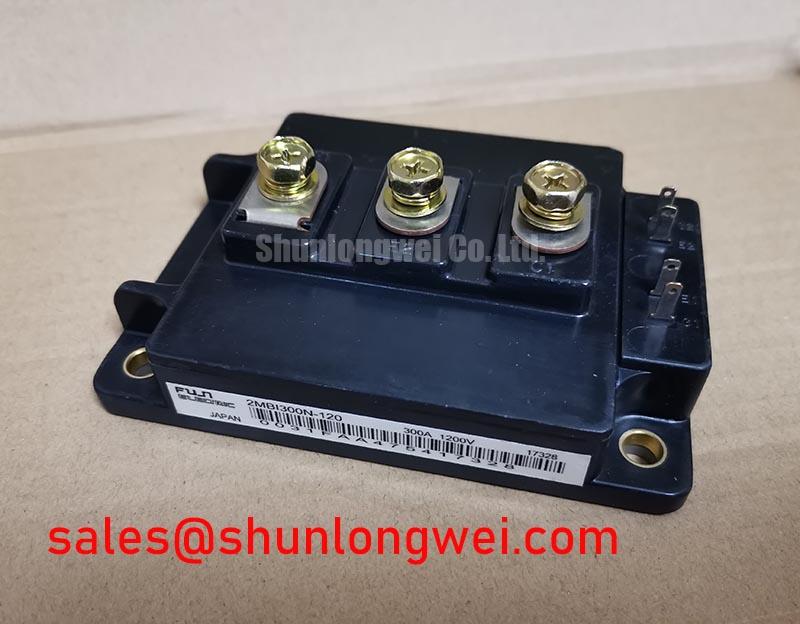
The Fuji Electric 2MBI300N-120 is an IGBT Module engineered for robust performance in high-power switching applications. This module’s key advantage lies in its use of Non-Punch-Through (NPT) IGBT technology, which ensures a square Reverse Bias Safe Operating Area (RBSOA) and excellent durability under demanding load conditions. Its architecture is particularly well-suited for systems requiring high reliability and straightforward parallel operation, facilitated by the chip’s inherent thermal characteristics.
- Core Specifications: 1200V | 300A | VCE(sat) 2.7V (Max)
- Key Advantages: High short-circuit ruggedness, simplified design for parallel configurations.
- Primary Applications: Ideal for industrial motor controls and high-capacity uninterruptible power supplies.
Download Official Datasheet (PDF)

Technical Analysis: Robustness and Design Simplicity
The engineering value of the 2MBI300N-120 is rooted in its NPT silicon design. This structure provides a wide Safe Operating Area (SOA) and a substantial short-circuit withstand time of 10 microseconds (µs). This level of ruggedness allows the module to survive critical fault conditions for a brief period, giving system protection circuits the necessary time to react and prevent catastrophic failure. This feature is a cornerstone of reliability in applications like high-frequency inverters and motor drives.
A significant characteristic for high-current system design is the positive temperature coefficient of the collector-emitter saturation voltage (VCE(sat)). Think of this as a self-regulating mechanism for current sharing. If one of several paralleled modules begins to carry more current and its temperature increases, its on-state voltage drop (VCE(sat)) also rises. This increased “resistance” naturally encourages current to redistribute to cooler, parallel devices. This inherent balancing simplifies the power stage design, mitigating the risk of thermal runaway that can occur with negative temperature coefficient devices.
Effective thermal management is dictated by the module’s thermal resistance. With a junction-to-case thermal resistance (Rth(j-c)) of 0.08°C/W for the IGBT, the module demonstrates efficient heat transfer from the silicon die to the baseplate. A lower thermal resistance is analogous to a wider pipe for heat flow; it allows thermal energy to escape more easily, enabling designers to maintain a lower operating junction temperature or utilize more compact cooling solutions for a given power dissipation.
Optimized Application Scenarios
- Variable Frequency Drives (VFDs): The module’s high current rating of 300A and its ability to withstand inductive load switching make it an excellent choice for controlling large AC motors.
- Uninterruptible Power Supplies (UPS): The 1200V breakdown voltage provides a safe operating margin for high DC bus voltages, while its proven reliability is critical for backup power systems.
- Welding Power Supplies: Welders demand components that can handle high-current pulses and tolerate frequent short-circuit events, aligning perfectly with the robust NPT structure of the 2MBI300N-120.
- AC and DC Servo Drives: Precision motion control systems benefit from the module’s fast and reliable switching characteristics, enabling accurate torque and speed regulation.
This module is an optimal fit for high-power industrial converters where operational robustness and reliable current sharing are primary design requirements.
Key Specification Parameters
| Absolute Maximum Ratings (Tc=25°C) | ||
|---|---|---|
| Collector-Emitter Voltage (VCES) | 1200 V | |
| Gate-Emitter Voltage (VGES) | ±20 V | |
| Continuous Collector Current (IC) | 300 A | |
| Max. Power Dissipation (PC) | 2100 W | |
| Electrical Characteristics (Tj=25°C unless otherwise noted) | ||
| Collector-Emitter Saturation Voltage (VCE(sat)) @ 300A, 15V | 2.7 V (Max, Tj=125°C) | |
| Gate-Emitter Threshold Voltage (VGE(th)) | 5.0 to 8.0 V | |
| Turn-on Time (ton) | 1.2 µs (Typ) | |
| Turn-off Time (toff) | 1.5 µs (Typ) | |
Engineer’s FAQ
- Does the 2MBI300N-120’s VCE(sat) characteristic support parallel operation?
- Yes. The datasheet graphs for the 2MBI300N-120 indicate a positive temperature coefficient for VCE(sat). This means as the IGBT’s temperature rises, its on-state voltage drop increases, which naturally helps balance current among multiple parallel-connected modules and prevents thermal runaway.
- What are the recommended mounting torque specifications?
- The datasheet specifies a mounting screw torque of 3.5 ± 0.5 N·m (for M6 screws). Adhering to this value is critical for ensuring low thermal resistance between the module’s baseplate and the heatsink. Improper torque can lead to insufficient cooling and potential device failure.
- What is the significance of the 10µs short-circuit withstand time?
- This rating signifies that the module can survive a direct short-circuit fault for up to 10 microseconds under specified conditions (Vcc=600V, Vge=15V, Tj=125°C). This provides a crucial safety margin, allowing the system’s gate drive protection circuitry to detect the fault and initiate a safe shutdown, thereby protecting the module from destruction.
- What is a typical gate drive voltage for this module?
- The datasheet specifies most characteristics using a gate-emitter voltage (VGE) of +15V for turn-on. For turn-off, using a negative voltage (e.g., -5V to -15V) is a common practice to provide a strong defense against noise-induced turn-on, especially in high dV/dt environments.
Enabling Reliable Power Conversion
For engineers tasked with creating high-power industrial systems, the Fuji 2MBI300N-120 offers a foundation of dependable performance. Its robust NPT IGBT architecture provides the thermal stability and fault tolerance necessary to construct durable and scalable motor drives, UPS systems, and welding power supplies that can operate consistently in challenging electrical environments.