Mitsubishi TM55DZ-H: A Technical Review for Robust AC Power Control
## Mitsubishi TM55DZ-H Thyristor Module | 800V 55A
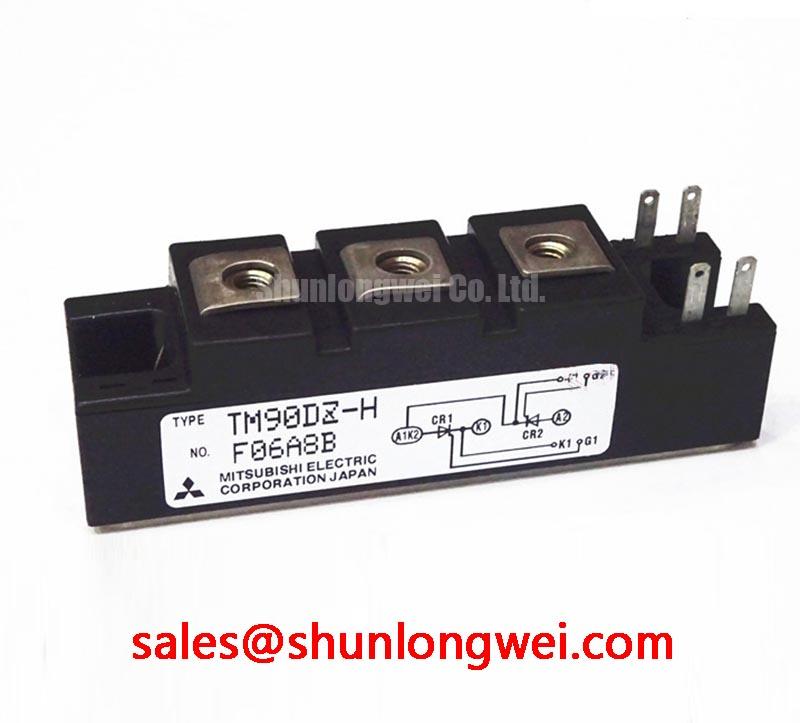
The Mitsubishi TM55DZ-H is a dual thyristor module providing robust and efficient AC power control through its integrated, electrically isolated package. It delivers reliable performance in demanding industrial applications by combining a high blocking voltage capability with a thermally efficient design, simplifying heatsink mounting procedures and enhancing overall system safety.
* **Core Specifications**: 800V VDRM/VRRM | 55A IT(AV) | 2500V VISO
* **Key Advantages**: Simplifies thermal management with an isolated base. Glass passivated junctions ensure long-term blocking stability.
* **Engineered for Control**: The dual thyristor configuration is structured for direct phase control in single-phase AC circuits, enabling precise power regulation.
Download the official TM55DZ-H Datasheet (PDF)


Technical Analysis for System Integration
The TM55DZ-H is engineered around two core principles: high electrical isolation and sustained reliability. The 2500V (RMS) isolation voltage is a critical feature, allowing the module to be mounted directly to a grounded heatsink without requiring additional insulating materials like mica pads or thermal grease with low dielectric strength. This simplifies the mechanical assembly, reduces component count, and ensures consistent thermal contact, which is vital for effective heat dissipation. The use of glass passivated thyristor junctions further enhances reliability by protecting the silicon from contaminants, ensuring stable blocking voltage characteristics throughout the operational life of the component.
Effective thermal management is directly addressed by the module’s specified thermal resistance. The junction-to-case thermal resistance (Rth(j-c)) is documented at a maximum of 0.5°C/W per arm. Think of thermal resistance as the width of a pipe for heat; a lower value signifies a wider pipe, allowing heat to flow more easily from the active thyristor junction to the module’s baseplate. This efficiency in heat transfer is fundamental to preventing the device from exceeding its maximum junction temperature of 125°C, thereby enabling the module to handle its rated 55A average current reliably under industrial load conditions. For further reading, consult our guide on mastering thermal design.
Optimized Application Scenarios
The characteristics of the TM55DZ-H make it a strong candidate for several AC power control applications:
- AC Motor Controllers: Its 55A average current rating is well-suited for soft-starters and speed controllers for single-phase AC motors, preventing high inrush currents.
- Industrial Heater and Furnace Control: The module’s ability to perform phase-angle switching allows for precise and continuous temperature regulation in electric heating systems.
- High-Power Light Dimmers: Ideal for controlling large-scale lighting systems in commercial or industrial settings where robust power handling is necessary.
- Static Switches: Can be used as a reliable solid-state switch for disconnecting or connecting AC loads with high durability compared to mechanical contactors.
This module is an optimal match for industrial AC power control systems requiring high electrical isolation and proven reliability for currents up to 55 amperes.
Key Specifications of the TM55DZ-H
| Parameter | Value | Conditions |
|---|---|---|
| Repetitive Peak Off-State/Reverse Voltage (VDRM, VRRM) | 800 V | Tj = 125°C |
| Average On-State Current (IT(AV)) | 55 A | Single-phase, half sine wave, 180° conduction |
| RMS On-State Current (IT(RMS)) | 86 A | – |
| Peak One-Cycle Surge Current (ITSM) | 1000 A | 60Hz, non-repetitive |
| Max On-State Voltage (VTM) | 1.6 V | ITM = 173A, Tj = 25°C |
| Isolation Voltage (VISO) | 2500 Vrms | Main terminals to base plate, AC 1 minute |
| Thermal Resistance (Rth(j-c)) | 0.5 °C/W | Junction to case, per arm |
| Mounting Torque | 2.5 – 3.5 N·m | M5 mounting screws |
Engineer’s FAQ for the TM55DZ-H
1. What is the recommended mounting torque for the TM55DZ-H?
The datasheet specifies a mounting torque of 2.5 to 3.5 N·m for the M5 mounting screws. Applying the correct torque is critical to ensure a low-resistance thermal path to the heatsink without inducing excessive mechanical stress on the module’s ceramic base, which could lead to fractures and thermal failure.
2. How does the isolated baseplate simplify thermal design?
The 2500V isolated baseplate eliminates the need for a separate, external insulator between the module and a grounded heatsink. This reduces assembly complexity and cost. It also creates a more direct and reliable thermal interface, improving heat transfer efficiency and long-term system reliability compared to designs requiring separate insulating layers.
3. Can the two thyristors in the TM55DZ-H be controlled independently?
Yes, the module contains two electrically separate thyristors (SCRs). Each has its own gate and cathode terminal, allowing them to be triggered independently. This configuration is ideal for creating a single-phase AC controller or two independent half-wave controllers within one compact package.
4. What does the glass passivation process contribute to this module?
Glass passivation is a manufacturing step where a layer of glass seals the high-voltage junctions of the thyristor die. This process protects the sensitive silicon from moisture and contaminants, which can cause voltage breakdown and leakage currents over time. It results in a highly stable device with consistent performance, especially in humid or polluted industrial environments.
Enabling Reliable Power Systems
The TM55DZ-H thyristor module offers a direct path to developing dependable AC power control circuits. Its foundation of high electrical isolation and efficient thermal characteristics allows engineers to construct compact, safe, and reliable systems for a range of industrial applications. This focus on integrated safety and performance simplifies the design process and contributes to long-term operational stability.