Fuji 2MBI200U4D-120 IGBT Module: Technical Analysis and Applications
Fuji 2MBI200U4D-120 IGBT Module | 1200V 200A
High-Efficiency 1200V Dual IGBT Module
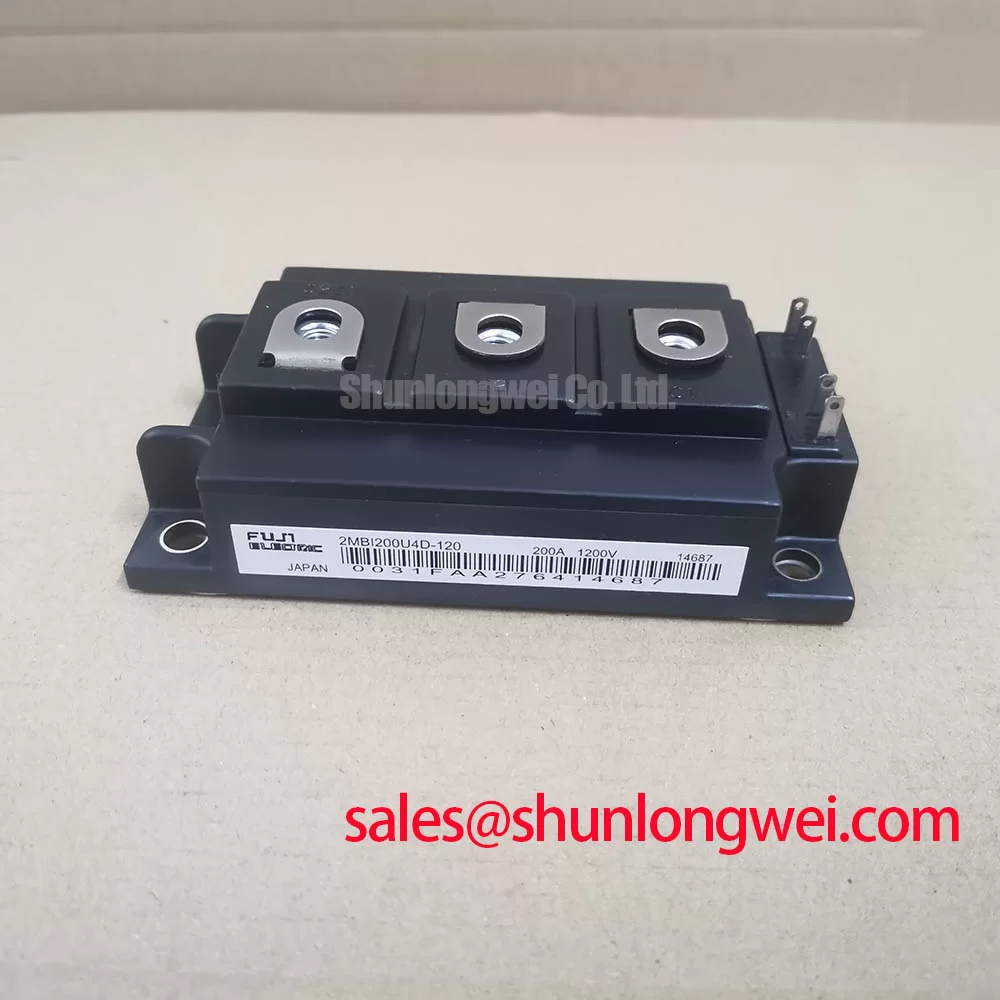
The Fuji Electric 2MBI200U4D-120 is a dual IGBT module from the U-series, delivering a robust solution for power conversion systems. It integrates NPT IGBT and FWD technology to achieve a favorable balance between conduction and switching losses. This design focus makes the module a strong candidate for systems where operational efficiency and thermal stability are primary engineering goals.
- Core Specifications: 1200V | 200A | VCE(sat) 2.2V (typ)
- Key Advantages: Low conduction loss, soft switching characteristics
- Application Focus: Well-suited for inverters and motor control systems
For detailed electrical and thermal characteristics, Download the Official 2MBI200U4D-120 Datasheet (PDF).


Technical Analysis for System Integration
The engineering value of the 2MBI200U4D-120 is centered on its electrical and thermal efficiency. The module specifies a typical collector-emitter saturation voltage (VCE(sat)) of 2.2V at its nominal current rating of 200A. This parameter is critical as it directly influences the conduction power loss during the on-state. A lower VCE(sat) translates to less heat generated, which simplifies thermal management and can lead to a smaller required heatsink, saving space and cost.
Effective heat dissipation is further supported by the module’s thermal resistance characteristics. The junction-to-case thermal resistance (Rth(j-c)) for the IGBT is documented at 0.12 K/W. Think of thermal resistance as the width of a pipe for heat; a lower value indicates a wider pipe, allowing heat to escape more easily from the semiconductor junction to the module’s baseplate. This efficient thermal path is essential for maintaining the junction temperature within safe operating limits, thereby enhancing long-term system reliability. For more on this, see our guide on mastering IGBT thermal design.
Optimized Application Scenarios
This module’s characteristics make it a versatile component for various high-power applications.
- Motor Drives: The 200A current rating and low VCE(sat) provide the necessary power handling and efficiency for industrial AC motor drives and servo systems.
- Uninterruptible Power Supplies (UPS): High reliability and efficient energy conversion are crucial in UPS systems. The robust thermal performance of the 2MBI200U4D-120 ensures stable operation during critical backup power situations.
- Welding Power Supplies: The module’s ability to handle high currents and its fast, soft-recovery freewheeling diode (FWD) are advantageous in the demanding, high-frequency switching environments of modern welding equipment.
- Solar Inverters: In grid-tied solar applications, maximizing energy conversion efficiency is paramount. This module helps minimize power losses during the DC-to-AC inversion process.
This module is an optimal match for systems requiring a balance of power density and high operational efficiency.
Key Specifications of the 2MBI200U4D-120
| Absolute Maximum Ratings | |
|---|---|
| Collector-Emitter Voltage (Vces) | 1200 V |
| Gate-Emitter Voltage (VGES) | ±20 V |
| Continuous Collector Current (Ic) @ Tc=80°C | 200 A |
| Pulsed Collector Current (Icp) @ 1ms | 400 A |
| Max Power Dissipation (Pc) | 1040 W |
| Operating Junction Temperature (Tj) | +150 °C |
| Electrical Characteristics | |
| Collector-Emitter Saturation Voltage (VCE(sat)) (Typ/Max) @ Ic=200A | 2.2 V / 2.7 V |
| Gate-Emitter Threshold Voltage (VGE(th)) | 5.0V to 7.0V |
| Forward Voltage (VF) of FWD (Typ/Max) @ IF=200A | 2.1 V / 2.6 V |
Engineer’s FAQ
1. How do the conduction losses of the 2MBI200U4D-120 affect overall system efficiency?
Conduction loss is a primary factor in IGBT efficiency, calculated as VCE(sat) multiplied by the collector current. With a typical VCE(sat) of 2.2V at 200A, the module demonstrates strong performance. Lowering this loss reduces waste heat, which improves the overall energy efficiency of the end application, such as a Variable Frequency Drive (VFD).
2. What are the recommended mounting torque specifications?
According to the datasheet, the recommended torque for the M6 mounting screws is between 3.0 and 4.0 N·m. For the main terminal screws (M6), the recommended torque is also 3.0 to 4.0 N·m. Applying the correct torque is critical to ensure good thermal contact and secure electrical connections without causing mechanical stress.
3. What is the significance of the “soft recovery” characteristic of the integrated FWD?
A soft-recovery freewheeling diode (FWD) exhibits a smoother, more gradual drop in reverse recovery current. This behavior significantly reduces voltage spikes and oscillations (ringing), which are major sources of EMI. This built-in feature can simplify the design of external snubber circuits and help the final system meet electromagnetic compatibility (EMC) standards.
4. Can this module be used in high-frequency applications?
While the 2MBI200U4D-120 is optimized for a balance between conduction and switching losses, its suitability for a specific “high-frequency” application depends on the exact frequency and operating conditions. The switching characteristics (Eon, Eoff, Erec) provided in the datasheet are essential for calculating switching losses, which increase with frequency. For very high-frequency designs, a different IGBT series may be more appropriate.
Enabling Reliable Power Conversion
The 2MBI200U4D-120 provides a well-documented and reliable foundation for power electronic systems. Its U-series technology delivers a balanced performance profile that addresses the core engineering challenges of minimizing power loss and managing heat. This allows designers to develop more efficient and dependable power conversion systems.