Fuji 2MBI200U4H-120-50 IGBT: A Technical Guide to High-Speed Power Conversion
Fuji 2MBI200U4H-120-50 IGBT Module | 1200V 200A
High-Speed Performance for Demanding Power Conversion
The Fuji Electric 2MBI200U4H-120-50 is a half-bridge IGBT module from the H-Series, engineered for high-frequency power systems that demand low switching losses and high reliability. By utilizing an advanced trench gate and field-stop structure, this module provides a finely tuned balance between conduction and switching performance, enabling increased operational efficiency and power density in demanding industrial applications.
- Core Specifications: 1200V | 200A | VCE(sat) (typ) 2.2V
- Key Advantages: Minimized switching losses for higher frequency operation, soft FWD recovery characteristics for reduced EMI.
This module’s design directly addresses the challenge of reducing heat dissipation in fast-switching circuits, allowing for more compact thermal management solutions. For a complete overview of its capabilities, you can access the official 2MBI200U4H-120-50 datasheet (PDF).
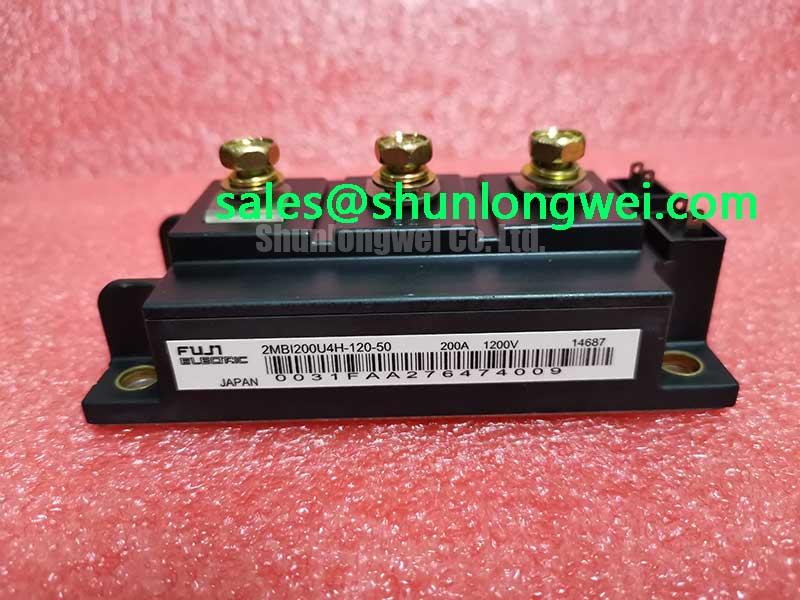

Technical Analysis for System Optimization
The engineering value of the 2MBI200U4H-120-50 is defined by its dynamic characteristics. The datasheet specifies typical turn-on (Eon) and turn-off (Eoff) energies of 15.0 mJ and 16.0 mJ respectively under 200A, 125°C conditions. These values are central to its high-speed designation, as lower switching energy directly translates to less power dissipated as heat during each cycle. This is particularly crucial in applications operating above 15 kHz, where switching losses often become the dominant source of thermal load.
Complementing its switching performance is the collector-emitter saturation voltage, VCE(sat), with a typical value of 2.2V at 200A and 125°C. You can think of VCE(sat) as the electrical “friction” the device presents when it’s fully on. A lower value signifies less friction, meaning reduced conduction losses and less heat generation. The module’s low thermal resistance from junction to case (Rth(j-c)) of 0.11 °C/W ensures that this generated heat can be efficiently transferred to a heatsink, maintaining a stable junction temperature. For more context on thermal design, see our guide on mastering IGBT thermal design.
Optimized Application Scenarios
- High-Frequency Welding Power Supplies: The module’s low switching losses and fast response are essential for creating stable, high-quality arcs and enabling more compact and lightweight welder designs.
- Uninterruptible Power Supplies (UPS): High efficiency is critical in UPS systems to maximize battery life. This module’s balanced loss profile reduces energy waste during both charging and discharging cycles.
- Solar Inverters: In solar applications, every fraction of a percent in efficiency matters. The fast switching of the 2MBI200U4H-120-50 helps to minimize losses during the DC-to-AC power conversion process, maximizing energy yield.
- High-Performance Motor Drives: For servo drives requiring rapid acceleration and deceleration, the module’s fast switching enables precise current control and superior dynamic response. Understanding the impact of parasitic inductance is key in these designs.
Its characteristics make this module a best-in-class fit for power converters where high switching frequency and efficiency are the primary design drivers.
Key Specifications of the 2MBI200U4H-120-50
| Absolute Maximum Ratings (Tc=25°C) | |
|---|---|
| Collector-Emitter Voltage (VCES) | 1200V |
| Continuous Collector Current (IC) @ Tc=80°C | 200A |
| Pulsed Collector Current (IC pulse) | 400A |
| Gate-Emitter Voltage (VGES) | ±20V |
| Collector Power Dissipation (Pc) | 1040W |
| Electrical & Thermal Characteristics (Tj=125°C unless noted) | |
| Collector-Emitter Saturation Voltage (VCE(sat)) @ 200A | 2.2V (typ.) |
| Gate-Emitter Threshold Voltage (VGE(th)) | 5.5V to 7.5V |
| Forward Voltage (VF) of FWD @ 200A | 2.1V (typ.) |
| Thermal Resistance, Junction-to-Case (Rth(j-c)), IGBT | 0.11 °C/W (max) |
| Short-Circuit Withstand Time (tsc) | ≥ 10µs |

Engineer’s FAQ
1. How do switching losses for the 2MBI200U4H-120-50 change with operating conditions?
Switching losses (Eon and Eoff) are primarily dependent on the collector current (Ic), DC bus voltage (Vcc), and gate resistor (Rg) value. The datasheet provides graphs showing these relationships. Increasing Rg will slow down switching and increase losses but can help manage EMI and voltage overshoots. Conversely, a smaller Rg reduces losses but may increase noise.
2. What are the recommended mounting torque specifications for this IGBT module?
To ensure optimal thermal contact and avoid mechanical stress, the datasheet specifies a mounting screw (M6) torque of 3.5 to 4.5 N·m. The electrical terminal screws (M6) should also be tightened to the same range, 3.5 to 4.5 N·m. Applying incorrect torque can lead to poor heat dissipation or damage to the module’s isolated baseplate.
3. What is the function of the integrated NTC thermistor?
The built-in NTC (Negative Temperature Coefficient) thermistor provides a means for real-time temperature monitoring of the module’s baseplate. A gate drive or control system can read its resistance to estimate the junction temperature, enabling over-temperature protection and enhancing overall system reliability. This is a crucial feature for implementing reliable thermal shutdown protocols.
4. Is this module suitable for paralleling to achieve higher current ratings?
Yes, but successful paralleling requires careful design. The datasheet specifies a tight distribution of VCE(sat) and VGE(th), which helps with current sharing. However, designers must ensure a symmetrical PCB layout to equalize stray inductances in the power paths and use separate gate resistors for each module to prevent oscillations. An unbalanced layout can lead to thermal runaway in one of the parallel modules.
Enabling Efficient Power System Design
The 2MBI200U4H-120-50 provides system designers with a robust, high-speed switching component. Its inherent low switching losses and controlled dynamic behavior empower the development of power conversion systems that are not only more efficient but also more compact. This focus on high-frequency performance makes it a strategic component for next-generation inverters and power supplies.