Fuji 2MBI200U4D-120-50 IGBT Module: A Technical Review for Power Conversion Systems
Fuji 2MBI200U4D-120-50 IGBT Module | 1200V 200A
Introduction and Core Highlights
The Fuji Electric 2MBI200U4D-120-50 is a 2-in-1 IGBT module engineered for high-performance power conversion systems. This module provides a robust solution centered on achieving low conduction losses and high-speed switching capabilities. By integrating Fuji Electric’s U-series technology, it offers a thermally efficient and reliable building block for demanding inverter and converter designs, enabling engineers to develop systems with greater power density. The design focuses on minimizing power dissipation, which is a critical factor in determining the required size of a heatsink for thermal management.
- Core Specifications: 1200V | 200A | VCE(sat) 2.2V (typ)
- Key Advantages: Low conduction and switching losses, integrated fast recovery diode (FWD).
- Primary Application Focus: High-power inverters and motor drives.
Download Official Datasheet (PDF)
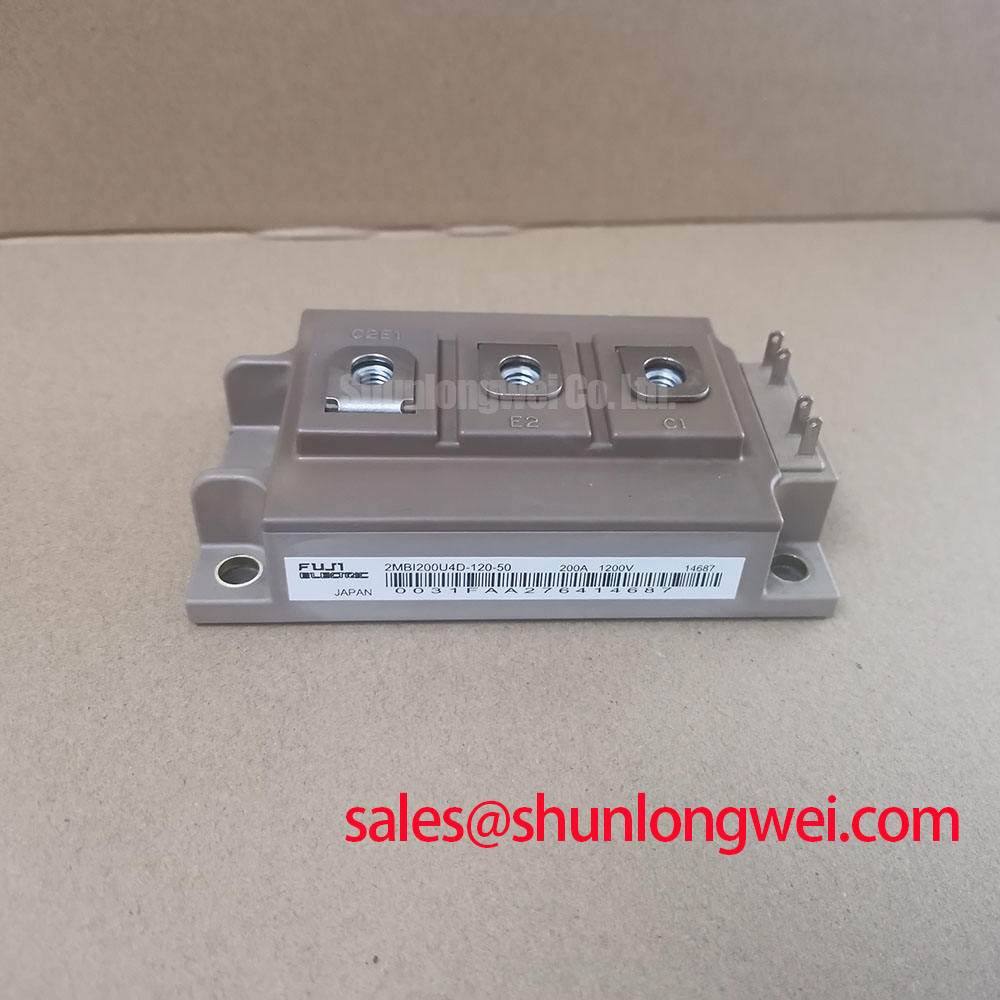

Technical Analysis: Efficiency and Thermal Performance
A defining characteristic of the 2MBI200U4D-120-50 module is its low collector-emitter saturation voltage (VCE(sat)), which is typically 2.2V at its nominal current rating and a junction temperature of 125°C. This parameter is crucial as it directly dictates the amount of power lost as heat when the IGBT is switched on. A lower VCE(sat) results in reduced conduction losses, a significant contributor to the total power loss in high-current applications. This efficiency allows for smaller heatsinks and can lead to a more compact overall system design.
The module’s thermal resistance from junction to case (Rth(j-c)) for the IGBT is specified at a maximum of 0.14 °C/W. Thermal resistance can be compared to the width of a pipe for heat; a lower value signifies a wider pipe, enabling heat to be extracted from the semiconductor die more effectively. This efficient heat transfer capability is critical for maintaining the junction temperature within safe operating limits, especially under heavy load conditions, which directly enhances the module’s long-term reliability and the system’s operational stability.
Optimized Application Scenarios
The technical specifications of the 2MBI200U4D-120-50 make it a strong candidate for several high-power applications:
- AC Motor Drives: Its 1200V breakdown voltage and 200A current rating provide ample headroom for three-phase industrial motor control. The low VCE(sat) improves drive efficiency.
- Uninterruptible Power Supplies (UPS): In high-power UPS systems, the module’s efficiency and fast switching reduce energy waste in the inverter stage, contributing to lower operational costs.
- Welding Machines: The module’s robust current handling and thermal performance are well-suited for the pulsed, high-current demands of modern welding power supplies.
- Solar Inverters: Its high voltage rating and efficiency are ideal for the DC-AC conversion stage in grid-tied solar power systems, maximizing energy harvest.
This module is best matched for applications requiring a balance between conduction efficiency, switching speed, and dependable thermal performance within a standard industrial package.
Key Specification Parameters
| Absolute Maximum Ratings (Tc=25°C) | ||
|---|---|---|
| Collector-Emitter Voltage (VCES) | 1200V | |
| Gate-Emitter Voltage (VGES) | ±20V | |
| Continuous Collector Current (IC) @ Tc=80°C | 200A | |
| Collector Power Dissipation (Pc) – 1 device | 1040W | |
| Operating Junction Temperature (Tj) | +150°C | |
| Electrical Characteristics (Tj=25°C) | ||
| Collector-Emitter Saturation Voltage (VCE(sat)) @ IC=200A, VGE=15V, Tj=125°C | 2.2V (typ), 2.7V (max) | |
| Gate-Emitter Threshold Voltage (VGE(th)) | 5.5V (min), 7.5V (max) | |
| FWD Forward Voltage (VF) @ IF=200A, VGE=0V, Tj=125°C | 2.0V (typ), 2.5V (max) | |
| Thermal and Mechanical Characteristics | ||
| Thermal Resistance, Junction to Case (Rth(j-c)) – IGBT | 0.14 °C/W (max) | |
| Thermal Resistance, Junction to Case (Rth(j-c)) – FWD | 0.23 °C/W (max) | |
| Mounting Screw Torque (M5) | 2.5 – 3.5 N·m | |
Engineer’s FAQ
- What are the recommended gate drive voltage settings for the 2MBI200U4D-120-50?
- The datasheet specifies electrical characteristics based on a gate-emitter voltage (VGE) of +15V for turn-on and -15V for turn-off. Operating within these recommended voltages ensures the device achieves its specified VCE(sat) and switching performance while preventing parasitic turn-on. For more information on this topic, refer to this guide on robust gate drive design.
- How should the module be mounted to a heatsink for effective cooling?
- For optimal thermal transfer, ensure the heatsink surface is flat and clean. Apply a thin, uniform layer of thermal compound (grease) before mounting. Tighten the M5 mounting screws evenly to the recommended torque of 2.5 to 3.5 N·m to avoid mechanical stress on the module’s baseplate. Uneven pressure or excessive torque can compromise thermal contact and long-term reliability.
- How does the VCE(sat) change with temperature?
- The VCE(sat) of this IGBT has a positive temperature coefficient. According to the datasheet, the typical VCE(sat) at 200A increases from 2.15V at Tj=25°C to 2.2V at Tj=125°C. This characteristic is beneficial when paralleling IGBT modules, as it helps promote current sharing between devices.
- Does this module include an NTC thermistor?
- Yes, the 2MBI200U4D-120-50 includes an integrated NTC thermistor for temperature monitoring. The resistance characteristics are provided in the official datasheet, allowing for implementation of over-temperature protection in the control system. The proper use of the integrated NTC is key to module safety.
Enabling Robust Power System Design
The 2MBI200U4D-120-50 provides a well-balanced set of electrical and thermal characteristics for engineers designing high-power systems. Its combination of low on-state voltage and effective heat dissipation allows for the creation of efficient, power-dense, and reliable inverters and motor drives. This component serves as a solid foundation for achieving demanding performance targets in industrial applications.