Fuji 6MBI450U-120-20: Technical Review of a 1200V, 450A 6-Pack IGBT Module
Fuji 6MBI450U-120-20: 1200V 450A 6-Pack IGBT Module
Introduction and Core Highlights
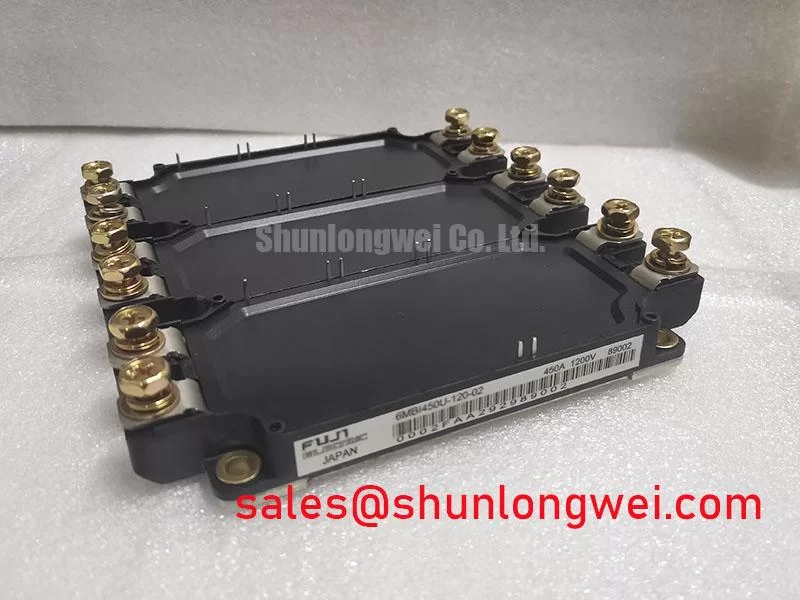
The Fuji Electric 6MBI450U-120-20 is a 6-in-1 IGBT module that integrates a complete three-phase inverter bridge into a single, compact package. This design approach streamlines the development of high-power motor drives and power converters by minimizing stray inductance and simplifying assembly. It offers a robust, balanced performance profile for demanding industrial applications, effectively managing the trade-off between conduction losses and switching speed. For engineers, this integration means a faster path from design to implementation and a more reliable power stage.
- Core Specifications: 1200V | 450A (at Tc=80°C) | VCE(sat) 2.7V max
- Key Advantages: Simplifies mechanical assembly and busbar design, includes an integrated NTC thermistor for real-time temperature feedback.
Download Official Datasheet (PDF)
Technical Analysis: Integration and Thermal Management
The primary engineering value of the 6MBI450U-120-20 lies in its 6-in-1 configuration. By housing all six IGBTs and their corresponding free-wheeling diodes (FWDs) in one module, designers can avoid the complexities of matching discrete components and creating symmetrical PCB layouts. This integration inherently reduces parasitic inductance in the power loop, a critical factor in minimizing voltage overshoot during high-speed switching events. The result is a cleaner switching waveform, reduced EMI, and potentially lower requirements for snubber circuits, contributing to a more efficient and compact overall system design.
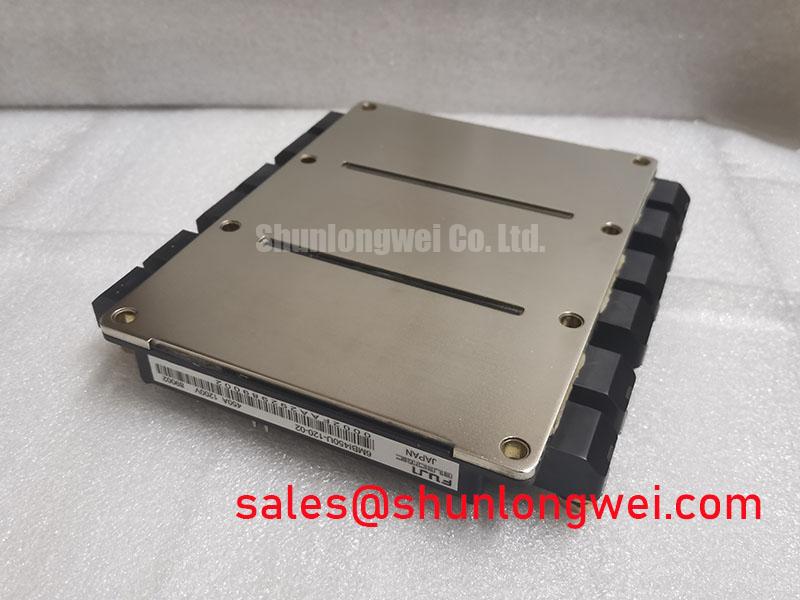
Effective thermal management is crucial for reliability in high-current applications. The module specifies a thermal resistance from junction to case (Rth(j-c)) of 0.06 °C/W for the IGBT and 0.10 °C/W for the FWD. Think of thermal resistance as the width of a pipe for heat; a lower value signifies a wider pipe, allowing heat to escape more easily from the semiconductor junction to the heatsink. This efficient heat transfer is vital for keeping the junction temperature (Tj) below its 150°C maximum rating and preventing premature failure. The inclusion of an NTC thermistor provides the necessary data for a control system to monitor temperature and initiate protective measures like power derating or shutdown.

Optimized Application Scenarios
The electrical and mechanical characteristics of this module are well-suited for the following applications:
- Inverters for Motor Drives: The three-phase bridge topology is the standard building block for AC motor inverters, making this module a direct fit. The 450A current rating supports high-horsepower motor control.
- Variable Frequency Drives (VFDs): Its robust thermal performance and integrated nature are ideal for VFDs, where reliability and compact size are key design drivers. For more on VFDs, see our guide on VFD efficiency.
- Uninterruptible Power Supplies (UPS): The high voltage (1200V) and current ratings enable the design of multi-kilowatt UPS systems, where the module can serve as the core of the inverter stage.
- Welding Machines: The module’s ability to handle high pulse currents (up to 900A at Tc=80°C) makes it a viable choice for power sources in industrial welding equipment.
This module is best matched for high-power inverter designs where simplified assembly, predictable performance, and integrated thermal monitoring are primary engineering requirements.
Key Specification Parameters
| Absolute Maximum Ratings | ||
|---|---|---|
| Collector-Emitter Voltage (VCES) | 1200 V | |
| Collector Current (IC) @ Tc=80°C | 450 A | |
| Collector Power Dissipation (PC) per device | 2080 W | |
| Junction Temperature (Tj) | +150 °C | |
| Electrical Characteristics | ||
| Collector-Emitter Saturation Voltage (VCE(sat)) @ IC=450A, VGE=15V | 2.2 V (Typ) / 2.7 V (Max) | |
| FWD Forward Voltage (VF) @ IF=450A | 2.0 V (Typ) / 2.5 V (Max) | |
| Turn-on Time (ton) @ IC=450A | 0.70 µs (Typ) | |
| Turn-off Time (toff) @ IC=450A | 0.37 µs (Typ) | |

Engineer’s FAQ
1. What is the main advantage of using a 6-pack module like the 6MBI450U-120-20 over six discrete IGBTs?
The primary advantage is system integration. A 6-pack module dramatically simplifies the mechanical layout, reduces assembly time, and ensures symmetrical, low-inductance connections between devices. This leads to more reliable and predictable electrical performance compared to a discrete solution. For further reading, explore the trade-offs in our analysis of PIM vs. discrete IGBTs.
2. How should I use the integrated NTC thermistor for protection?
The NTC thermistor allows for direct monitoring of the module’s internal temperature. It should be connected to your control system’s analog input. The datasheet specifies its resistance as 5 kΩ at 25°C with a B-constant of 3375 K. Your controller can use these values to calculate the real-time temperature and trigger alarms or derating protocols if it approaches the maximum junction temperature of 150°C. Learn more about the role of the NTC in our article on IGBT module safety.
3. What are the recommended mounting torque values?
Proper mounting is essential for good thermal contact. The datasheet specifies a mounting screw torque of 2.5 to 3.5 N·m for the M5 mounting holes and 3.5 to 4.5 N·m for the M6 main terminals. Using a calibrated torque wrench and applying an appropriate thermal compound is critical for achieving the specified thermal resistance.
4. Is the 6MBI450U-120-20 suitable for high-frequency applications above 20 kHz?
This module is specified for “high-speed switching.” The turn-on (0.70 µs) and turn-off (0.37 µs) times are indicative of its capabilities. However, total switching losses (Eon, Eoff, Err) increase with frequency. While it can operate at higher frequencies, designers must perform careful thermal analysis to ensure the junction temperature remains within safe limits, as higher frequencies will generate more heat.
Enabling Robust Power System Design
The 6MBI450U-120-20 IGBT module provides a solid engineering foundation for high-power three-phase inverters. Its integrated design abstracts away the complexity of managing multiple discrete components, allowing design teams to focus on system-level performance. By delivering a well-defined package with predictable electrical and thermal characteristics, this module enables the development of reliable and efficient industrial power conversion systems.