FF800R12KE7: A Technical Analysis of a High-Power IGBT Module
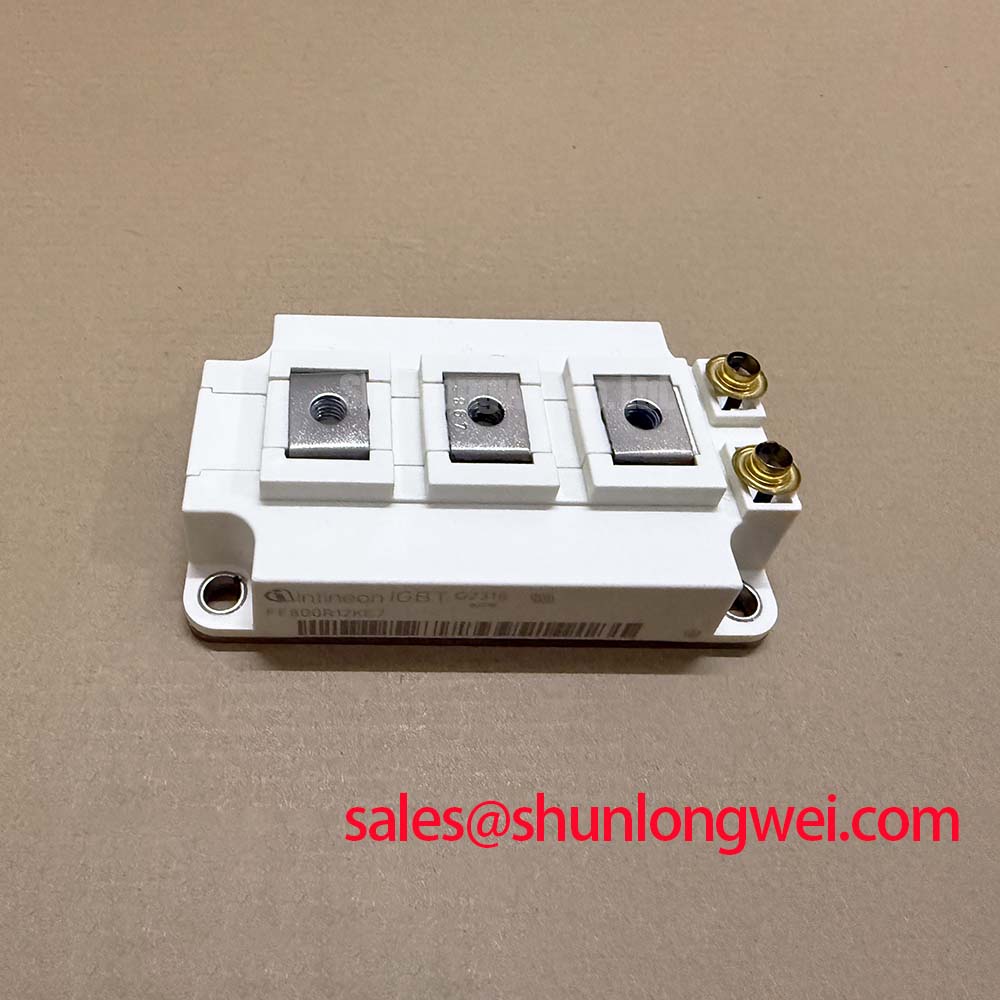
FF800R12KE7 1200V 800A EconoDUAL™ 3 IGBT Module
Technical Analysis of the FF800R12KE7 IGBT Module
The Infineon FF800R12KE7 is a high-power EconoDUAL™ 3 half-bridge module engineered for demanding inverter applications. Its performance centers on a combination of high current capacity and superior thermal efficiency, derived from its TrenchSTOP™ IGBT3 technology and established package design. This module provides a robust foundation for building high-power density converters where reliability and efficiency are primary objectives.
- Core Specifications: 1200V | 800A | VCE(sat) 1.70V (typ. at Tvj=150°C)
- Key Advantages: Low conduction losses for enhanced system efficiency and excellent thermal performance for improved reliability.
For systems such as high-power motor drives, this module’s electrical and thermal characteristics allow for reduced cooling requirements and more compact mechanical designs. You can download the official datasheet (PDF) for complete specifications.


Efficiency and Thermal Management by Design
A defining characteristic of the FF800R12KE7 is its low collector-emitter saturation voltage (VCE(sat)). At the nominal current of 800A and an operating junction temperature of 150°C, the typical VCE(sat) is just 1.70V. This low on-state voltage is a direct result of the TrenchSTOP™ IGBT3 technology, minimizing conduction losses. For system designers, this translates directly into less waste heat and higher overall converter efficiency, a crucial factor in energy-intensive applications.
Effective heat dissipation is fundamental to the reliability of any power module. The FF800R12KE7 features a very low thermal resistance from junction to case (RthJC) of 0.052 K/W for the IGBT. Think of thermal resistance as the narrowness of a pipe; a lower value indicates a wider pipe that allows heat to flow away from the silicon die more easily. This efficient heat transfer prevents the junction temperature from exceeding its maximum limit of 175°C under operating conditions, contributing to a longer service life. A robust thermal management strategy is essential for leveraging this capability.
Optimized Application Scenarios
The technical specifications of the FF800R12KE7 make it a strong candidate for several high-power applications:
- High-Power Motor Drives: The 800A current rating and low VCE(sat) enable efficient control of large industrial motors, reducing operational energy costs.
- Solar and Wind Inverters: High efficiency is critical for maximizing energy generation. This module’s low overall losses help improve the energy yield of renewable systems.
- Uninterruptible Power Supplies (UPS): The module’s high current handling capability and robust thermal design ensure reliable performance during critical backup operations.
- Commercial and Agricultural Vehicles (CAV): The module provides the necessary power handling and reliability for electric powertrain inverters in demanding environments.
This module is an optimal match for applications requiring high efficiency and reliability in the power range of 250 kW to over 500 kW.
Key Specifications of the FF800R12KE7
| Absolute Maximum Ratings | |
|---|---|
| Collector-Emitter Voltage (VCES) | 1200 V |
| Continuous DC Collector Current (IC nom) | 800 A (TC=90°C) |
| Repetitive Peak Collector Current (ICRM) | 1600 A |
| Gate-Emitter Peak Voltage (VGES) | ±20 V |
| Electrical & Thermal Characteristics (Tvj = 150°C unless otherwise specified) | |
| Collector-Emitter Saturation Voltage (VCE(sat)) at IC=800A, VGE=15V | 1.70 V (typ.) |
| Gate Threshold Voltage (VGE(th)) | 5.15 V to 6.45 V |
| Thermal Resistance, Junction-to-Case (RthJC), IGBT | 0.052 K/W |
| Short Circuit Withstand Time (tpsc) at VGE ≤ 15V, VCC ≤ 800V | 10 µs |
| Operating Junction Temperature (Tvj op) | -40 to +175 °C |
Engineer’s FAQ
What are the key considerations for the thermal design when using the FF800R12KE7?
A proper thermal design is critical. The module’s low RthJC of 0.052 K/W provides an excellent starting point. However, the overall performance depends on the thermal resistance from case-to-heatsink (RthCH) and the heatsink’s ability to dissipate heat. Ensure a flat mounting surface, correct application of thermal interface material, and adequate heatsink performance to keep the junction temperature below the 175°C maximum operating limit.
What is the recommended gate driver voltage for this module?
The datasheet specifies an absolute maximum gate-emitter voltage (VGES) of ±20V. For driving the IGBT, a positive voltage of +15V is typically used for turn-on, and a negative voltage between -8V and -15V is recommended for turn-off to ensure immunity against parasitic turn-on events. For further information, explore resources on robust gate drive design.
Does the FF800R12KE7 include a freewheeling diode?
Yes, the module is configured as a half-bridge and includes an integrated, high-efficiency emitter-controlled diode antiparallel to each IGBT. This diode is optimized for soft switching behavior and low forward voltage drop to handle freewheeling currents in inverter applications.
What is the purpose of the integrated NTC thermistor?
The built-in NTC (Negative Temperature Coefficient) thermistor allows for real-time monitoring of the module’s baseplate temperature. This data is essential for the system’s control and protection logic, enabling functions like over-temperature warnings or shutdowns to prevent thermal runaway and enhance the long-term reliability of the IGBT.
The FF800R12KE7 EconoDUAL™ 3 module offers a well-balanced set of features for high-power conversion. Its low on-state voltage and effective thermal characteristics empower engineers to develop systems that are not only powerful but also highly efficient and reliable over their operational lifespan.