Infineon FF600R12ME4_B72 IGBT Module: A Comprehensive Technical Review
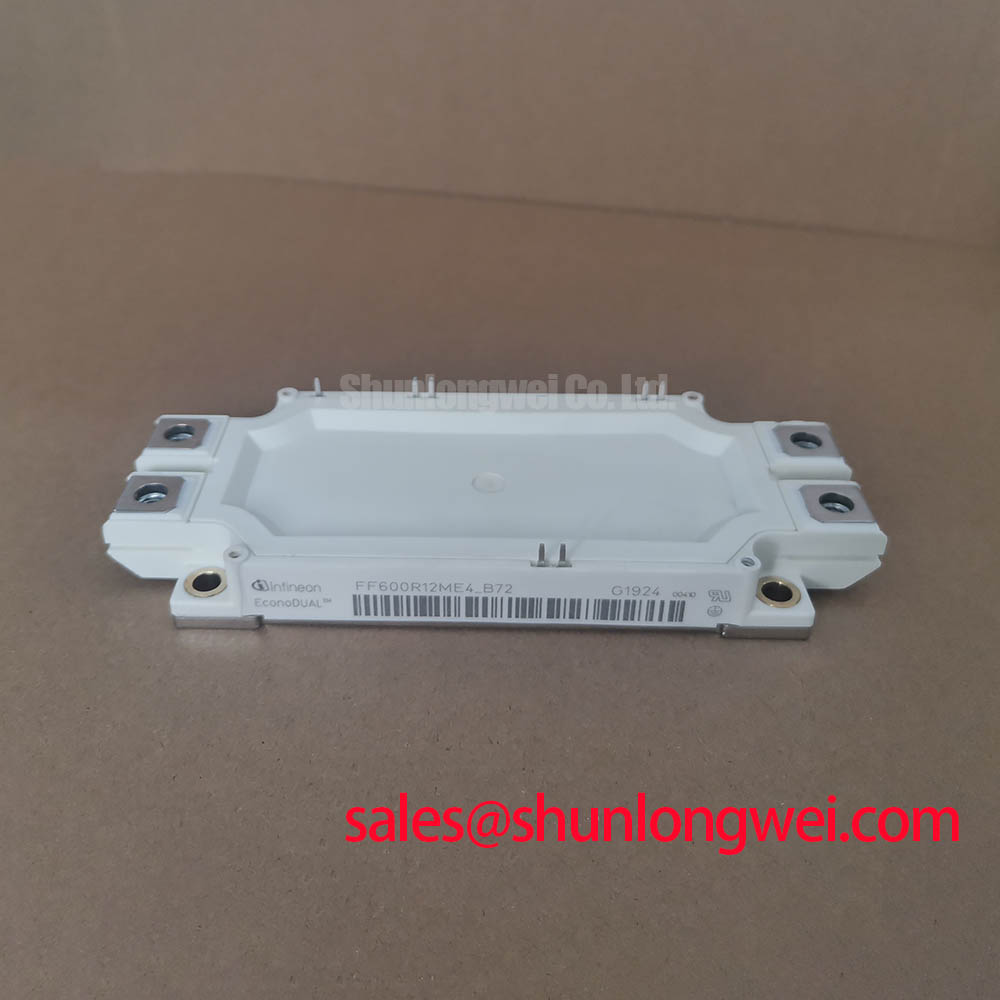
Infineon FF600R12ME4_B72 1200V 600A IGBT Module
Introduction and Core Highlights
The Infineon FF600R12ME4_B72 is a high-power IGBT module that integrates proven TRENCHSTOP™ IGBT4 technology into the industry-standard EconoDUAL™ 3 package. This combination provides a robust and efficient solution for high-power conversion systems. It is engineered to balance low conduction and switching losses with high reliability, offering a dependable foundation for demanding industrial applications. The module’s thermal characteristics are well-defined, which simplifies the process of selecting an appropriate heatsink to maintain optimal operating temperatures.
- Core Specifications: 1200 V | 600 A | VCE(sat) 1.75 V (typ. @25°C)
- Key Advantages: Minimizes conduction losses for greater efficiency, offers robust short-circuit protection for system reliability.
Download the Official Datasheet (PDF)

Technical Analysis: Efficiency and Reliability
The core of the FF600R12ME4_B72 is Infineon’s TRENCHSTOP™ IGBT4 technology. This design provides a low collector-emitter saturation voltage (VCE(sat)), specified with a typical value of 1.75 V at a nominal current of 600 A and 25°C junction temperature. A low VCE(sat) is critical for system efficiency. Think of it like mechanical friction; a lower value means less energy is converted into waste heat during operation. This reduction in conduction losses directly translates to lower cooling requirements and higher overall inverter efficiency, a crucial factor in energy-conscious designs.
System reliability is further enhanced by the module’s robust construction and protective features. It is specified with a short-circuit withstand time of 10 µs, providing a sufficient window for protection circuits to react and prevent catastrophic failure. Coupled with a maximum operating junction temperature of 150°C, the module is built to endure the thermal stresses found in heavy industrial environments. The EconoDUAL™ 3 package, an industry benchmark, features an isolated copper baseplate and a low-inductance layout that aids in achieving clean switching performance and simplifies thermal management. For further reading on thermal design, see this guide on mastering the Zth curve.


Optimized Application Scenarios
The performance characteristics of the FF600R12ME4_B72 make it a strong candidate for several high-power applications:
- Motor Drives: The high current capability and low conduction losses are ideal for AC motor drives, where efficiency under varying load conditions is paramount.
- Solar Inverters: Its 1200V blocking voltage and efficient operation are well-suited for large-scale solar inverters, maximizing energy conversion from photovoltaic arrays.
- Uninterruptible Power Supplies (UPS): The module’s proven reliability and short-circuit ruggedness are essential for critical backup power systems.
- Welding Power Supplies: Capable of handling high current pulses and dissipating thermal loads effectively, this module meets the demands of modern welding equipment.
This module is an optimal match for high-power converters requiring a balance of efficiency, thermal stability, and proven industrial-grade reliability.
Key Specification Parameters
| Absolute Maximum Ratings (Tvj = 25°C unless otherwise specified) | ||
|---|---|---|
| Collector-Emitter Voltage (VCES) | 1200 V | |
| Continuous DC Collector Current (IC,nom) | 600 A (TC = 100°C) | |
| Repetitive Peak Collector Current (ICRM) | 1200 A | |
| Gate-Emitter Peak Voltage (VGES) | ±20 V | |
| Electrical & Thermal Characteristics | ||
| Collector-Emitter Saturation Voltage (VCE(sat)) (IC = 600A, VGE = 15V, Tvj = 25°C) | 1.75 V (Typ.) | |
| Gate Threshold Voltage (VGE(th)) | 5.2V (Min) to 6.4V (Max) | |
| Short Circuit Withstand Time (tsc) | 10 µs (VGE ≤ 15V, VCC ≤ 800V, Tvj ≤ 150°C) | |
| Thermal Resistance, Junction-to-Case (RthJC) per IGBT | 0.057 K/W | |
| Operating Junction Temperature (Tvj op) | -40 to +150°C | |
Engineer’s FAQ
- What are the key considerations for the thermal design when using the FF600R12ME4_B72?
- Effective thermal management is crucial. The datasheet specifies a thermal resistance from junction to case (RthJC) of 0.057 K/W per IGBT. The total thermal resistance, including the thermal interface material (TIM) and the heatsink, must be low enough to keep the junction temperature below the 150°C maximum operating limit under worst-case load conditions. Careful selection of the heatsink and proper application of TIM are essential. For further insights, explore topics on IGBT failure analysis.
- Is it possible to operate these modules in parallel?
- Yes, paralleling is possible but requires careful design. The positive temperature coefficient of VCE(sat) helps to ensure thermal stability and balanced current sharing between modules. However, a symmetrical busbar layout is critical to minimize stray inductance imbalances. Additionally, individual gate drivers for each module are recommended to prevent oscillations and ensure controlled switching. Explore our resources on robust gate drive design for more information.
- What is the purpose of the integrated NTC thermistor?
- The integrated NTC (Negative Temperature Coefficient) thermistor provides a means for real-time temperature monitoring of the module’s baseplate. This feedback is vital for the system’s control and protection logic. It can be used to trigger thermal warnings, de-rate the output power gracefully, or initiate a shutdown if the temperature exceeds safe limits, thereby protecting the power semiconductors.
Concluding Statement
The Infineon FF600R12ME4_B72 provides a well-documented and highly reliable component for power system engineers. Its foundation in TRENCHSTOP™ IGBT4 technology delivers a valuable combination of low power loss and operational toughness. Housed in the versatile EconoDUAL™ 3 package, this module enables the development of efficient, power-dense, and dependable inverters for a wide range of industrial systems.