SK30GD128 Technical Analysis: Balancing Efficiency and Reliability with Trench Gate and CAL Diode Technology
SK30GD128 SEMIKRON IGBT Module | 1200V 30A Chopper
Technical Analysis of the SK30GD128 IGBT Module
The SEMIKRON SK30GD128 is a 1200V single-switch (chopper) IGBT module engineered for reliability in demanding industrial power conversion systems. Its unique value proposition lies in the integration of efficient Trench Gate IGBT technology with a soft-recovery CAL (Controlled Axial Lifetime) freewheeling diode. This combination provides a balanced performance profile, optimizing both conduction losses and switching behavior to enhance overall system efficiency and robustness.
- Core Specifications: 1200V | 52A (IC, Tc=25°C) | 2.15V VCE(sat) (typ)
- Key Advantages: Minimized EMI due to soft diode recovery, enhanced reliability from the industrially proven SEMITRANS package with an isolated baseplate.
- System Benefit: The well-behaved switching characteristics of the integrated CAL diode reduce voltage overshoots, often simplifying or eliminating the need for external snubber circuits.
Download the Official SK30GD128 Datasheet (PDF)
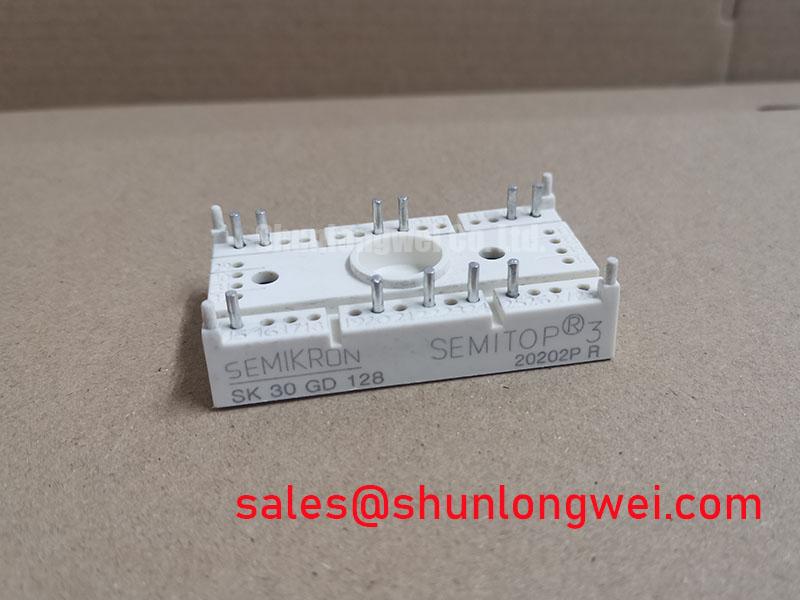
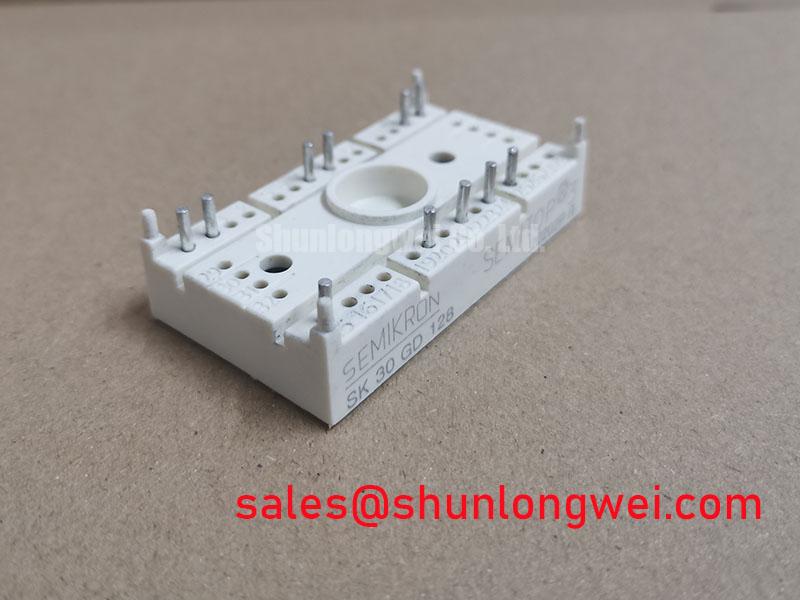
Engineered for Balanced Performance
The core of the SK30GD128 module is its Trench Gate IGBT. This structure provides a lower on-state voltage drop, or VCE(sat), compared to older planar technologies. Think of VCE(sat) as a toll on an electrical highway; a lower toll means less energy is wasted just to let the current pass. With a typical VCE(sat) of 2.15V at its nominal current, this module directly reduces conduction losses, which translates into less heat generation and improved energy efficiency for the end application. This characteristic is fundamental to achieving higher power density and can reduce the requirements for extensive thermal management systems.
Complementing the IGBT is an integrated CAL freewheeling diode. In hard-switching topologies, the diode’s recovery behavior is critical. A fast, abrupt recovery can induce significant voltage spikes and electromagnetic interference (EMI). The CAL diode is specifically engineered for “soft” recovery, meaning it transitions smoothly from a conducting to a blocking state. This controlled behavior is crucial for mitigating EMI, reducing voltage stress on the IGBT, and improving the overall reliability and stability of the power stage.
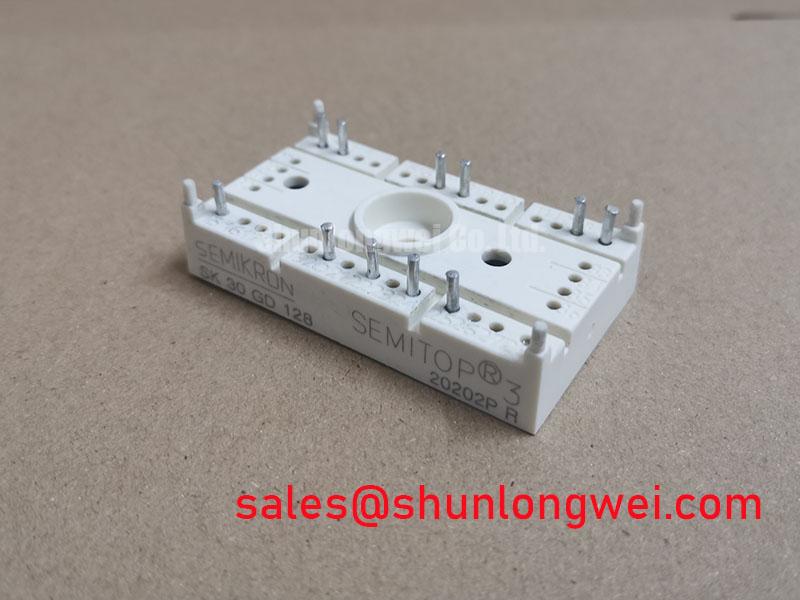
Optimized Application Scenarios
The technical attributes of the SK30GD128 make it well-suited for a range of industrial applications where efficiency and reliability are paramount.
- AC Motor Drives: The soft-recovery CAL diode helps to minimize system EMI, making it ideal for Variable Frequency Drives (VFDs) that must operate reliably in electromagnetically sensitive industrial environments.
- Uninterruptible Power Supplies (UPS): A low VCE(sat) contributes directly to higher conversion efficiency, a critical performance metric for UPS systems where minimizing energy waste is essential.
- Welding Power Supplies: The module’s robust SEMITRANS package and specified thermal characteristics provide the durability needed to withstand the demanding, high-current pulse loads found in welding applications.
- Switched Mode Power Supplies (SMPS): The balance of switching and conduction losses allows for effective performance in high-power DC-DC converters and other SMPS topologies.
This module is an optimal match for industrial applications requiring a balance between conduction efficiency and switching ruggedness at currents up to 50A.
Key Specifications of the SK30GD128
| Electrical & Thermal Characteristics (Tc = 25°C unless otherwise noted) | ||
|---|---|---|
| Parameter | Symbol | Value |
| Max Collector-Emitter Voltage | VCES | 1200 V |
| DC Collector Current (Tc = 25°C) | IC | 52 A |
| DC Collector Current (Tc = 80°C) | IC | 38 A |
| Collector-Emitter Saturation Voltage (IC=30A, Tj=25°C, typ.) | VCE(sat) | 2.15 V |
| Gate-Emitter Threshold Voltage (IC=1.2mA, Tj=25°C) | VGE(th) | 5…6.5 V |
| Diode Forward Voltage (IF=30A, Tj=25°C, typ.) | VF | 1.95 V |
| Thermal Resistance, Junction to Case (IGBT) | Rth(j-c) | ≤ 1.3 K/W |
| Isolation Voltage (AC, 50Hz, 1 min) | Visol | 2500 V |
Engineer’s FAQ for the SK30GD128
1. What is the primary engineering benefit of the CAL freewheeling diode in the SK30GD128?
The CAL diode’s main benefit is its soft recovery characteristic. This reduces voltage overshoots and high-frequency ringing during IGBT turn-off. For the engineer, this translates to lower EMI, reduced stress on the device, and potentially simpler and less costly snubber circuit designs, leading to a more reliable system.
2. How does the VCE(sat) of the SK30GD128 change with increasing temperature?
According to the datasheet graphs, the SK30GD128 exhibits a positive temperature coefficient for VCE(sat) at its nominal operating currents. This means that as the junction temperature (Tj) increases from 25°C to 125°C, the on-state voltage drop will also increase. This characteristic is beneficial for paralleling modules, as it helps promote natural current sharing.
3. What is the recommended mounting torque for this module?
The datasheet specifies a mounting torque for the case to the heatsink of 3 Nm (Newton-meters) and a torque of 2.5 Nm for the electrical terminals, using M5 screws. Adhering to these values is critical to ensure proper thermal contact and reliable electrical connections without causing mechanical stress to the module.
4. Is the module’s baseplate electrically isolated?
Yes, the SK30GD128 features an Al2O3 (Aluminium Oxide) substrate that provides electrical isolation between the semiconductor chips and the metal baseplate. The datasheet specifies an isolation test voltage (Visol) of 2500V, making it suitable for applications requiring high electrical isolation from the heatsink.
Design & Integration
The SK30GD128 provides a dependable foundation for medium-power conversion systems. Its design focuses on balancing low conduction losses with controlled switching behavior. This allows engineers to develop power electronics that achieve both high operational efficiency and robust, long-term reliability in industrial environments. For further insights into IGBT technology, consider exploring topics on the evolution of Trench Gate structures and the critical role of the free-wheeling diode.