SKM40GD123D Technical Analysis: Optimizing Power Conversion with Trench Gate and CAL Diode Technology
SKM40GD123D SEMITRANS 2 Dual IGBT Module Technical Analysis
Efficient Power Conversion with Trench Gate and CAL Diode Technology
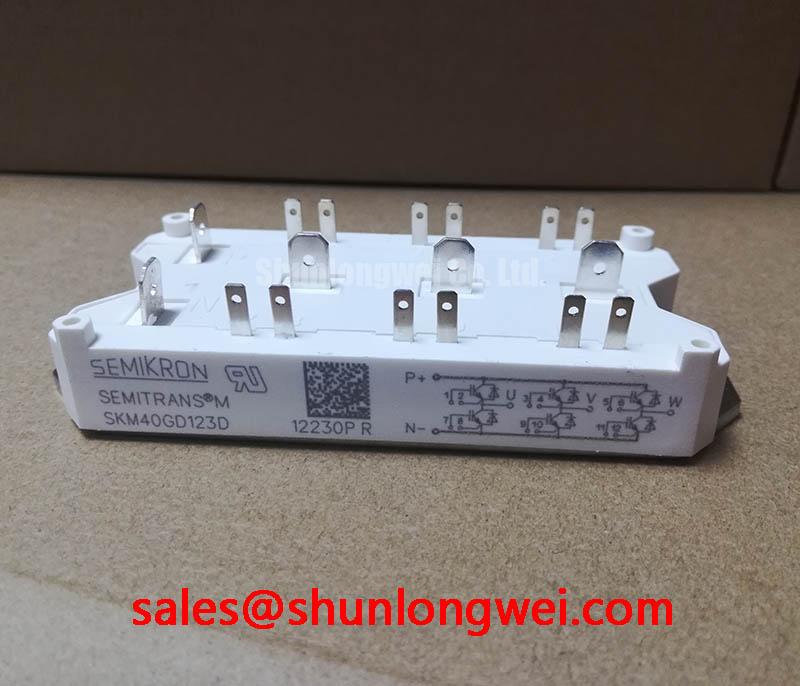
The SKM40GD123D is a SEMITRANS 2 dual IGBT module from Semikron that integrates Trench Gate IGBTs with fast and soft inverse Controlled Axial Lifetime (CAL) freewheeling diodes. This combination provides a robust and efficient solution for power conversion systems. Its architecture is engineered to balance low on-state voltage with controlled switching characteristics, addressing the demands of modern high-frequency applications such as variable frequency drives.
- Core Specifications: 1200V | 40A (@ 25°C) | VCE(sat) 2.5V (typ)
- Key Engineering Advantages: Low conduction losses from Trench Gate technology and reduced EMI due to soft-recovery CAL diodes.
Download Official Datasheet (PDF)

Technical Analysis for System Optimization
A defining characteristic of the SKM40GD123D is its low typical collector-emitter saturation voltage (VCE(sat)) of 2.5V at a nominal current of 25A. This is achieved through the use of Trench Gate IGBT technology, which enhances conductivity compared to older planar structures. The lower VCE(sat) is analogous to reducing the friction in a pipe; it allows current to flow with less resistance, directly translating to lower conduction losses and reduced heat generation. This efficiency gain simplifies thermal management, potentially allowing for smaller heatsinks and a more compact overall system design.
Complementing the IGBTs are the integrated CAL freewheeling diodes. The datasheet highlights their “fast & soft” recovery behavior. This “softness” is crucial in reducing voltage overshoots and high-frequency oscillations (ringing) during diode turn-off. By mitigating these transient effects, the CAL diodes help to lower electromagnetic interference (EMI). This enables a more stable and reliable operation, particularly in systems where electromagnetic compatibility is a critical design constraint. The role of these diodes is further explored in our guide, Why Soft Recovery Diodes are Key to IGBT Performance.
Optimized Application Scenarios
The electrical and thermal performance of the SKM40GD123D makes it suitable for a range of demanding applications:
- AC Motor Speed Control: The module’s low overall losses and robust diode performance are well-suited for the dynamic loads found in Variable Frequency Drives (VFDs).
- Switched Mode Power Supplies (SMPS): High efficiency is critical in SMPS designs. The low VCE(sat) directly contributes to meeting stringent efficiency targets.
- Uninterruptible Power Supplies (UPS): The module’s reliability, stemming from its latch-up free design and controlled switching, is essential for power backup systems.
- Welding Equipment: The device’s ability to handle high pulsed currents (ICRM up to 70A at 25°C) makes it a viable component for welding power sources.
This module’s balanced characteristics provide a solid foundation for industrial power converters where efficiency and reliability are primary objectives.
Key Specifications of the SKM40GD123D
| Absolute Maximum Ratings (Tc = 25°C unless otherwise specified) | |
|---|---|
| Collector-Emitter Voltage (VCES) | 1200 V |
| Continuous Collector Current (IC) @ Tc=25°C / 80°C | 40 A / 25 A |
| Repetitive Peak Collector Current (ICRM), tp=1ms | 70 A |
| Gate-Emitter Voltage (VGES) | ± 20 V |
| Total Power Dissipation per IGBT (Ptot) | 200 W |
| Operating Junction Temperature (Tj) | -40 to +150 °C |
| Electrical & Thermal Characteristics (Tj = 125°C unless otherwise specified) | |
| Collector-Emitter Saturation Voltage (VCE(sat)) @ IC=25A, VGE=15V | 3.1 V (typ) |
| Gate Threshold Voltage (VGE(th)) | 4.5 V (min) to 6.5 V (max) |
| Diode Forward Voltage (VF) @ IF=25A | 1.8 V (typ) |
| Thermal Resistance, Junction-to-Case per IGBT (Rth(j-c)) | 0.56 K/W (max) |
Engineer’s FAQ
- What are the critical mounting considerations for the SKM40GD123D to ensure proper thermal performance?
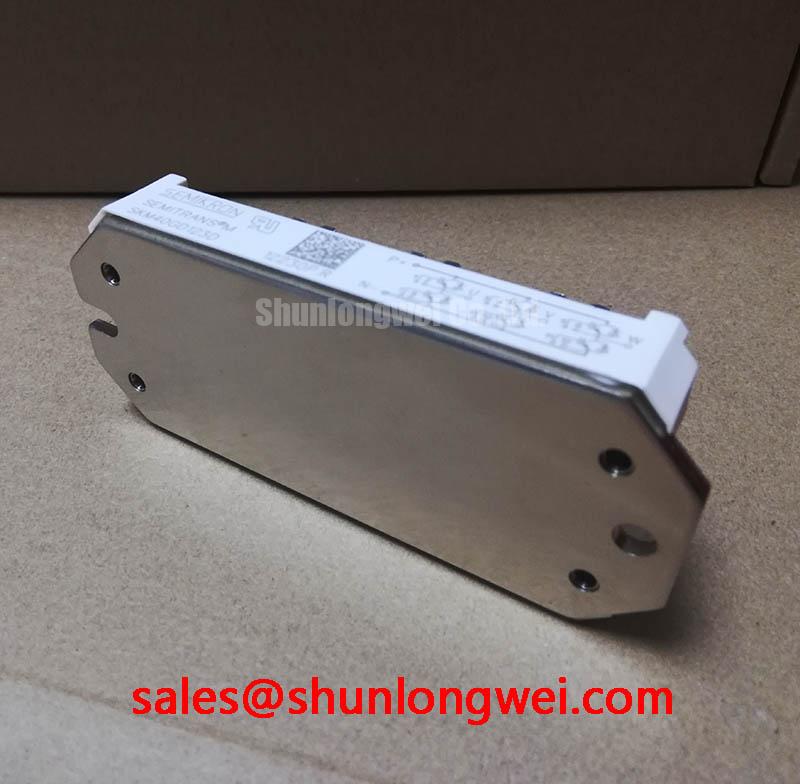
- To achieve the specified thermal resistance, the datasheet indicates a mounting torque of 4-5 Nm for the M5 heatsink mounting screws. It is crucial to use a thin, uniform layer of thermal grease on an appropriately flat heatsink surface to minimize the thermal resistance between the module’s isolated copper baseplate and the heatsink.
- How does the short-circuit capability of this module enhance system robustness?
- The datasheet states the SKM40GD123D has high short-circuit capability, with a self-limiting current of up to 6 times the nominal current. This inherent ruggedness provides a critical protection margin, allowing the system’s gate drive and control logic sufficient time to detect a fault and safely shut down the device, preventing catastrophic failure.
- What does the ‘CAL’ designation for the freewheeling diode signify?
- CAL stands for “Controlled Axial Lifetime,” a technology used to engineer the diode’s reverse recovery characteristics. For engineers, this means the diode is optimized for a “soft” recovery, which reduces voltage spikes and EMI during switching. This can simplify the design of snubber circuits and improve overall system reliability.
- Does this module include temperature sensing?
- The datasheet for the standard SKM40GD123D does not explicitly list an integrated NTC thermistor. For designs requiring direct temperature feedback, it is important to either select a module variant that includes this feature or implement an external temperature sensing solution adjacent to the module baseplate. Read more on the importance of this feature in our article about the role of integrated NTCs in IGBT modules.
By integrating proven Trench Gate IGBTs with soft-recovery CAL diodes in the industry-standard SEMITRANS 2 package, the SKM40GD123D provides a reliable and efficient foundation for developing robust power conversion systems.