Hitachi LMG7550XUFC: A Technical Review of a Robust Industrial FSTN Display
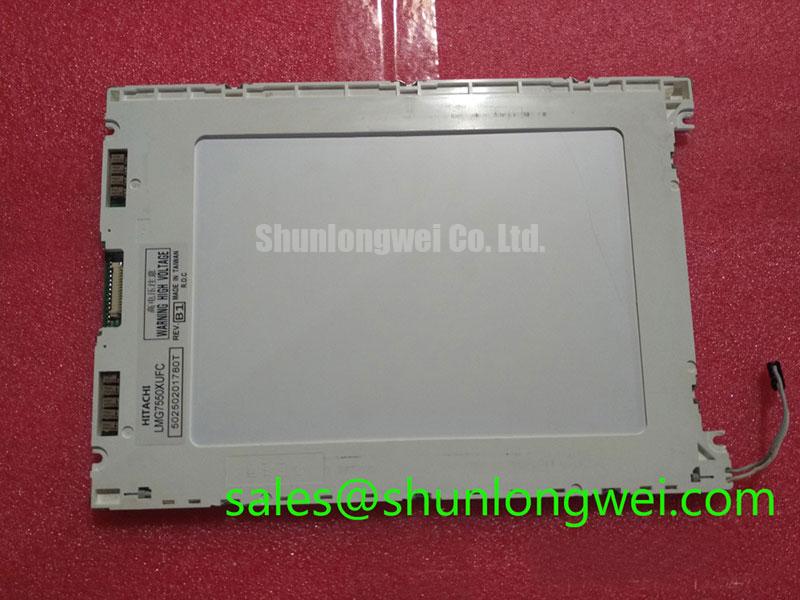
## Hitachi LMG7550XUFC 640×200 FSTN Graphic LCD Module
The Hitachi LMG7550XUFC is a monochrome graphic LCD module engineered for applications demanding high clarity and operational robustness. This display leverages Film Super-Twisted Nematic (FSTN) technology to deliver superior contrast and wide viewing angles, making it a definitive choice for industrial control panels, test equipment, and legacy system sustainment. It provides a clear, reliable human-machine interface solution built for longevity.
* **Core Specifications**: 640×200 Resolution | FSTN Monochrome | CCFL Backlight
* **Key Advantages**: Exceptional character and graphic legibility; integrated backlight driver simplifies power design.
* **User Intent Answered**: This module’s parallel data interface is straightforward for direct connection to a system’s host controller, simplifying the process of driving a 640×200 graphic LCD.
Download Official Datasheet (PDF)


Technical Analysis for System Integration
### Superior Readability with FSTN Technology
The LMG7550XUFC employs FSTN (Film-compensated Super-twisted Nematic) technology, which provides a significant advantage in monochrome display performance. The compensating film layer corrects optical dispersion, resulting in a sharper, higher-contrast image with a true black-and-white appearance rather than the blue-on-yellow of standard STN displays. For an engineer, this translates directly to improved readability in a variety of lighting conditions, a critical requirement for HMIs where operators must absorb information quickly and accurately. The importance of contrast ratio is like the clarity of a radio signal; a low ratio is full of static, while a high ratio delivers a crisp, intelligible message.
### Optimized 640×200 Wide-Format Resolution
The unconventional 640×200 dot matrix format of the LMG7550XUFC is specifically suited for instrumentation and control applications. Unlike standard 4:3 or 16:9 displays, this wide aspect ratio is highly efficient for displaying multiple lines of text-based data, status indicators, or simple waveforms without wasting vertical space. This makes it a prime candidate for systems where data presentation is paramount, such as in rack-mounted test equipment or specialized industrial controllers. The design allows for a dense yet uncluttered presentation of operational parameters. For more information on core display technologies, see our guide on LCD Core Technology.
Optimized Application Scenarios
The specific characteristics of this display make it a strong fit for the following uses:
* **Industrial Control Panels:** The high-contrast FSTN display ensures that critical system alerts and status messages are easily readable from a distance and at various angles.
* **Test and Measurement Equipment:** Its 640×200 resolution is ideal for rendering basic waveforms, spectral data, and complex menu systems with precision.
* **Medical Instrumentation:** The module’s stable performance and clear, unambiguous display of vital information are well-suited for patient monitors and diagnostic devices.
* **Legacy System Sustainment:** A reliable replacement for aging displays in older equipment, extending the operational life of valuable industrial machinery.
This module is best matched for systems requiring a highly readable, robust, wide-format monochrome graphical interface.
Key Specifications of the LMG7550XUFC
| Parameter | Specification |
|---|---|
| Display Specifications | |
| Display Mode | FSTN, Black & White Mode, Transmissive |
| Resolution | 640 x 200 dots |
| Active Area | 243.0(W) x 81.8(H) mm |
| Dot Pitch | 0.379(W) x 0.409(H) mm |
| Backlight | Cold Cathode Fluorescent Lamp (CCFL) |
| Electrical Characteristics | |
| Logic Supply Voltage (Vdd) | 5.0 V ± 5% |
| LCD Drive Voltage (VEE) | -20.5 V (Typ.) |
| Input Signal Interface | 4-bit or 8-bit Parallel (via MPU interface) |
| Mechanical & Environmental | |
| Module Size | 285.0(W) x 110.0(H) x 12.0(max T) mm |
| Operating Temperature | 0°C to +50°C |
| Storage Temperature | -20°C to +60°C |
Engineer’s FAQ
1. How is data sent to the LMG7550XUFC display?
The LMG7550XUFC uses a parallel interface that can be configured for 4-bit or 8-bit data transfer. It is controlled via standard signals such as Register Select (RS), Read/Write (R/W), and an Enable signal (E), making it compatible with a wide range of microcontrollers.
2. What are the power supply requirements, especially for the CCFL backlight?
The module requires a +5V supply for logic and a negative voltage (typically around -20.5V) for the LCD drive. The CCFL backlight requires a separate high-voltage AC inverter. The datasheet specifies the connector and input requirements for this inverter.
3. What makes this display suitable for industrial environments?
Its specified operating temperature range of 0°C to 50°C and robust construction allow it to function reliably in factory and control room settings. The FSTN technology ensures the display remains readable even when viewed from off-angles, which is common in industrial workplaces. For deeper insights into display durability, read our guide on vibration and shock resistance.
4. Can this module display grayscale images?
No, the LMG7550XUFC is a monochrome (1-bit) display. Each pixel is either on (black) or off (white/greenish). It cannot natively display shades of gray. Grayscale effects would have to be simulated through dithering techniques in software.
Enabling Clear and Reliable HMI Design
The LMG7550XUFC delivers a focused feature set that enables engineers to create highly effective and reliable user interfaces. Its excellent contrast, straightforward parallel interface, and industrial-grade construction provide the necessary components for systems where clarity and long-term performance are the primary design drivers. This module empowers the development of HMIs that communicate information unambiguously and withstand the demands of their operational environment. For more on the building blocks of modern systems, explore our resources on power semiconductors.