Infineon FZ400R12KS4: High-Performance 1200V 400A Fast-Switching IGBT Module
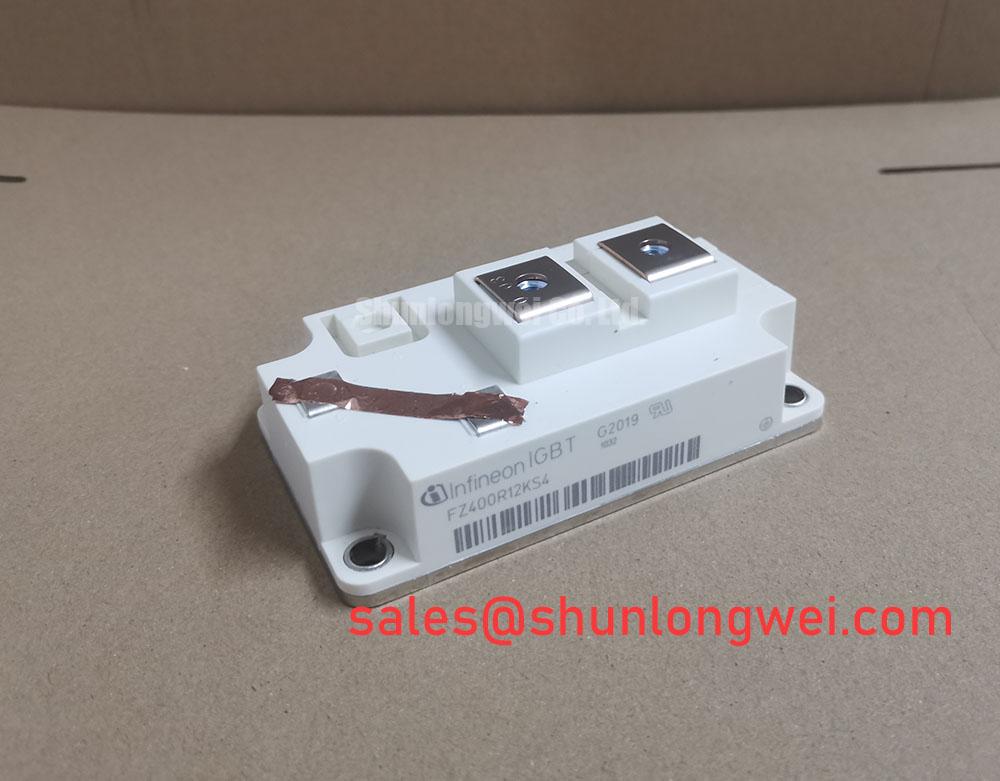
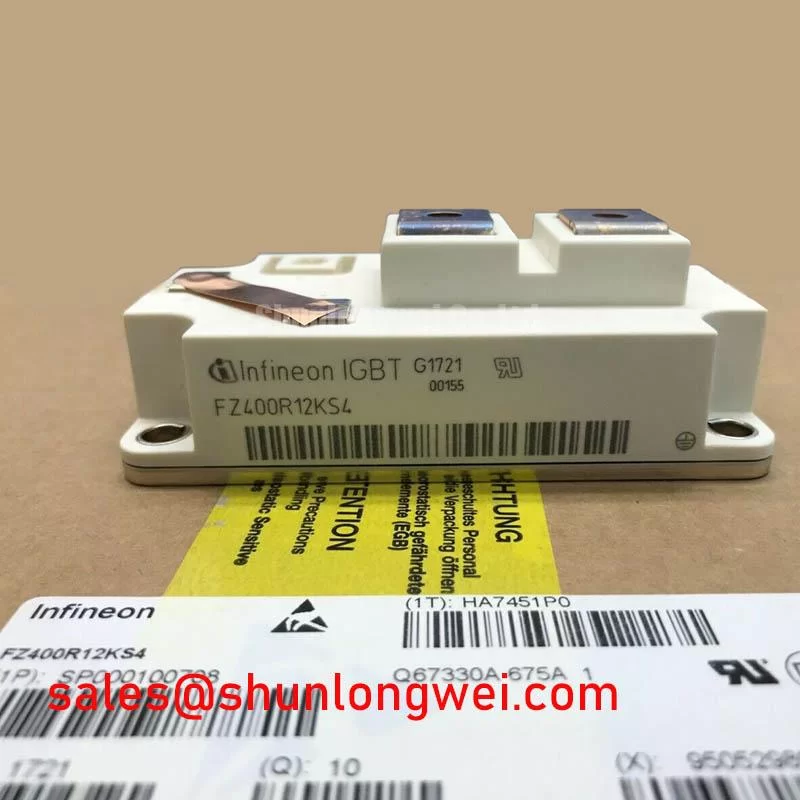
Infineon FZ400R12KS4 IGBT Module 1200V 400A Single Switch
Optimized Fast-Switching Performance for High-Power Density Systems
The FZ400R12KS4 is an industrial-grade Single IGBT module engineered for high-frequency switching applications where efficiency and robustness are paramount. By utilizing Infineon’s specialized KS4 technology, this module provides a superior balance between conduction and switching losses, making it a benchmark for 1200V power electronics. It offers a rated current of 400A (at Tc=80°C), specifically serving the needs of engineers designing advanced high-frequency inverters and UPS systems.
- Core Specifications: 1200V | 400A | $V_{CE(sat)}$ 3.2V (Typical at 25°C)
- Key Advantage 1: Reduced switching losses enable higher carrier frequencies without excessive thermal stress.
- Key Advantage 2: Integrated high-speed free-wheeling diode with soft recovery behavior to minimize EMI.
For designers asking how the FZ400R12KS4 handles extreme load transients, the module features a 10µs short-circuit withstand time ($t_{sc}$) at $T_j=125^circ C$, ensuring a reliable safety margin during fault conditions.
Download Official Datasheet (PDF)
Technical Analysis: Precision Engineering of the KS4 Series
The engineering logic behind the FZ400R12KS4 centers on its high-speed switching characteristics. Unlike standard “Trench/Fieldstop” modules optimized solely for low conduction losses, the KS4 technology aims to minimize the energy dissipated during each switching transition ($E_{on}$ and $E_{off}$). According to the Infineon datasheet, the typical turn-off energy loss ($E_{off}$) is 60mJ at 400A, which allows the module to operate comfortably at frequencies that would cause standard modules to overheat.
A critical parameter for system longevity is the thermal resistance junction-to-case ($R_{thJC}$). For the FZ400R12KS4, this is rated at 0.031 K/W per IGBT. To visualize this engineering value, think of thermal resistance as a highway for heat; the lower the value, the wider the highway. This low resistance ensures that heat generated during high-frequency switching flows efficiently to the heat sink, preventing the silicon from reaching its maximum $T_j$ limit of 125°C. This thermal overhead is essential for maintaining reliability in 24/7 industrial environments.
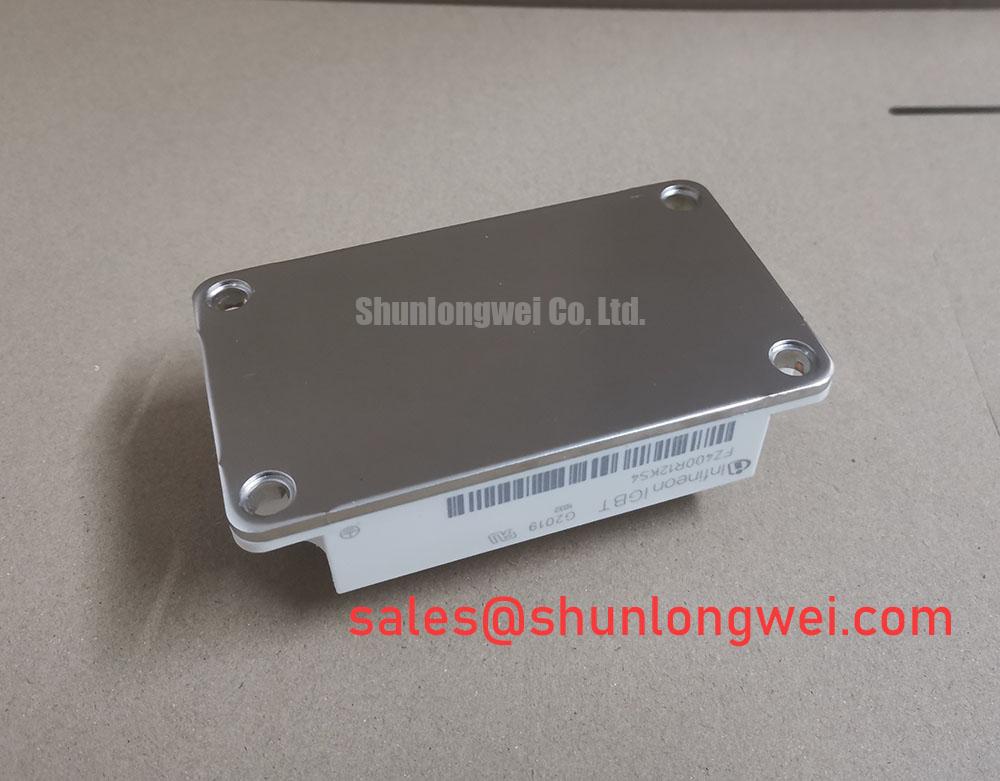
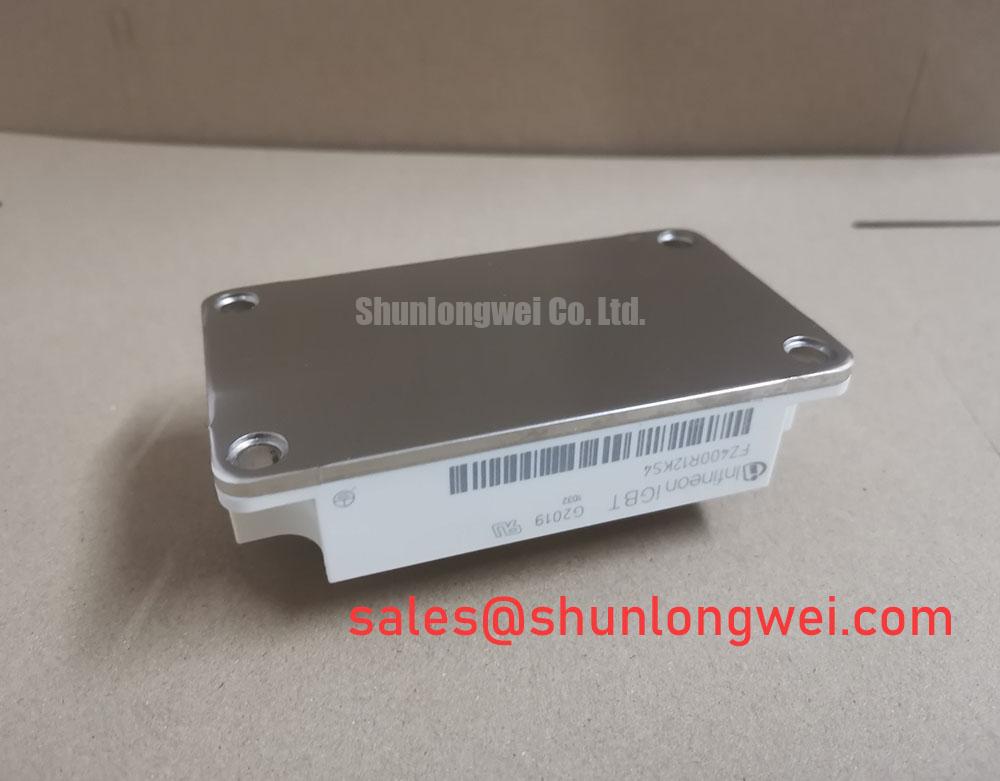
Furthermore, the FZ400R12KS4 utilizes an isolated baseplate technology. This isolation provides high dielectric strength, allowing multiple modules to be mounted on a single heat sink without additional insulation layers. This significantly simplifies the mechanical assembly and enhances the overall power density of the converter unit. When combined with its high short-circuit ruggedness, the module offers a highly resilient solution for demanding power conversion tasks.

Optimized Application Scenarios
The FZ400R12KS4 is specifically tailored for applications that demand high throughput and rapid response times. Its design excels in the following areas:
- Uninterruptible Power Supplies (UPS): High switching frequency reduces the size of filtering components, leading to more compact and efficient system designs.
- Induction Heating: The fast-switching nature is a perfect fit for induction systems, effectively managing the Frequency vs Q-factor trade-offs required for consistent metal heating.
- Medical Equipment: Ideal for X-ray generators and MRI gradient amplifiers where precise, high-speed pulse control is mandatory.
- Frequency Converters: Its robustness against short circuits makes it a stable choice for industrial frequency drives operating in harsh electrical environments.
Best Match: Power systems requiring a 400A current rating with switching frequencies exceeding 10kHz while demanding a high short-circuit safety factor.
Key Technical Specifications
| Category | Parameter | Value |
|---|---|---|
| Absolute Maximum Ratings | Collector-Emitter Voltage ($V_{CES}$) | 1200 V |
| Continuous DC Collector Current ($I_C$) | 400 A (at $T_C = 80^circ C$) | |
| Repetitive Peak Collector Current ($I_{CRM}$) | 800 A | |
| Electrical Characteristics | Collector-Emitter Saturation Voltage | 3.2 V (Typ, $T_j = 25^circ C$) |
| Gate Threshold Voltage ($V_{GE(th)}$) | 4.5 V to 6.5 V | |
| Short Circuit Withstand Time ($t_{sc}$) | ≤ 10 µs | |
| Thermal & Mechanical | Thermal Resistance ($R_{thJC}$) | 0.031 K/W (per IGBT) |
| Isolation Test Voltage ($V_{ISOL}$) | 2.5 kV (RMS, f=50Hz, t=1min) |
Engineer’s FAQ
Q1: How should I calculate the heat dissipation requirements for the FZ400R12KS4?
A1: You must sum the conduction losses and the switching losses. Conduction loss is $P_{cond} = V_{CE(sat)} times I_C times Duty Cycle$. Switching losses are $P_{sw} = (E_{on} + E_{off}) times Frequency$. Use the Zth curve provided in the datasheet to account for transient thermal impedance during pulsed operation.
Q2: Can I parallel these modules to achieve 800A or higher capacity?
A2: Yes, the FZ400R12KS4 has a positive temperature coefficient of $V_{CE(sat)}$ at high temperatures, which naturally promotes current sharing. However, you must follow strict symmetrical layout design to minimize parasitic inductance differences between the branches.
Q3: What is the recommended gate voltage for optimal switching?
A3: The data sheet specifies a recommended gate-emitter voltage of +15V for the “ON” state. For robust “OFF” state performance and noise immunity, a negative gate bias (typically -5V to -15V) is recommended to prevent parasitic turn-on due to Miller capacitance effects.
Empowering High-Frequency Power Design
The FZ400R12KS4 stands as a highly specialized power semiconductor that enables engineers to push the boundaries of switching frequency and power density. By integrating advanced KS4 technology with exceptional thermal management capabilities, this module serves as a reliable cornerstone for modern high-performance conversion systems. Its documented stability under fault conditions and optimized loss profile provide the technical foundation necessary for high-stakes industrial and medical power applications.