Semikron SKKT570/16E Dual Thyristor Module: Technical Analysis, Specifications, and Applications
Semikron SKKT570/16E Dual Thyristor Module Overview
Introduction and Core Value Proposition
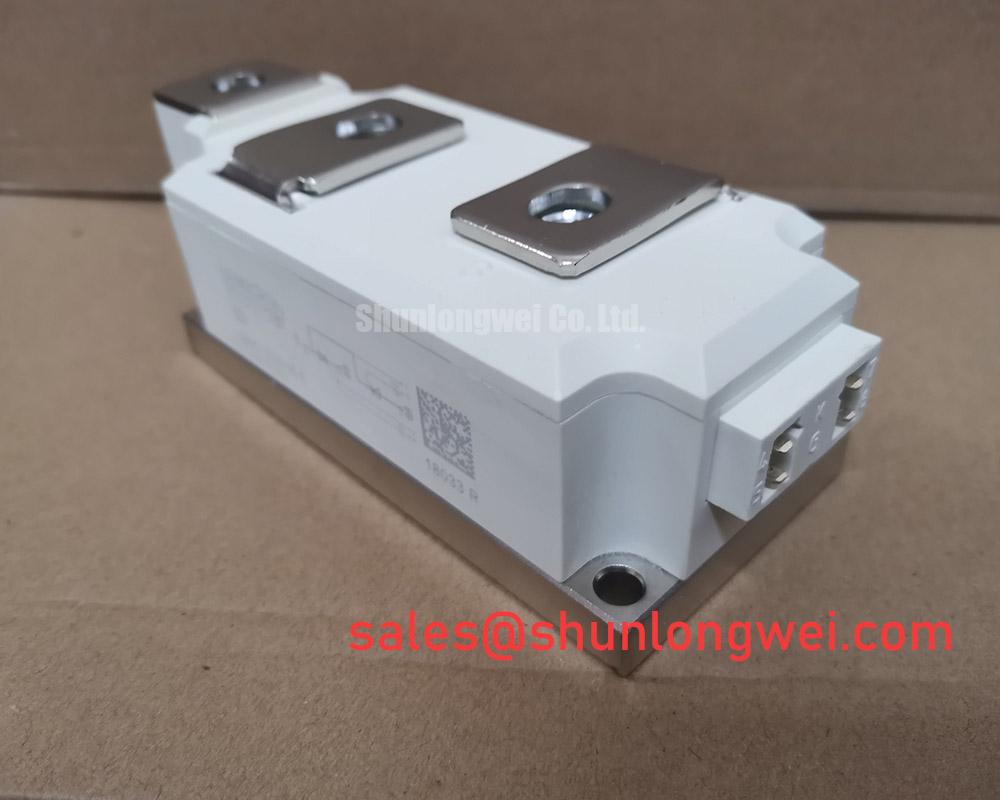
The SKKT570/16E is a high-power line-commutated thyristor/thyristor module housed in an industry-standard SEMIPACK 5 outline, engineered for heavy-duty phase-control rectifiers and AC line regulation. Utilizing internal pressure contact technology over an isolated copper baseplate, the module delivers superior power-cycling endurance and thermal dissipation in continuous, high-ampacity deployments.

- Core Ratings: 1600 V repetitive peak off-state/reverse voltage ($V_{DRM}/V_{RRM}$) | 570 A nominal mean on-state current ($I_{TAV}$) at $T_c = 85^circtext{C}$ ($700text{ A}$ at $T_c = 60^circtext{C}$) | 17,000 A surge peak capability ($I_{TSM}$).
- Engineering Advantages: Direct heat transfer through a low-thermal-resistance junction-to-case path ($0.054text{ K/W}$ per switch) minimizes heatsink volume while pressure contacts eliminate solder-layer fatigue under cyclic thermal strain.
- Design Fulfillment: For designers managing severe overload events in line-frequency converters, the high $I^2t$ rating ($1,445,000text{ A}^2text{s}$) simplifies semiconductor fuse coordination without oversizing the power stack.
Download Official SKKT570/16E Datasheet (PDF)

Technical Analysis: Electrical Dynamics and Thermal Architecture
The internal construction of the SKKT570/16E relies on compression bonding rather than traditional soldered die attachments. This architecture significantly decreases thermomechanical stress on the silicon chips during repetitive line-frequency power surges. By using an isolated metal baseplate with an aluminum-oxide ceramic layer, the device achieves a test isolation voltage rating of $3000text{ V AC}$ (1 minute), allowing multiple power semiconductors to mount onto a shared heatsink.
Thermal management is dictated by a low junction-to-case thermal resistance ($R_{th(j-c)}$) of $0.054text{ K/W}$ per single switch ($0.027text{ K/W}$ per complete module). To understand thermal resistance, picture heat dissipation as fluid draining through a pipe: a smaller resistance value functions like a wider conduit, allowing junction heat to exit into the heatsink with minimal thermal head build-up, preventing destructive thermal runaway.
Handling dynamic turn-on events requires careful attention to critical rate-of-rise parameters. The SKKT570/16E is rated for a critical $(dv/dt)_{cr}$ of $1000text{ V/}mutext{s}$ at $T_vj = 130^circtext{C}$ and a $(di/dt)_{cr}$ of $250text{ A/}mutext{s}$. These limits ensure that noise transients on the line side do not trigger un-gated conduction, while snubber networks can be sized compactly when operating in demanding line commutation schemes.


Optimized Application Scenarios
- AC Motor Soft Starters: The $17text{ kA}$ surge current withstands the high starting torque and inrush current demands of heavy industrial motors, aligning directly with strategies detailed in our guide to thyristor selection for soft starters.
- Line-Rectifier Bridges for DC Drives: With a blocking capability of $1600text{ V}$, this phase leg provides sufficient safety margins for $400text{ V}$ to $500text{ V AC}$ mains lines without excessive voltage clamping overhead.
- Industrial Resistance Heating Control: The high continuous $I_{TRMS}$ rating ($950text{ A}$) enables precise phase-angle or burst-firing power modulation, matching principles outlined in our study of thyristor control in electric furnaces.
- Uncontrolled/Controlled Front-End Supplies: Works effectively alongside systems using a SEMIPACK 5 dual thyristor module to feed bulk intermediate DC bus capacitors in large converter cabinets.
System Fit: Best suited for 400–500 V AC line systems requiring up to 700 A continuous output per phase leg under forced cooling.
Key Technical Specifications
| Parameter | Symbol | Conditions / Rating | Unit | |
|---|---|---|---|---|
| Repetitive Peak Off-State & Reverse Voltage | $V_{DRM}, V_{RRM}$ | $T_{vj} = -40 dots +130^circtext{C}$ | 1600 | V |
| Continuous Average On-State Current | $I_{TAV}$ | $sin 180^circ; T_c = 85^circtext{C} / 60^circtext{C}$ | 570 / 700 | A |
| RMS On-State Current | $I_{TRMS}$ | Continuous; $T_c = 85^circtext{C}$ | 950 | A |
| Surge On-State Current (Peak) | $I_{TSM}$ | $10text{ ms}, sin 180^circ; T_{vj} = 25^circtext{C} / 130^circtext{C}$ | 17000 / 15000 | A |
| Melting Integral ($I^2t$ Value) | $I^2t$ | $10text{ ms}; T_{vj} = 25^circtext{C} / 130^circtext{C}$ | 1,445,000 / 1,125,000 | $text{A}^2text{s}$ |
| On-State Voltage (Peak) | $V_T$ | $I_T = 1500text{ A}; T_{vj} = 25^circtext{C}$ (typ./max.) | 1.45 / 1.60 | V |
| Critical Rate of Rise of Off-State Voltage | $(dv/dt)_{cr}$ | $T_{vj} = 130^circtext{C}$ | 1000 | $text{V/}mutext{s}$ |
| Thermal Resistance (Junction to Case) | $R_{th(j-c)}$ | Per switch / Per module (cont. DC) | 0.054 / 0.027 | K/W |
| Isolation Voltage | $V_{isol}$ | $50text{ Hz}, text{RMS}, 1text{ s} / 1text{ min}$ | 3600 / 3000 | V~ |
Engineering FAQ
How is semiconductor fuse protection coordinated for the SKKT570/16E?
Fuse selection requires ensuring the clearing $I^2t$ of the high-speed semiconductor fuse remains below the thyristor’s maximum melting integral ($1,125,000text{ A}^2text{s}$ at $130^circtext{C}$). This preserves silicon integrity during bolted short-circuit occurrences before the gate trigger can be safely deactivated.
What mounting torque specifications should be applied during installation?
Datasheet specifications dictate a mounting torque ($M_1$) of $6text{ N}cdottext{m} pm 15%$ to secure the module base to the heatsink, and a terminal tightening torque ($M_2$) of $12text{ N}cdottext{m} pm 15%$ for the main electrical connections. Even torque distribution and an even layer of thermal grease ($50,mutext{m}$ thickness) are mandatory to avoid mechanical die stress and localized hot spots.
Can multiple SKKT570/16E modules be paralleled for higher current output?
Yes, but direct parallel connection requires symmetrical mechanical layout of busbars to equalize stray inductances. Additionally, thyristors should be matched for forward voltage drop ($V_T$) within specified grouping bands, or decoupling reactors should be introduced to balance transient current distribution.
Operational Takeaway
The SKKT570/16E provides a rugged, electrically isolated phase-leg building block engineered for high-surge industrial rectification and control. Its pressure-contact package and high $I^2t$ safety margin give power system engineers the mechanical longevity and thermal headroom needed for dependable line-frequency power conversion.