SKM22GD125D IGBT Module: A Technical Analysis for Power Converters
SKM22GD125D Semikron IGBT Module for Power Converters
Technical Analysis of the SKM22GD125D IGBT Module
The SKM22GD125D is a half-bridge IGBT module from Semikron, engineered for efficiency and reliability in power conversion systems. Its unique value proposition lies in the integration of Trench Gate IGBT technology with fast and soft inverse CAL (Controlled Axial Lifetime) freewheeling diodes. This combination delivers a superior balance between low on-state voltage and robust switching performance, enabling designers to improve system efficiency and manage thermal loads effectively.
- Core Specifications: 1200V | 22A | VCE(sat) (typ) 1.7V
- Key Advantages: Low conduction and switching losses, high short-circuit capability.
This module’s low thermal resistance from junction to case simplifies the selection of an appropriate heatsink, which is a critical step in the thermal management of power systems.
Download Official Datasheet (PDF)

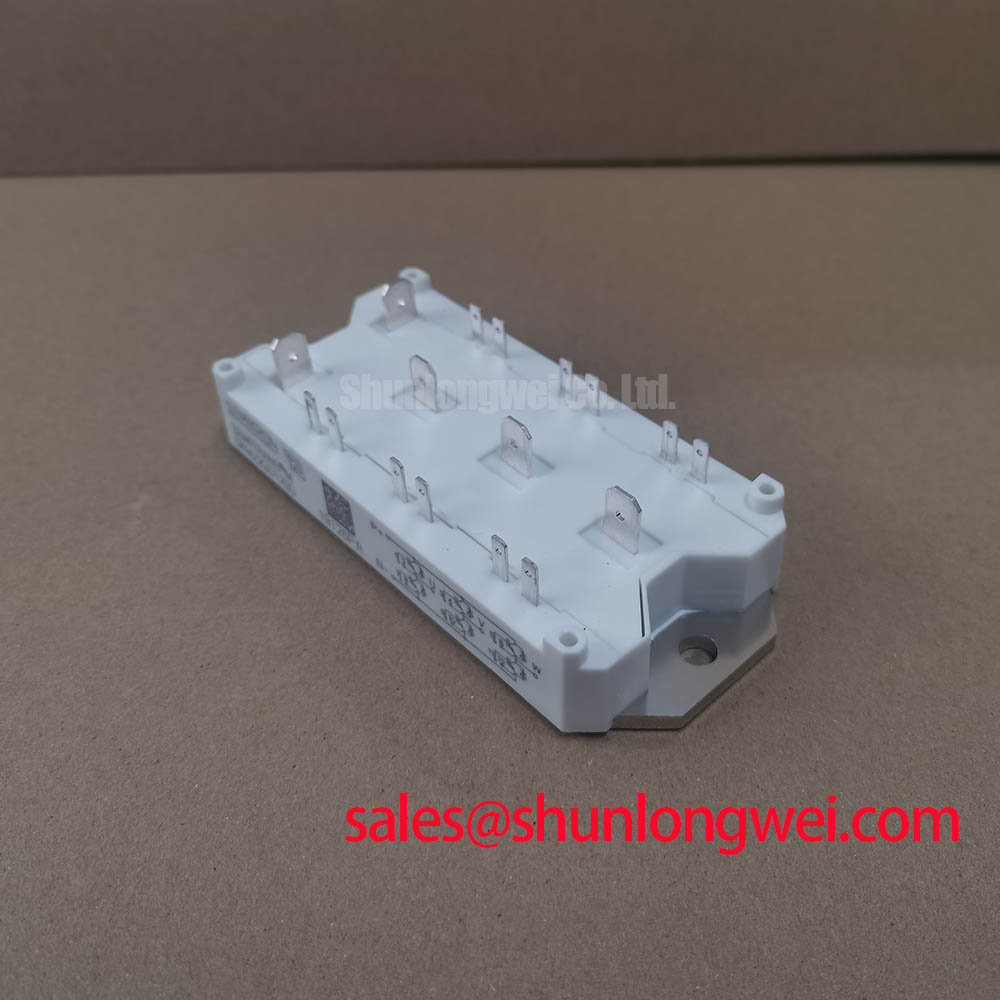
Engineered for Low Losses and High Reliability
A key parameter determining an IGBT’s efficiency is its collector-emitter saturation voltage, VCE(sat). The SKM22GD125D datasheet specifies a typical VCE(sat) of 1.7V at a junction temperature of 25°C. This low value is a direct result of its advanced Trench Gate structure. You can think of VCE(sat) as the electrical “friction” the current encounters when the switch is on. Lower friction means less energy is converted into waste heat, which directly improves system efficiency and reduces the demands on the cooling system. This is particularly important for achieving higher power density in modern converter designs.
Furthermore, the module integrates CAL freewheeling diodes. These diodes are characterized by their “soft” recovery behavior. During the switching process in an inverter, a diode’s recovery can generate significant electromagnetic interference (EMI) and voltage spikes. The soft recovery of the CAL diode mitigates these effects, leading to cleaner switching waveforms and enhanced system reliability. This reduces the need for external snubber circuits and simplifies EMC compliance, a crucial consideration for any power electronics engineer.

Optimized Application Scenarios
The technical characteristics of the SKM22GD125D make it well-suited for a range of demanding applications where efficiency and robustness are paramount.
- AC Motor Drives: The low VCE(sat) directly translates to lower power dissipation, making it ideal for compact and efficient Variable Frequency Drives (VFDs).
- Uninterruptible Power Supplies (UPS): The module’s high short-circuit capability, self-limiting to 6 times the nominal current, provides essential robustness to withstand fault conditions.
- Switched-Mode Power Supplies (SMPS): The fast switching characteristics combined with the soft recovery diode enable higher switching frequencies, which allows for the use of smaller passive components.
- Inductive Heating Systems: Its ability to handle high currents and switch efficiently at frequencies above 20 kHz makes it a strong candidate for resonant inverters used in industrial heating.
For mid-power inverter applications requiring a balance of low conduction losses and clean switching, this IGBT module provides a technically sound solution.
Key Technical Specifications for SKM22GD125D
| Absolute Maximum Ratings (Tcase = 25°C unless otherwise specified) | |
|---|---|
| Collector-Emitter Voltage (VCES) | 1200 V |
| Continuous Collector Current (IC @ 80°C) | 22 A |
| Pulsed Collector Current (ICM, tp=1ms) | 44 A |
| Operating Junction Temperature (Tj) | -40 to +150 °C |
| Isolation Voltage (Visol, AC 50Hz, 1 min) | 2500 V |
| IGBT Characteristics (Tj = 25°C) | |
| Collector-Emitter Saturation Voltage (VCE(sat), IC=22A, VGE=15V), typ. | 1.7 V |
| Gate-Emitter Threshold Voltage (VGE(th)) | 5 V (typ) |
| Freewheeling Diode Characteristics (Tj = 25°C) | |
| Forward Voltage (VF, IF=22A), typ. | 1.75 V |
| Thermal and Mechanical | |
| Thermal Resistance, Junction to Case (Rth(j-c)) per IGBT | 1.65 K/W |
| Mounting Torque, Terminals (M4) | 1.3 – 1.7 Nm |
Engineer’s FAQ
1. What is the VCE(sat) of the SKM22GD125D at higher operating temperatures like 125°C?
The datasheet indicates that VCE(sat) has a positive temperature coefficient. The typical VCE(sat) at Tj=125°C is 2.05V (for IC=22A, VGE=15V). This characteristic is beneficial for paralleling modules as it helps in balancing current sharing.
2. What is the recommended mounting torque for the SKM22GD125D, and why is it critical?
The recommended mounting torque for the heat sink mounting screws (M5) is 2.5 – 3.5 Nm. Applying the correct torque is crucial for ensuring low thermal resistance between the module’s baseplate and the heatsink. Insufficient torque leads to poor thermal contact and overheating, while excessive torque can cause mechanical stress and damage the module’s isolated substrate.
3. What does the “CAL” designation for the freewheeling diode mean for my design?
CAL stands for “Controlled Axial Lifetime”. For a design engineer, this signifies a freewheeling diode with a soft and fast recovery characteristic. This reduces voltage overshoots and ringing during switching, which lowers electromagnetic interference (EMI) and improves the overall reliability of the power stage.
4. How does the integrated NTC thermistor aid in system protection?
The built-in NTC thermistor provides a means for real-time temperature monitoring of the module’s baseplate. This feedback can be used by the system controller to trigger alarms, reduce power output (derating), or initiate a shutdown if the temperature exceeds safe limits, thus preventing catastrophic failure due to overheating.
The SKM22GD125D offers a well-balanced set of features for motor drives and power converters. Its use of Trench Gate technology and integrated CAL diodes provides a direct path to achieving lower operational losses and enhanced electrical ruggedness in demanding industrial power systems.