SKM400GAL176D: A Technical Review of a High-Frequency 1700V IGBT Module
“`html
SKM400GAL176D Single IGBT Module | 1700V 400A
High-Frequency Performance in High-Voltage Applications
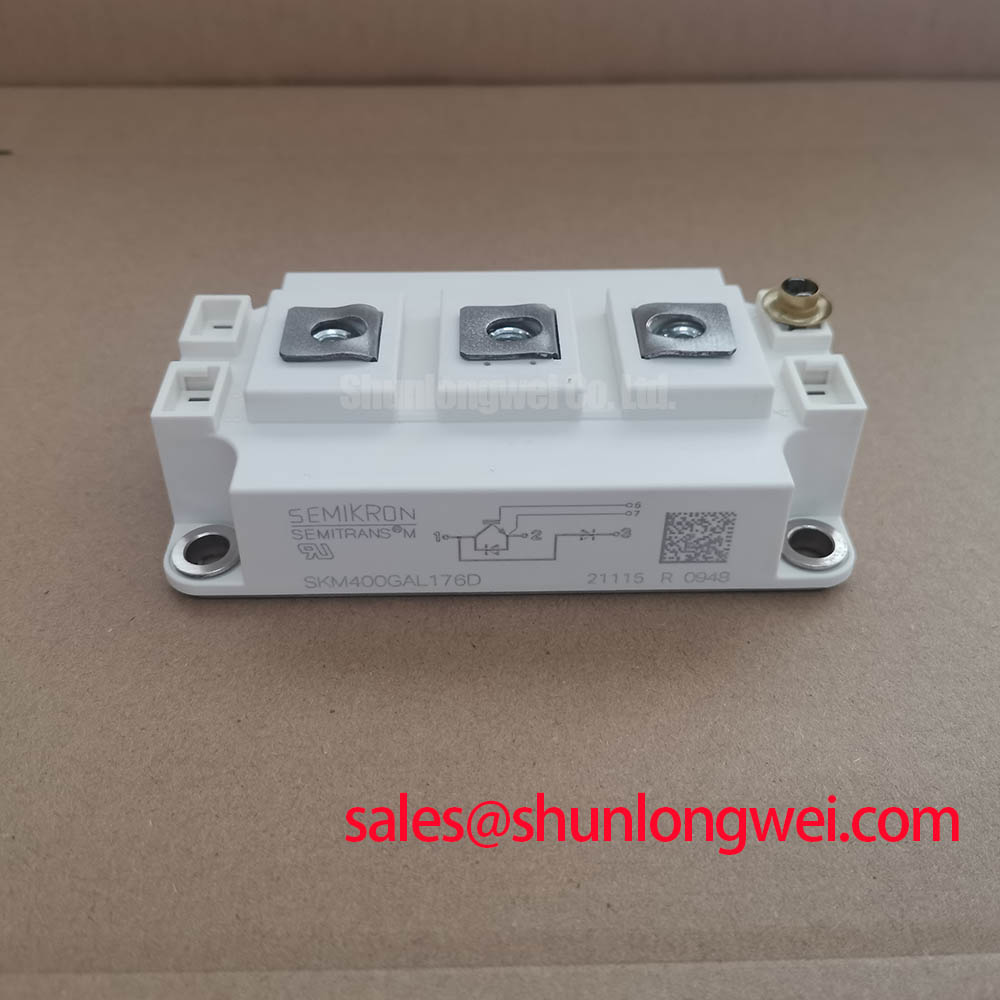
The Semikron SKM400GAL176D is a single IGBT module that delivers robust 1700V performance with optimized high-frequency operation. Its core value stems from the integration of advanced Trench Gate IGBT technology with a soft-recovery SEMIKRON CAL 4 freewheeling diode, enabling both efficiency and reduced electromagnetic interference (EMI). Its positive VCE(sat) temperature coefficient simplifies the design process for paralleling modules, ensuring stable current sharing under heavy loads.
- Core Specifications: 1700V | 400A | VCE(sat) 2.15V (typ. at 125°C)
- Key Advantages: Enables higher switching frequencies up to 20 kHz, reduces EMI through soft-recovery diode technology.
Download Official SKM400GAL176D Datasheet (PDF)


Technical Analysis for System Integration
The SKM400GAL176D’s capability to operate at frequencies up to 20 kHz is directly attributable to its Trench Gate IGBT structure. This design results in controlled switching characteristics, with typical turn-on (Eon) and turn-off (Eoff) energies of 240 mJ and 340 mJ respectively, measured at a junction temperature of 125°C. These parameters are critical for designers of high-frequency inverters, as lower switching losses translate directly to reduced heat generation, allowing for smaller heatsinks and improved overall system efficiency.
A key contributor to the module’s clean switching performance is the integrated SEMIKRON CAL 4 freewheeling diode. This diode is specified to have “soft recovery” characteristics. The soft recovery behavior can be compared to a high-performance vehicle’s braking system; instead of a sudden, jarring stop that creates significant noise and stress, it decelerates smoothly. Electrically, this means the diode current returns to zero without inducing large voltage spikes or high-frequency oscillations. This significantly reduces EMI, a crucial benefit that can simplify system-level filtering and accelerate regulatory compliance testing. For a deeper look at this technology, see our guide on why soft-recovery diodes are key to IGBT performance.
Optimized Application Scenarios
The technical specifications of the SKM400GAL176D make it a strong candidate for several demanding power semiconductor applications:
- Solar Inverters: The 1700V collector-emitter voltage provides a substantial safety margin for 1000 VDC bus systems, and its high-frequency capability improves the efficiency of the DC-AC conversion stage.
- Uninterruptible Power Supplies (UPS): Its high current rating of 400A allows for the design of robust UPS systems capable of supporting critical high-power loads with high reliability.
- Industrial Motor Drives: The ability to switch at 20 kHz enables quieter motor operation and improved torque control, while the industry-standard SEMITRANS 3 package ensures mechanical robustness.
- Welding Power Supplies: The fast and efficient switching is essential for modern inverter-based welding equipment, allowing for precise control of the welding arc.
This module is an excellent match for high-power inverter designs requiring high-frequency operation, low EMI, and robust voltage overhead.
Key Specifications of the SKM400GAL176D
| Absolute Maximum Ratings | |
|---|---|
| Collector-Emitter Voltage (VCES) | 1700 V |
| Continuous Collector Current (IC) @ Tc = 25°C | 535 A |
| Continuous Collector Current (IC) @ Tc = 80°C | 400 A |
| Gate-Emitter Voltage (VGES) | ±20 V |
| Short Circuit Withstand Time (tpsc) | 10 µs |
| IGBT & Diode Characteristics (Tj = 125°C) | |
| Collector-Emitter Saturation Voltage (VCE(sat)) (Typ. @ 400A) | 2.15 V |
| Diode Forward Voltage (VF) (Typ. @ 400A) | 2.1 V |
| Turn-On Switching Energy (Eon) (Typ.) | 240 mJ |
| Turn-Off Switching Energy (Eoff) (Typ.) | 340 mJ |
| Thermal and Mechanical Characteristics | |
| Thermal Resistance, Junction-to-Case (Rth(j-c)) per IGBT | 0.055 K/W |
| Thermal Resistance, Junction-to-Case (Rth(j-c)) per Diode | 0.09 K/W |
| Insulation Test Voltage (Visol) | 4000 V (AC, 1 min.) |
Engineer’s FAQ
What is the junction-to-case thermal resistance for the SKM400GAL176D?
According to the datasheet, the thermal resistance from junction to case (Rth(j-c)) is 0.055 K/W for the IGBT and 0.09 K/W for the freewheeling diode. These values are fundamental for calculating the heat dissipation and designing an appropriate cooling system to maintain the junction temperature within safe operating limits. A practical guide on this topic is available in our article on mastering IGBT thermal design.
Why is the positive temperature coefficient of VCE(sat) important?
A positive temperature coefficient means that as the IGBT chip heats up, its on-state voltage drop (VCE(sat)) increases. When paralleling multiple SKM400GAL176D modules, this characteristic promotes automatic current balancing. If one module starts to conduct more current and gets hotter, its VCE(sat) will rise, naturally redirecting current to the cooler modules. This prevents thermal runaway and ensures reliable operation in high-current arrays.
What are the recommended gate drive voltage levels for this module?
The datasheet’s characteristic curves are based on a gate-emitter voltage (VGE) of ±15 V. The maximum allowable continuous VGE is ±20 V. Operating at the recommended +15 V for turn-on and a negative voltage like -15 V for turn-off ensures full enhancement of the IGBT channel while providing a robust noise margin against parasitic turn-on.
What is the specified mounting torque for this module?
The datasheet specifies a mounting torque of 4.5 Nm for the M6 case mounting screws and 4.5 Nm for the M6 power terminals. Adhering to these torque specifications is critical to ensure a low-resistance thermal interface to the heatsink and reliable electrical connections without causing mechanical stress to the module’s housing.
Enabling Efficient and Reliable Power Conversion
The SKM400GAL176D provides a balanced solution for power system designers. It combines a high 1700V breakdown voltage with the speed of Trench Gate technology and the low-noise performance of a CAL 4 diode. This unique combination enables the development of reliable, high-frequency, and efficient power converters for the most demanding industrial applications.
“`