Vicor V24B3V3H150BL: A Technical Analysis of a 150W High-Density DC-DC Converter
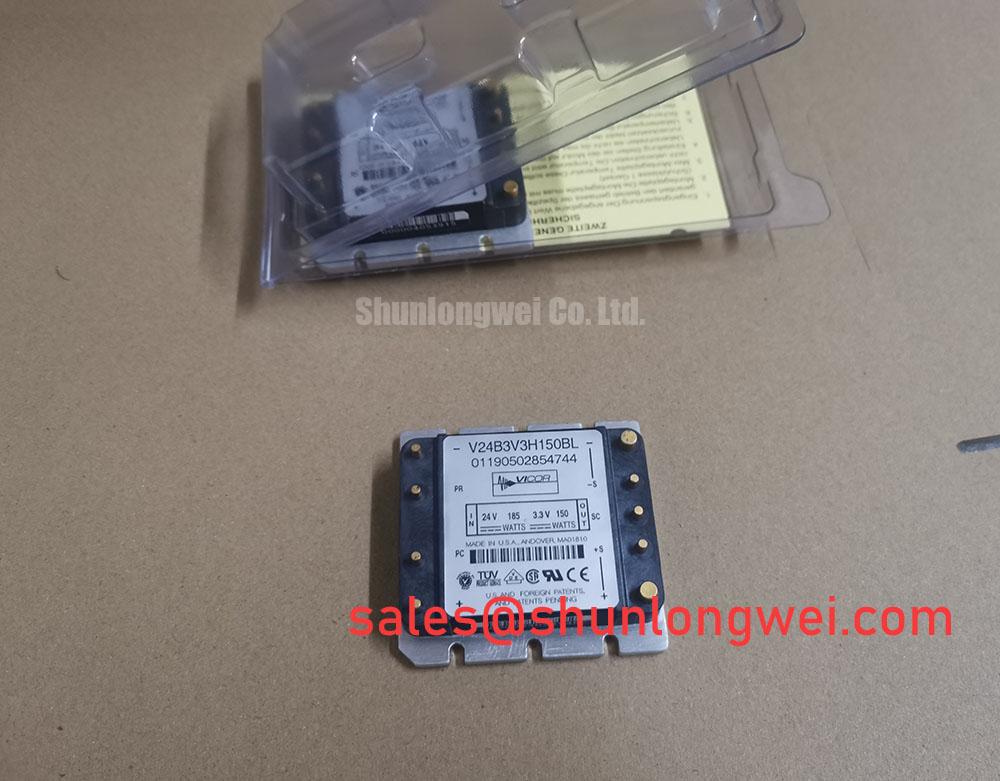
Vicor V24B3V3H150BL DC-DC Converter Module, 150W
Introduction and Core Highlights
The Vicor V24B3V3H150BL is an isolated DC-DC converter module that delivers exceptional power density and high efficiency from a nominal 24V input. Its unique value proposition lies in providing a robust, regulated 150W output within a compact, board-mountable Mini package, achieved through a high-frequency Zero-Voltage Switching (ZVS) topology. This architecture enables system designers to develop space-constrained power systems without compromising on thermal performance or reliability.
- Core Specifications: 18-36V DC Input | 3.3V DC Output | 150W Power
- Key Advantages: Maximizes board space with high power density, reduces thermal management complexity due to high efficiency.
- Design Flexibility: The wide input range accommodates voltage fluctuations common in battery-powered or distributed power systems.
Download Official Datasheet (PDF)

Technical Analysis of High-Density Power Conversion
The V24B3V3H150BL delivers up to 80W per cubic inch, a power density that directly enables the miniaturization of complex electronic systems. This is made possible by its ZCS/ZVS switching architecture, which minimizes switching losses that would otherwise generate significant heat. The module’s efficiency, reaching up to 87% at full load, is a critical enabler of this density. High efficiency means less power is wasted as heat, simplifying thermal design and allowing for reliable operation up to a baseplate temperature of 100°C. This contributes to a longer mean time between failures (MTBF), a key metric for industrial and high-reliability applications.
Think of the module’s thermal resistance as the width of a pipe meant to drain heat away from the core components. A lower thermal resistance value, achieved through the module’s construction, is like having a wider pipe, allowing heat to escape more easily. This efficient heat transfer, combined with low power dissipation, prevents the internal components from exceeding their safe operating temperatures, even when the module is delivering its full 150W of power.
Optimized Application Scenarios
The performance characteristics of this converter make it well-suited for a range of demanding applications:
- Industrial Process Control: The wide input range (18-36V) ensures stable operation from common 24V industrial buses, which are often subject to voltage sags and surges.
- ATE (Automated Test Equipment): High power density allows for more channels and functionality within a standard test rack, and the remote sense feature ensures precise voltage delivery to the device under test.
- Telecommunications Infrastructure: In densely packed server racks, the module’s high efficiency minimizes waste heat, reducing the overall cooling load and operational expenditure.
- Distributed Power Architectures: As a modular component, the V24B3V3H150BL facilitates scalable power system designs where power conversion is located close to the point of load, improving transient response and reducing distribution losses.
This module is best matched for systems where delivering regulated, low-voltage, high-current power in a minimal footprint is the primary engineering constraint.
Key Specifications of the V24B3V3H150BL
| Parameter | Value | |
|---|---|---|
| Input | Input Voltage Range | 18 – 36 VDC |
| Input Surge Withstand (100ms) | 50 VDC | |
| Output | Output Voltage | 3.3 VDC |
| Output Power | 150 Watts | |
| Output Current | 45.5 A | |
| Programmable Output Range | 10% to 110% of nominal | |
| Performance & Features | Efficiency (at Full Load) | Up to 87% |
| Isolation Voltage (+IN/-IN to Output) | 3000 Vrms | |
| Protection Features | OVP, Current Limit, Thermal Shutdown | |
| Mechanical & Thermal | Operating Temperature (Baseplate) | -40°C to 100°C |
| Dimensions | 57.9 x 61.0 x 12.7 mm (2.28″ x 2.4″ x 0.5″) | |
Engineer’s FAQ
- How does output load affect the efficiency of the V24B3V3H150BL?
- Based on the typical performance curves in the datasheet, efficiency peaks around 60-80% of the full load. While efficiency remains high across a broad range, it tends to be slightly lower at very light loads (below 20%) and can decrease marginally as the load approaches 100%. For optimal system efficiency, operating the module within its peak efficiency range is recommended when possible.
- What are the critical thermal management considerations for this module?
- The primary objective is to keep the baseplate temperature at or below the 100°C maximum rating under worst-case operating conditions. This requires a low thermal resistance path from the module’s baseplate to an external heatsink or a thermally conductive chassis. Proper mounting with a suitable thermal interface material (TIM) is essential to minimize contact resistance and ensure effective heat transfer away from the converter.
- What is the function of the remote sense pins (+S and –S)?
- The remote sense pins are used to compensate for voltage drops across the output power leads. By connecting these pins directly to the load terminals, the module regulates the voltage at the point of load rather than at its output pins. This ensures precise voltage regulation for sensitive loads, especially in high-current applications where even small resistances in traces or wires can cause significant voltage drops.
- How can the output voltage be adjusted?
- The output voltage of the V24B3V3H150BL can be programmed from 10% to 110% of its nominal 3.3V output. This is accomplished by connecting an external fixed resistor or a potentiometer between the Trim pin and either the +S or –S pins, as detailed in the official datasheet and related design guides. This feature provides engineers the flexibility to fine-tune the output voltage for specific application requirements.
Enabling Compact and Reliable Power Systems
The V24B3V3H150BL provides a component-level solution for complex power challenges. Its integration of high efficiency, extensive protection features, and high power density in a standard Mini package allows engineers to accelerate development and enhance the reliability of their final designs. This module is a strategic component for creating compact, robust, and thermally efficient power conversion stages in demanding industrial and communications equipment.