MDC100B-18: A Robust 1800V, 100A Thyristor/Diode Module for Power Control
## MDC100B-18 Thyristor/Diode Module | 1800V, 100A Rectifier
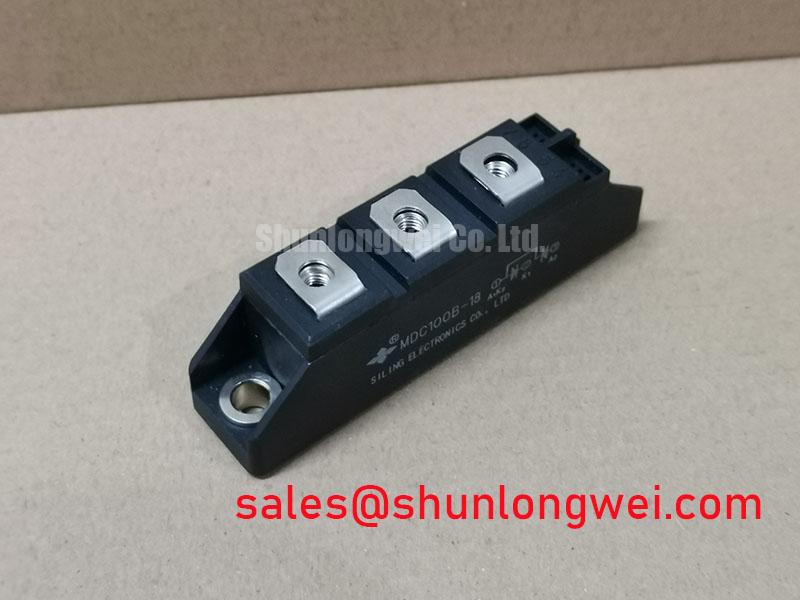
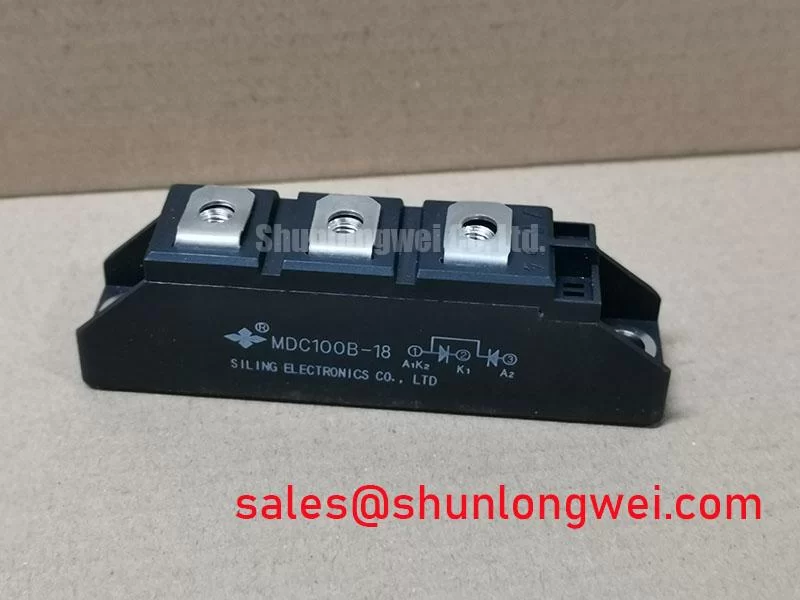
This MDC100B-18 is a half-bridge thyristor/diode module engineered for high-reliability AC-to-DC power conversion. Its core value proposition lies in combining a high blocking voltage of 1800V with a robust 100A current rating and a dielectrically isolated mounting base, facilitating simplified and safe thermal management in industrial power systems. This component is specifically structured for controlled rectification and AC power control applications.
* **Core Specifications**: 1800V VDRM/VRRM | 100A IT(AV) | 2500V Isolation
* **Key Advantages**: Simplifies heatsink mounting with an isolated baseplate; glass passivated die enhances operational stability.
* **Application Focus**: Well-suited for power stages in battery chargers, DC motor drives, and industrial power supplies.
Download Official Datasheet (PDF)
Technical Analysis
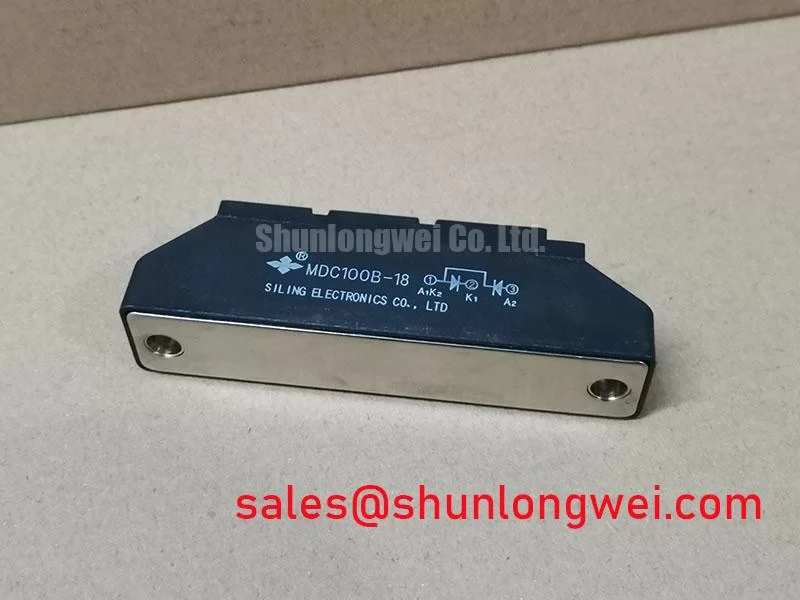
The engineering value of the MDC100B-18 is rooted in its electrical robustness and thermal efficiency. The module specifies a repetitive peak off-state and reverse voltage (VDRM/VRRM) of 1800V, providing a substantial safety margin for systems operating on high-voltage AC mains. This high voltage rating, combined with a 2500V RMS isolation voltage between the terminals and the baseplate, allows for direct mounting to a grounded chassis or heatsink without requiring additional costly and complex insulating layers. This construction detail, as outlined in the datasheet, directly contributes to system reliability by minimizing thermal interfaces and potential points of failure.
Effective thermal management is critical for power semiconductor longevity. The MDC100B-18 features a thermal resistance from junction to case (Rth(j-c)) of 0.28°C/W for each internal device. This parameter can be thought of like the width of a pipe for heat flow; a lower value indicates a wider, less restrictive path for heat to escape from the active silicon die to the module’s baseplate. This efficient heat transfer capability is fundamental to maintaining the junction temperature within its maximum operating limit of 125°C, ensuring stable performance under continuous load.

Optimized Application Scenarios
The specifications of this module make it a strong candidate for several power control and conversion tasks:
- Industrial Battery Chargers: The 1800V rating and 100A current capacity are well-suited for the controlled rectifier front-end of high-power battery charging systems.
- DC Motor Drives: Provides reliable phase-controlled rectification to generate the variable DC voltage needed for controlling the speed and torque of DC motors.
- AC Power Controllers: In an anti-parallel configuration, the thyristor can be used for AC voltage regulation in applications like industrial heating or lighting control.
- Welding Power Supplies: The module’s high surge current rating (ITSM) of 2100A ensures it can withstand the inrush currents and load transients typical in welding applications.
This module is an excellent fit for systems requiring robust AC-to-DC rectification from high-voltage mains up to a 100A continuous load.
Key Specifications of the MDC100B-18
| Parameter | Value | Conditions |
|---|---|---|
| Absolute Maximum Ratings | ||
| Repetitive Peak Reverse/Off-State Voltage (VRRM/VDRM) | 1800 V | Tj = -40 to 125°C |
| Average On-State Current (IT(AV)) | 100 A | Tc = 85°C, 180° Conduction |
| Peak Surge Current (ITSM/IFSM) | 2100 A | 10 ms, Half Sine Wave |
| Electrical & Thermal Characteristics | ||
| Peak On-State Voltage (VTM/VFM) | 1.65 V (Max) | IT = 314 A, Tj = 125°C |
| Gate Trigger Current (IGT) | 150 mA (Max) | Tj = 25°C |
| Thermal Resistance, Junction-to-Case (Rth(j-c)) | 0.28 °C/W | Per Device |
| Isolation Voltage (VISO) | 2500 VRMS | 50/60 Hz, 1 minute |
Engineer’s FAQ
1. What is the recommended mounting procedure for this module?
To ensure optimal thermal contact, the heatsink mounting surface should be flat to within 0.05mm. Apply a thin, uniform layer of thermal grease before mounting. The datasheet specifies a mounting torque of 4.0 N·m (±15%) for the M6 mounting screws. Uneven or excessive torque can compromise thermal performance and module integrity.
2. What are the primary considerations for selecting a heatsink for the MDC100B-18?
Heatsink selection depends on the expected power dissipation and maximum ambient temperature. First, calculate the total power loss (conduction and switching losses). Then, use the module’s thermal resistance (Rth(j-c) = 0.28 °C/W), the thermal resistance of the interface material, and the maximum allowable junction temperature (125°C) to determine the required maximum thermal resistance of the heatsink (Rth(c-a)) to maintain safe operation.
3. What does the ‘Glass Passivated’ feature mean for reliability?
Glass passivation involves applying a layer of glass over the silicon die’s junction. This provides a hermetic seal that protects the junction from moisture and contaminants, significantly improving long-term stability and reliability, especially at high operating voltages and temperatures. Explore more about how materials impact the reliability of power semiconductors.
4. Can this module be used for single-phase or three-phase rectification?
Yes. The MDC100B-18’s half-bridge (thyristor and diode) configuration is highly versatile. A single module can be used as a half-controlled single-phase bridge. For full-controlled single-phase applications, two modules would be needed. For three-phase applications, three modules can be configured to create a half-controlled six-pulse bridge rectifier.
The MDC100B-18 thyristor/diode module provides a durable and electrically robust component for power system engineers. Its integration of high voltage and current ratings with an isolated baseplate enables the development of simplified, reliable, and thermally efficient high-power control and conversion circuits.