SKM200GB176D: A Technical Review of a High-Power 1700V IGBT Module
“`html
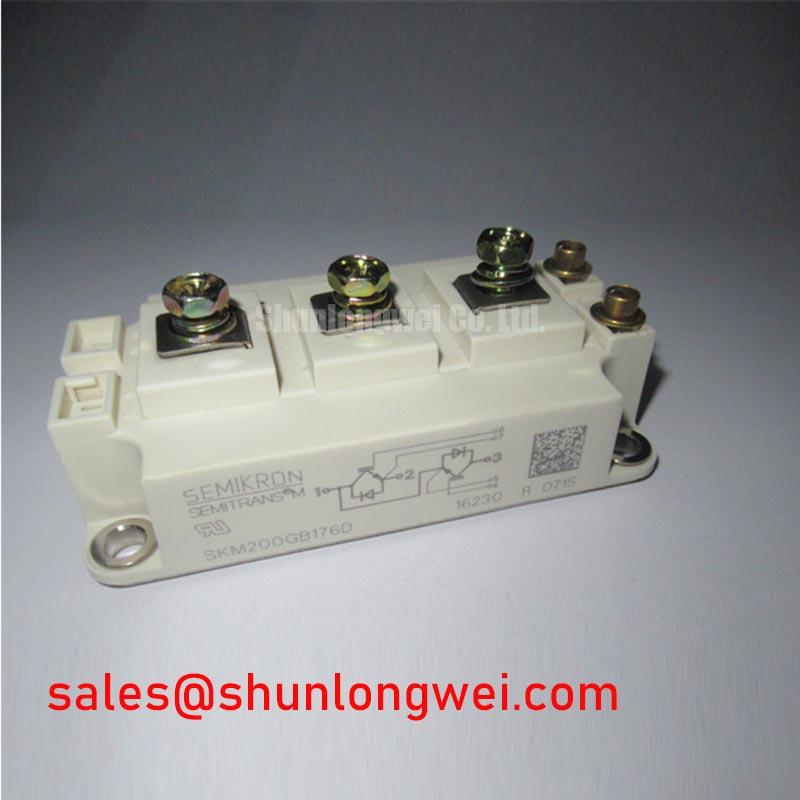
SKM200GB176D | Semikron 1700V 200A IGBT Module
Introduction to the SKM200GB176D IGBT Module
The Semikron SKM200GB176D is a high-power SEMITRANS 2 IGBT module that provides a robust and efficient solution for 1700V power conversion systems. Its core value proposition is the integration of advanced Trench Gate IGBT technology with a CAL (Controlled Axial Lifetime) freewheeling diode. This combination delivers optimized electrical performance and switching characteristics for demanding high-voltage applications. This module’s architecture enables engineers to achieve lower system losses and enhanced reliability.
- Core Specifications: 1700V | 200A | VCE(sat) 2.45V (typ. @ 125°C)
- Key Advantages: Reduced conduction losses due to Trench IGBTs, soft switching characteristics minimizing EMI.
For complete electrical and thermal specifications, refer to the official manufacturer’s documentation. Download the official SKM200GB176D Datasheet (PDF).


Technical Analysis Based on Datasheet Metrics
A key performance indicator for an IGBT module is its collector-emitter saturation voltage, VCE(sat). The SKM200GB176D leverages Trench Gate technology, which creates a more efficient path for current flow when the device is active. This results in a typical VCE(sat) of 2.45V at its nominal current and a junction temperature of 125°C. You can think of VCE(sat) as the price of admission for current; a lower value directly translates to lower conduction losses. This reduction in wasted energy as heat simplifies thermal management and can potentially reduce heatsink size and cost.
Complementing the efficient IGBTs is an inverse parallel CAL (Controlled Axial Lifetime) freewheeling diode. In hard-switched applications, the recovery behavior of the freewheeling diode is critical. The CAL diode is engineered for a “soft” recovery, meaning it turns off smoothly with a low peak reverse recovery current (IRRM). This characteristic significantly reduces voltage overshoots and high-frequency electromagnetic interference (EMI). For engineers, this means less reliance on external snubber circuits and a more straightforward path to achieving system-level EMC compliance.
The module’s construction provides robust electrical isolation, specified at 4000V (VISOL) for 1 minute. This is achieved using an Aluminum Oxide (Al2O3) substrate between the power semiconductors and the baseplate. This high dielectric strength ensures dependable separation between the high-voltage circuit and the earthed heatsink, a fundamental safety and reliability requirement in industrial power systems. Further details on silicone gel’s role in insulation can provide additional context.
Optimized Application Scenarios
The specifications of the SKM200GB176D make it well-suited for several high-power applications:
- Industrial Motor Drives: The 1700V blocking voltage offers a significant safety margin for drives operating on 690V AC mains, while its low VCE(sat) enhances overall drive efficiency.
- Solar and Wind Power Inverters: In renewable energy systems, high DC-link voltages are common. The module’s voltage rating and robust thermal cycling capability are advantageous for handling fluctuating power generation.
- Uninterruptible Power Supplies (UPS): The high current rating of 200A and efficient switching performance ensure reliable power delivery and minimize energy loss in critical backup systems.
- Welding Equipment: The module’s ability to handle high currents and its robust thermal design are beneficial for the demanding load cycles found in industrial welding power supplies.
This module is best matched for high-voltage inverter designs where minimizing conduction losses and ensuring robust, reliable operation are primary engineering goals.
Key Specifications of the SKM200GB176D
| Parameter | Value | |
|---|---|---|
| Absolute Maximum Ratings (per IGBT) | ||
| Collector-Emitter Voltage (VCES) | 1700 V | |
| Continuous DC Collector Current (IC) @ Tc = 80°C | 200 A | |
| Repetitive Peak Collector Current (ICRM) | 400 A | |
| Gate-Emitter Voltage (VGES) | ±20 V | |
| Electrical Characteristics (Tj = 25 °C unless otherwise noted) | ||
| Collector-Emitter Saturation Voltage (VCE(sat)) @ IC = 200A, VGE = 15V | 2.15 V (typ.), 2.65 V (max.) | |
| Gate Threshold Voltage (VGE(th)) | 5.8 V (typ.) | |
| Diode Forward Voltage (VF) @ IF = 200A, VGE = 0V | 2.1 V (typ.), 2.6 V (max.) | |
| Thermal and Mechanical Characteristics | ||
| Thermal Resistance, Junction to Case (Rth(j-c)) per IGBT | 0.12 °C/W (max.) | |
| Operating Junction Temperature (Tj) | -40 to +150 °C | |
| Isolation Test Voltage (VISOL) | 4000 V (AC, 1 min.) | |
Engineer’s FAQ for the SKM200GB176D
1. How does the thermal resistance (Rth(j-c)) impact heatsink selection for this module?
The maximum thermal resistance from junction to case (Rth(j-c)) is specified as 0.12 °C/W for each IGBT and 0.22 °C/W for each diode. To select a heatsink, you must first calculate the total power loss (conduction + switching). Then, use this Rth value to determine the case temperature. The heatsink’s thermal resistance must be low enough to keep the module’s case temperature, and thus its junction temperature, below the maximum limit of 150°C under worst-case operating conditions. A detailed guide on power and thermal cycling can be helpful.
2. What is the recommended mounting torque for the electrical terminals?
The datasheet specifies a mounting torque of 5 Nm (with a tolerance of ±15%) for the M6 main terminals. Adhering to this specification is critical. Insufficient torque can lead to high contact resistance, causing overheating at the terminal. Excessive torque can cause mechanical stress on the module’s internal structure, potentially leading to long-term reliability issues or damage. Always use a calibrated torque wrench for installation.
3. What is the primary advantage of the CAL freewheeling diode technology used in the SKM200GB176D?
The CAL (Controlled Axial Lifetime) diode is engineered for a soft recovery characteristic. This means it has a lower tendency to cause high-frequency ringing and voltage overshoots when it turns off. This “softer” behavior reduces electromagnetic interference (EMI), which can simplify system design, reduce the need for bulky filtering components, and help meet regulatory EMC standards.
Enabling Robust High-Voltage Designs
The SKM200GB176D module offers a well-balanced set of parameters for engineers developing high-power industrial systems. By combining a 1700V rating with efficient Trench Gate IGBTs and soft-recovery CAL diodes, this SEMITRANS 2 module provides a reliable foundation for building power conversion stages that minimize thermal load and electromagnetic emissions.
“`