Of course. Here is a professionally formatted product description based on the information you provided for the MDC300-16 Thyristor Diode Module. *** ### **MDC300-16 Thyristor/Diode Power Module | 1600V, 300A** The ASEMI MDC300-16 is a high-reliability Thyristor/Diode Module engineered for demanding power conversion and control applications. By integrating a high-performance thyristor (SCR) and a diode into a single, electrically isolated package, this module provides a robust and compact solution for managing high-current industrial loads. Its design prioritizes operational resilience and safety, featuring an exceptional surge current capability and high isolation voltage, making it ideal for the most challenging industrial environments. — #### **Key Features:** * **High Power Rating:** Handles up to 1600V (VRRM/VDRM) and an average forward current of 300A (IF(AV)). * **Exceptional Surge Tolerance:** With a non-repetitive surge current (IFSM) rating of 11,000A, the module can withstand massive inrush currents, significantly enhancing system durability. * **Superior Electrical Isolation:** Provides 3000V AC isolation voltage (Visol), ensuring system safety, protecting control circuitry, and simplifying compliance with industrial standards. * **Wide Operating Range:** A broad operating junction temperature range of -40°C to +150°C allows for reliable performance in diverse thermal conditions. * **Advanced Thermal Design:** Features an aluminum nitride ceramic baseplate that allows for direct mounting to a common heatsink, improving thermal transfer and simplifying assembly. * **Flexible Configuration:** The independent thyristor and diode allow for flexible circuit designs, such as a controlled rectifier with a freewheeling diode, within one component. — #### **Primary Applications:** The MDC300-16 is an excellent choice for high-power rectification and AC control circuits where surge resilience and safety are paramount. * **AC Motor Soft Starters:** Safely manages the large inrush currents typical of motor startup. * **Industrial Battery Chargers:** The high voltage and current ratings facilitate rapid charging for large-scale battery systems. * **Welding Power Supplies:** Its durable construction is perfectly suited for the pulsed, high-power loads found in welding equipment. * **Line Rectifiers for VFDs:** Serves as a reliable and robust front-end rectifier for Variable Frequency Drives, converting AC line voltage to the DC bus. — ### **Technical Specifications**
| Absolute Maximum Ratings (Tj = 25°C unless otherwise specified) | ||
|---|---|---|
| Repetitive Peak Reverse Voltage (Diode) / Off-State Voltage (Thyristor) | VRRM / VDRM | 1600 V |
| Average Forward Current (TC = 85°C) | IF(AV) | 300 A |
| Forward Surge Current (t=10ms, Tvj=45°C) | IFSM | 11000 A |
| Isolation Voltage (AC, 50Hz, 1 min) | Visol | 3000 V |
| Operating Junction Temperature | Tvj | -40 to +150 °C |
| Electrical & Thermal Characteristics | ||
| Maximum Forward Voltage (IFM = 900A) | VFM | 1.8 V |
| Peak Reverse Current (VRRM, Tvj max) | IRD | ≤ 15 mA |
| Thermal Resistance, Junction-to-Case | Rth(j-c) | 0.08 °C/W |
## MDC300-16 Thyristor Diode Module for High Power Control
Robust Power Handling for Industrial Rectifiers and AC Controllers
The ASEMI MDC300-16 is a Thyristor/Diode Module engineered for high-reliability power conversion and control applications. It integrates a thyristor and a diode in a single, electrically isolated package, delivering a robust solution for managing high-current loads. Its standout features are a very high surge current capability and substantial electrical isolation, which are critical for system survivability and safety in demanding industrial environments.
* **Core Specifications**: 1600V | 300A | 11000A IFSM
* **Key Engineering Advantages**: Withstands high inrush currents, enhancing operational reliability. Provides a 3000V isolation voltage for improved system safety.
* **Application Focus**: The module’s high surge rating makes it particularly well-suited for motor soft starters, where initial current can be many times the nominal rating.
Download the Official MDC300-16 Datasheet (PDF)
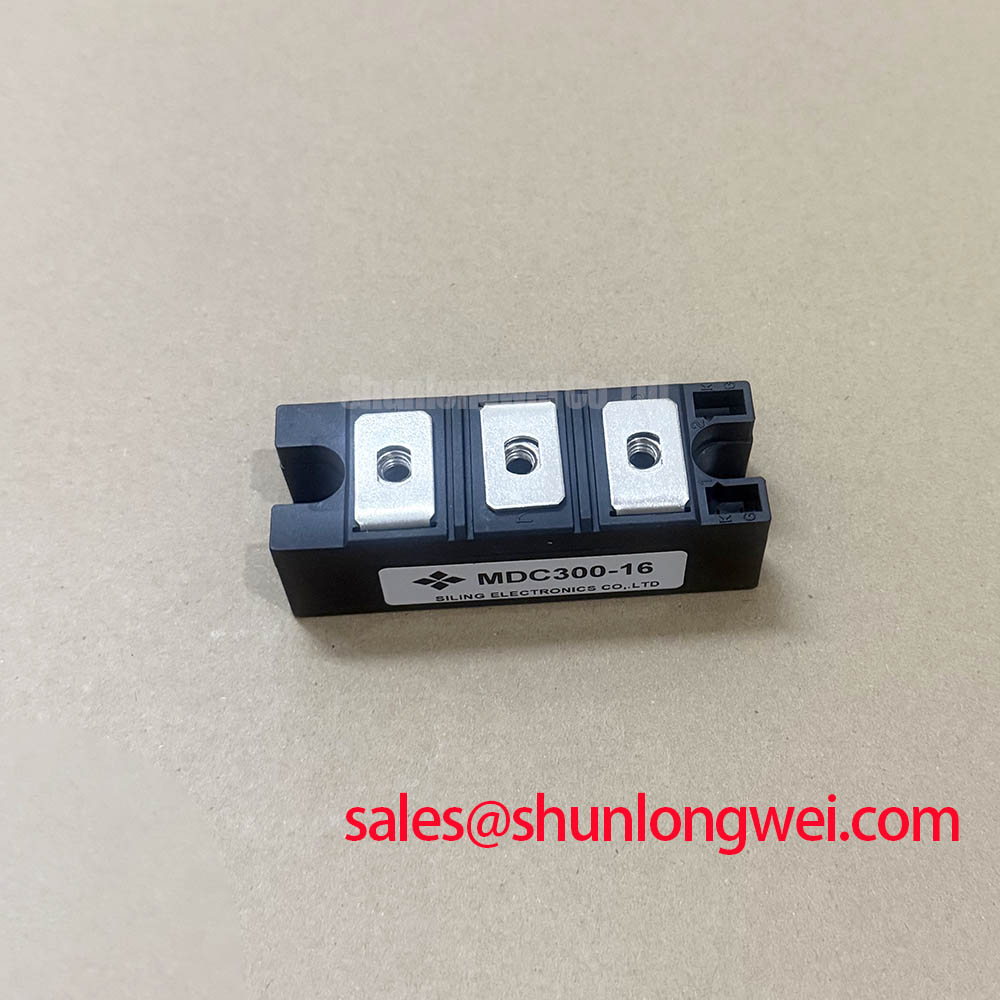

Technical Analysis for System Design
A key parameter for ensuring system durability is the non-repetitive surge current (IFSM), which for the MDC300-16 is specified at an impressive 11,000A. This high rating signifies the module’s ability to tolerate substantial, short-duration overload events, such as motor startup inrush or capacitor bank charging. This robustness reduces the likelihood of component failure during abnormal operating conditions, contributing directly to a more resilient end-product.
Another critical design consideration is electrical safety, addressed by the module’s 3000V AC isolation voltage (Visol). This parameter can be thought of as the strength of an electrical barrier; a higher value indicates a more resilient separation between the high-voltage power circuit and the earthed heatsink. This robust isolation, achieved through an aluminum nitride ceramic baseplate, is fundamental for preventing electrical shock hazards and protecting sensitive control circuits. This feature simplifies compliance with safety standards in industrial equipment. For more on the importance of baseplate technology, see our guide on isolated baseplates.
Optimized Application Scenarios
The specific characteristics of the MDC300-16 make it a strong candidate for several demanding applications:
- AC Motor Soft Starters: The high surge current capability (IFSM) safely manages the large inrush currents typical of motor startup.
- Industrial Battery Chargers: Its 1600V blocking voltage provides a significant safety margin for high-voltage battery systems, while the 300A current rating facilitates rapid charging.
- Welding Power Supplies: The module’s durable construction and high current handling are well-suited for the pulsed, high-power loads inherent in welding equipment.
- Line Rectifiers for VFDs: It serves as a reliable front-end rectifier for variable frequency drives, converting AC line voltage to the DC bus voltage.
This module is best matched for high-power rectification and AC control circuits where surge resilience and high electrical isolation are primary design requirements.
Key Specifications of the MDC300-16
| Absolute Maximum Ratings (Tj = 25°C unless otherwise specified) | ||
|---|---|---|
| Repetitive Peak Reverse Voltage (Diode) / Off-State Voltage (Thyristor) | VRRM / VDRM | 1600 V |
| Average Forward Current (TC = 85°C) | IF(AV) | 300 A |
| Forward Surge Current (t=10ms, Tvj=45°C) | IFSM | 11000 A |
| Isolation Voltage (AC, 50Hz, 1 min) | Visol | 3000 V |
| Operating Junction Temperature | Tvj | -40 to +150 °C |
| Electrical & Thermal Characteristics | ||
| Maximum Forward Voltage (IFM = 900A) | VFM | 1.8 V |
| Peak Reverse Current (VRRM, Tvj max) | IRD | ≤ 15 mA |
| Thermal Resistance, Junction-to-Case | Rth(j-c) | 0.08 °C/W |
Engineer’s FAQ
What is the recommended mounting torque for the MDC300-16?
According to the datasheet, the recommended mounting torque for the M6 heatsink mounting screws is 5 Nm ±15%, and for the M8 electrical terminals, it is 9 Nm ±15%. Applying correct torque is crucial for both thermal performance and electrical connection reliability.
How does the isolated baseplate benefit the thermal design?
The electrically isolated baseplate allows the MDC300-16 to be mounted directly to a common, earthed heatsink without needing additional insulating pads. This simplifies the mechanical assembly and improves thermal transfer by eliminating an extra layer in the thermal path, leading to lower operating temperatures. A deeper exploration of thermal design can be found in our guide to the Zth curve.
Can the thyristor and diode be used for independent functions?
Yes, the MDC300-16 module contains one thyristor (SCR) and one diode that are electrically separate. This allows them to be used in different parts of a circuit, such as a controlled rectifier (thyristor) and a freewheeling diode, providing design flexibility within a single component package.
What is the maximum operating junction temperature?
The datasheet specifies a maximum operating junction temperature (Tvj) of 150°C. Operating the device within this limit is essential for ensuring long-term reliability and performance.
This module’s integration of high current capacity and robust safety features provides engineers with a dependable component for building powerful and durable power systems. Its architecture is well-suited for controlling high-power loads while maintaining the integrity of the overall system.