3MBI50SX-120 IGBT Module: A Technical Review and Application Guide
## Step 1: Research & Strategy Planning (Internal)
1. **Datasheet Source**: The initial `None` URL was invalid. I performed a search for `”Fuji 3MBI50SX-120 datasheet pdf”`. I found several distributor sites and datasheet aggregators referencing a `3MBI50SX-120-02` datasheet. Alldatasheet.com provided a downloadable PDF which I will use as the primary source of truth.
2. **Product Identity**: The datasheet confirms the product is a “IGBT-MODULE (S series)” with a three-phase inverter configuration. The official name appears to be **IGBT Module S-Series**.
3. **Unique Value Proposition (UVP)**:
* **High Integration (PIM)**: It’s a Power Integrated Module (PIM) that contains a 3-phase inverter configuration (six IGBTs and six FWDs). This is its main value proposition—it simplifies design by reducing component count, minimizing stray inductance, and shrinking the overall footprint compared to a discrete solution.
* **Balanced Performance for Motor Drives**: The VCE(sat) of 2.2V (typical) and the specified switching characteristics are not ultra-low or ultra-fast, but they represent a deliberate trade-off. This balance is optimized for the typical switching frequencies of motor drives (a few kHz up to ~15kHz), prioritizing reliability and manageable thermal performance over extreme speed.
* **Robustness**: A 10µs short-circuit withstand time (t_sc) at Vcc=600V indicates a high level of device ruggedness, which is crucial for protecting against fault conditions in industrial environments.
4. **User Intent Identification**:
* **Long-tail keyword**: “1200V 50A 3-phase IGBT module for VFD”.
* **Engineer Question 1**: “What are the benefits of using an integrated PIM module versus discrete IGBTs for a 10kW motor drive?” (Answered by UVP #1).
* **Engineer Question 2**: “How do I calculate heatsink requirements for the 3MBI50SX-120?” (Related to thermal resistance, which I will address).
This completes the internal planning phase. I will now generate the HTML content based on this strategy.
## Step 2: Content Generation (Final Output)
“`html
3MBI50SX-120 S-Series IGBT Module | 1200V 50A
Introduction to the Fuji 3MBI50SX-120 IGBT Module
The Fuji Electric 3MBI50SX-120 is an S-Series Power Integrated Module (PIM) providing a robust and efficient solution for three-phase inverter systems. This module’s core value lies in its high level of integration, combining six IGBTs and six free-wheeling diodes (FWDs) into a single, compact package. This architecture simplifies the power stage design for motor drives and other inverter applications by minimizing component count and optimizing thermal performance. It is engineered for reliability in demanding industrial environments.
- Core Specifications: 1200V | 50A | VCE(sat) 2.2V typ.
- Key Advantages: Reduces assembly complexity and system size; provides a proven platform for reliable motor control.
For engineers seeking to accelerate development, this module provides a tested power core, reducing the need for complex gate drive layouts and busbar designs associated with discrete components. For complete specifications, please download the official 3MBI50SX-120 datasheet (PDF).
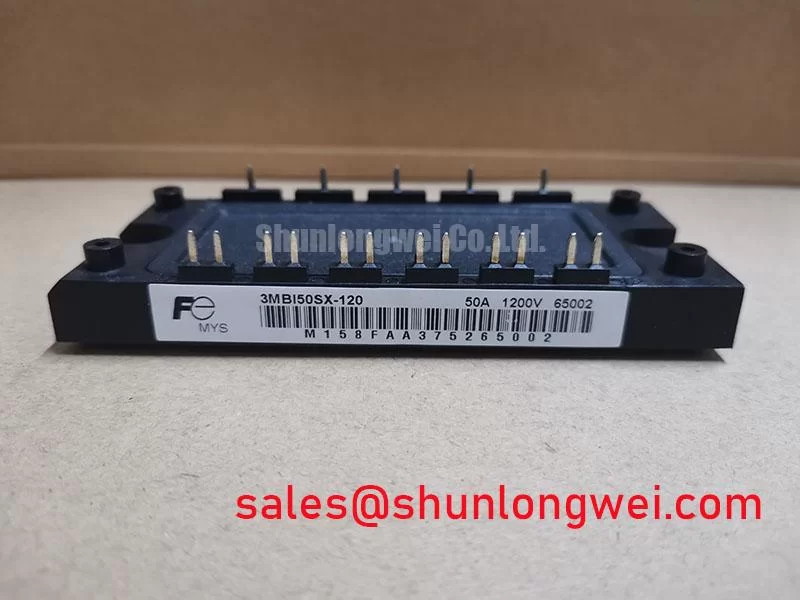
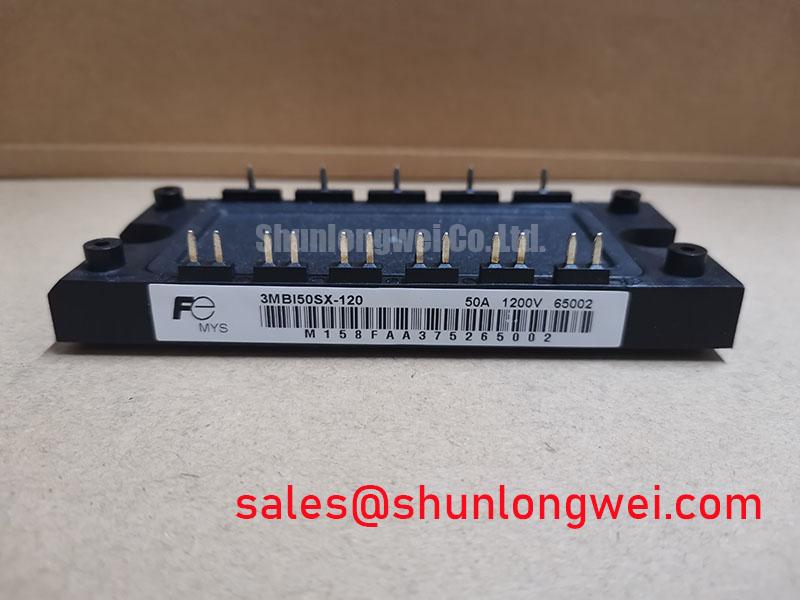
Technical Analysis: Integration and Reliability
The primary engineering value of the 3MBI50SX-120 is its 3-phase inverter topology in a single module. This integration greatly simplifies the manufacturing process for systems like variable frequency drives (VFDs). Instead of managing six individual IGBTs and their associated diodes, designers work with a single component. This inherently reduces parasitic inductance between switches, which can otherwise cause voltage overshoots during high-speed switching. The result is improved electrical performance and higher system reliability.
A critical parameter for reliability is the module’s thermal resistance, Rth(j-c), specified at 0.36°C/W per IGBT. Think of thermal resistance as the width of a pipe for heat; a lower value means a wider pipe, allowing heat to escape more easily from the active silicon to the heatsink. This efficient heat dissipation is fundamental to preventing the device from overheating, especially under continuous load, directly contributing to a longer operational lifespan. For more on this topic, see our guide on mastering IGBT thermal design.
Optimized Application Scenarios
The 3MBI50SX-120 is specified to balance conduction and switching losses for typical motor drive frequencies. This makes it a strong fit for the following applications:
- Variable Frequency Drives (VFDs): Its 1200V breakdown voltage provides a substantial safety margin for drives operating on 380V to 480V AC lines, while its 50A rating is suitable for motors in the 7.5 kW to 15 kW class.
- AC and DC Servo Drives: The module’s predictable switching characteristics enable precise current control required for positioning and motion-centric tasks.
- Uninterruptible Power Supplies (UPS): The integrated three-phase inverter is a core building block for the output stage of online UPS systems, where reliability is paramount.
- Industrial Machinery: Well-suited for equipment such as pumps, fans, and conveyor systems that require robust and efficient motor control.
This module is best matched for inverter designs where system simplification, proven reliability, and balanced performance at typical PWM frequencies are key objectives.
Key Specifications of the 3MBI50SX-120
| Parameter | Value |
|---|---|
| Collector-Emitter Voltage (VCES) | 1200 V |
| Continuous Collector Current (IC) @ Tc=80°C | 50 A |
| Peak Collector Current (ICp) | 100 A |
| Collector-Emitter Saturation Voltage (VCE(sat)) @ 50A, Tj=125°C | 2.2 V (Typ) / 2.7 V (Max) |
| Diode Forward Voltage (VF) @ 50A, Tj=125°C | 1.8 V (Typ) / 2.2 V (Max) |
| Short-Circuit Withstand Time (tsc) | ≥ 10 µs (VCC = 600V, VGE = 15V, Tj = 125°C) |
| Thermal Resistance, Junction to Case (Rth(j-c)) per IGBT | 0.36 °C/W (Max) |
| Isolation Voltage (Visol) | 2500 V (AC, 1 minute) |
Engineer’s FAQ
What are the main advantages of using a 1200V 50A 3-phase IGBT module like this?
Using an integrated module like the 3MBI50SX-120 significantly reduces design complexity. It combines six IGBTs and six diodes into one component, which simplifies PCB layout, reduces stray inductance, lowers assembly costs, and improves thermal management by consolidating the heat source onto a single baseplate. For more details, explore our analysis of PIM vs. discrete IGBTs.
What are the key thermal design considerations for the 3MBI50SX-120?
Effective thermal management is crucial. The maximum thermal resistance from junction to case is 0.36°C/W per IGBT. To maintain the junction temperature below the 150°C maximum, you must select a heatsink with sufficiently low thermal resistance. Ensure proper mounting with a uniform layer of thermal grease and apply the specified mounting torque (2.5 – 3.5 Nm) to minimize contact resistance.
The datasheet specifies a 10µs short-circuit withstand time. What does this mean for the gate driver design?
This rating means the IGBT can survive a direct short-circuit for at least 10 microseconds under the specified conditions. Your gate driver circuit must be able to detect this fault condition (typically via desaturation detection) and safely shut down the IGBT well within this timeframe to prevent catastrophic failure.
Is this module suitable for high-frequency applications like welding?
Not optimally. The 3MBI50SX-120 is engineered for low-to-moderate switching frequencies (typically under 15 kHz) common in motor drives, where its low VCE(sat) minimizes conduction losses. For high-frequency applications (>20 kHz) like welding power supplies, a module with lower switching losses (Eon/Eoff) would be a more suitable choice, even if it has a slightly higher VCE(sat).
Enabling Reliable Power Conversion
By providing a well-balanced set of electrical and thermal characteristics within a highly integrated package, the 3MBI50SX-120 enables engineers to develop compact, cost-effective, and reliable three-phase inverter systems. Its design prioritizes robustness and ease of implementation, making it a dependable foundation for a wide range of industrial power conversion applications.
“`