Semikron SKiiP 11NAB12T4V1 MiniSKiiP 1 CIB IGBT Module: Technical Overview and Application Guide
Semikron SKiiP 11NAB12T4V1 MiniSKiiP 1 CIB IGBT Module
Authoritative Overview of the SKiiP 11NAB12T4V1 Power Module
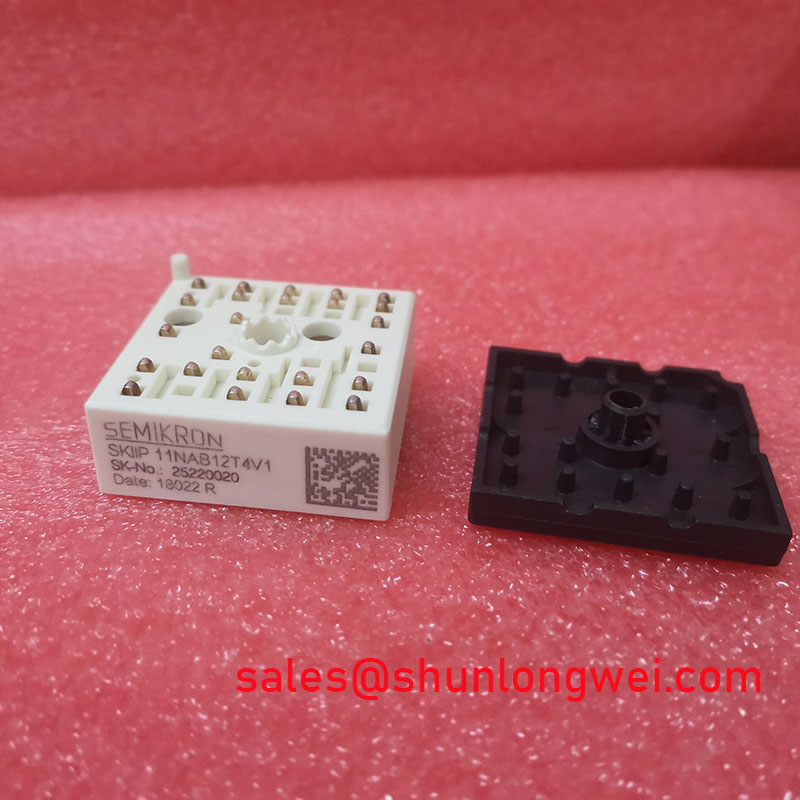
The Semikron SKiiP 11NAB12T4V1 is a high-integration Power Integrated Module (PIM) utilizing the MiniSKiiP® 1 housing. This specific variant adopts the Converter-Inverter-Brake (CIB) topology, combining a three-phase uncontrolled bridge rectifier, a three-phase inverter using Trench IGBT 4 technology, and an integrated brake chopper. By leveraging solder-free spring contact technology, this module provides superior mechanical reliability and simplifies the assembly process for designers focusing on compact power semiconductors and industrial drives.
- Core Specifications: 1200V | 11A (Inverter) | VCE(sat) 1.85V
- Key Advantages: Enhanced thermal cycling via spring contacts; minimized switching losses through Trench 4 architecture.
- Design Efficiency: Engineers frequently ask how to eliminate solder fatigue in high-vibration environments; the SKiiP 11NAB12T4V1 addresses this by using pressure-based contact points instead of rigid solder joints.
Download Official Datasheet (PDF)
M3: Technical Analysis of Trench IGBT4 and Pressure Contact Technology
The performance of the SKiiP 11NAB12T4V1 is rooted in the synergy between its silicon and its interconnect technology. The inclusion of Trench IGBT 4 chips allows for a typical saturation voltage ($V_{CE(sat)}$) of just 1.85V at rated current. This low conduction loss is critical for reducing the total dissipated energy during high-duty-cycle operation. Furthermore, the maximum junction temperature ($T_{jmax}$) of 175°C provides an extended safety buffer during transient overload conditions, ensuring the module remains within its Safe Operating Area (SOA).
A distinguishing feature of the MiniSKiiP® 1 series is its solder-free construction. Instead of traditional soldered pins, the SKiiP 11NAB12T4V1 utilizes spring contacts to interface the power chips with the printed circuit board (PCB). You can imagine these spring contacts as a high-performance vehicle suspension system; while a rigid weld might crack under the repeated stress of vibration and thermal expansion, the springs maintain constant, reliable electrical contact through flexibility. This architecture significantly reduces the risk of wire-bond lift-off or solder joint failure over the system’s life cycle.
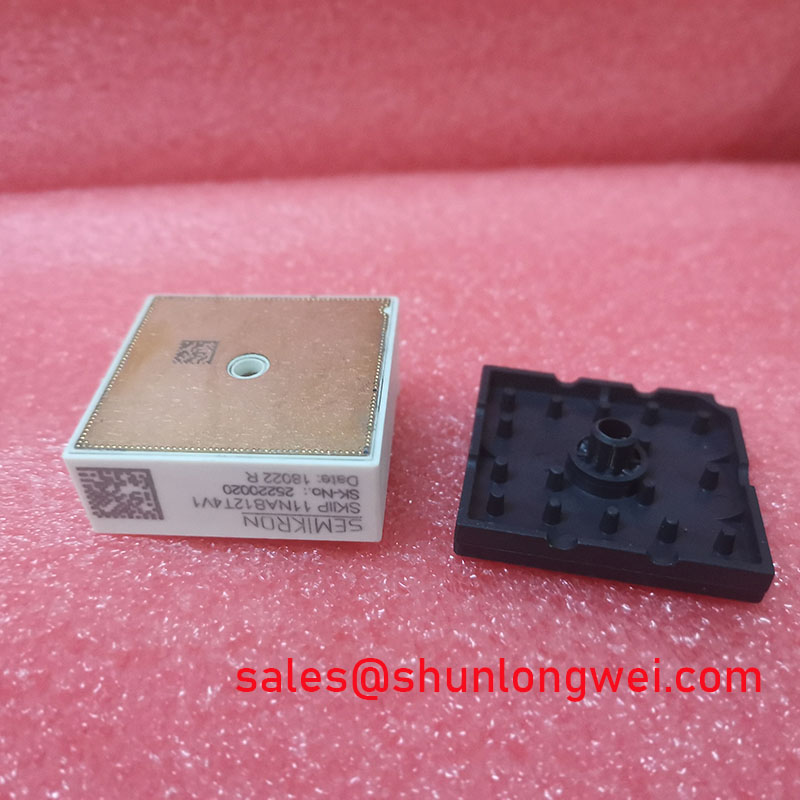
Thermal management is further optimized by the thin ceramic substrate, which ensures a low thermal resistance from junction to heatsink ($R_{th(j-s)}$). When compared to traditional welded modules, the pressure contact system allows for more uniform pressure distribution across the heatsink interface. This uniformity minimizes hotspots and allows for a more compact cooling solution without compromising the 1200V dielectric insulation capability.
M4: Optimized Application Scenarios
- Small Motor Drives (VFD): The integrated CIB topology allows for a full 3-phase motor controller within a minimal footprint, ideal for space-constrained industrial enclosures.
- Servo Drive Systems: High-speed Trench 4 switching combined with the integrated NTC temperature sensor provides the precision and safety monitoring required for dynamic motion control.
- Solar Inverter Sub-stages: The 1200V rating and low $V_{CE(sat)}$ make this module suitable for auxiliary power conversion units within renewable energy systems.
- Braking Control: The dedicated integrated brake chopper simplifies the management of regenerative energy in decentralized drive systems.

Best Match Conclusion: High-reliability MiniSKiiP® 1 architecture delivering 1200V performance in a solder-free package for decentralized motor control applications requiring maximum power density.
M5: Key Specification Parameters
| Parameter Group | Specification | Value (Max/Typ) |
|---|---|---|
| Inverter (IGBT) | Collector-Emitter Voltage ($V_{CES}$) | 1200 V |
| Inverter (IGBT) | Continuous Collector Current ($I_C$ @ $T_s=70^circ C$) | 8 A |
| Inverter (IGBT) | Saturation Voltage ($V_{CE(sat)}$ @ $T_j=25^circ C$) | 1.85 V |
| Rectifier (Diode) | Reverse Repetitive Peak Voltage ($V_{RRM}$) | 1600 V |
| Rectifier (Diode) | Forward Current ($I_F$ @ $T_s=70^circ C$) | 15 A |
| Module Level | Isolation Voltage ($V_{isol}$ AC 1 min) | 2500 V |
| Integrated Sensor | NTC Resistance ($R_{25}$) | 5 kΩ (±5%) |
M6: Technical FAQ for Design Engineers
Q1: What is the benefit of the Trench IGBT4 chips in the SKiiP 11NAB12T4V1?
A1: The Trench 4 architecture provides a significant reduction in switching losses and a more compact chip size compared to previous generations. This enables higher switching frequencies and improved efficiency in motor drive applications.
Q2: How does the solder-free spring contact technology affect assembly?
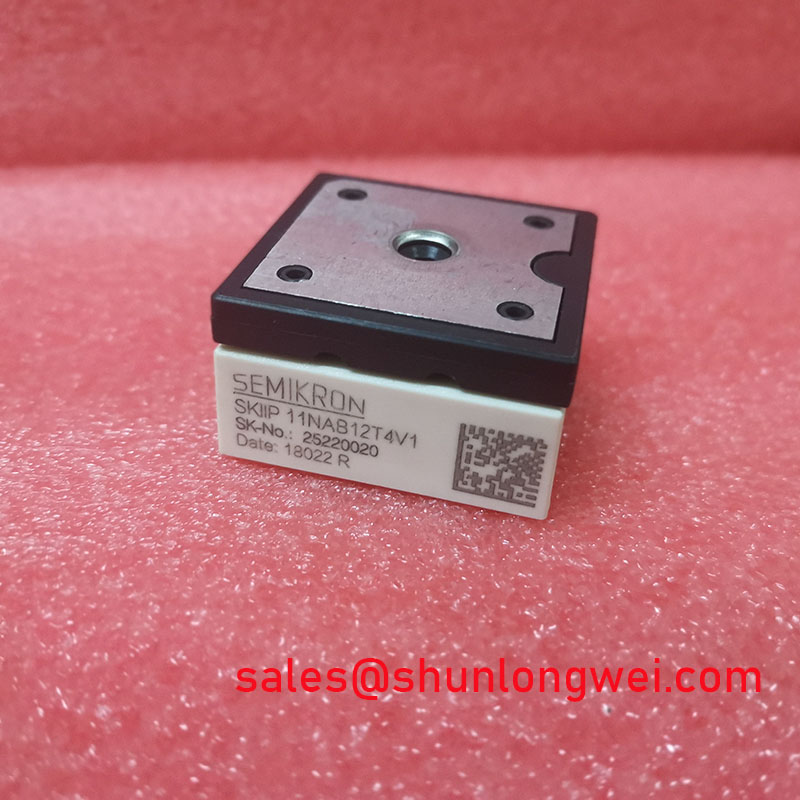
A2: It eliminates the need for wave soldering or manual soldering of the power pins. Assembly is performed by a single screw that provides the necessary pressure to contact the PCB and the heatsink simultaneously, reducing production time and thermal stress on the board.
Q3: Is a specific thermal grease required for the MiniSKiiP® 1?
A3: For optimal performance, Semikron recommends a high-quality thermal interface material (TIM) with a specified layer thickness (typically 20-30 μm). Proper application is essential to maintain the low $R_{th(j-s)}$ specified in the datasheet.
Q4: Can the integrated NTC be used for short-circuit protection?
A4: The integrated NTC is designed for steady-state temperature monitoring and thermal overload protection. For millisecond-level short-circuit protection, engineers should use desaturation detection (Vce sensing) via the gate driver circuit.
M7: Final Engineering Summary
The Semikron SKiiP 11NAB12T4V1 offers a robust and thermally efficient solution for low-to-medium power industrial drive designs. By integrating the entire Converter-Inverter-Brake chain into a single MiniSKiiP® 1 package and utilizing advanced Trench 4 silicon, it maximizes power density while ensuring long-term operational stability through spring contact interconnects. This module enables engineers to achieve compact, reliable, and high-performance drive solutions while simplifying complex power stage assembly.