A Technical Analysis of the FS100R12KT4G_B11 H-Bridge IGBT Module
FS100R12KT4G_B11 1200V 100A IGBT Four-Pack Module
Introduction and Core Highlights
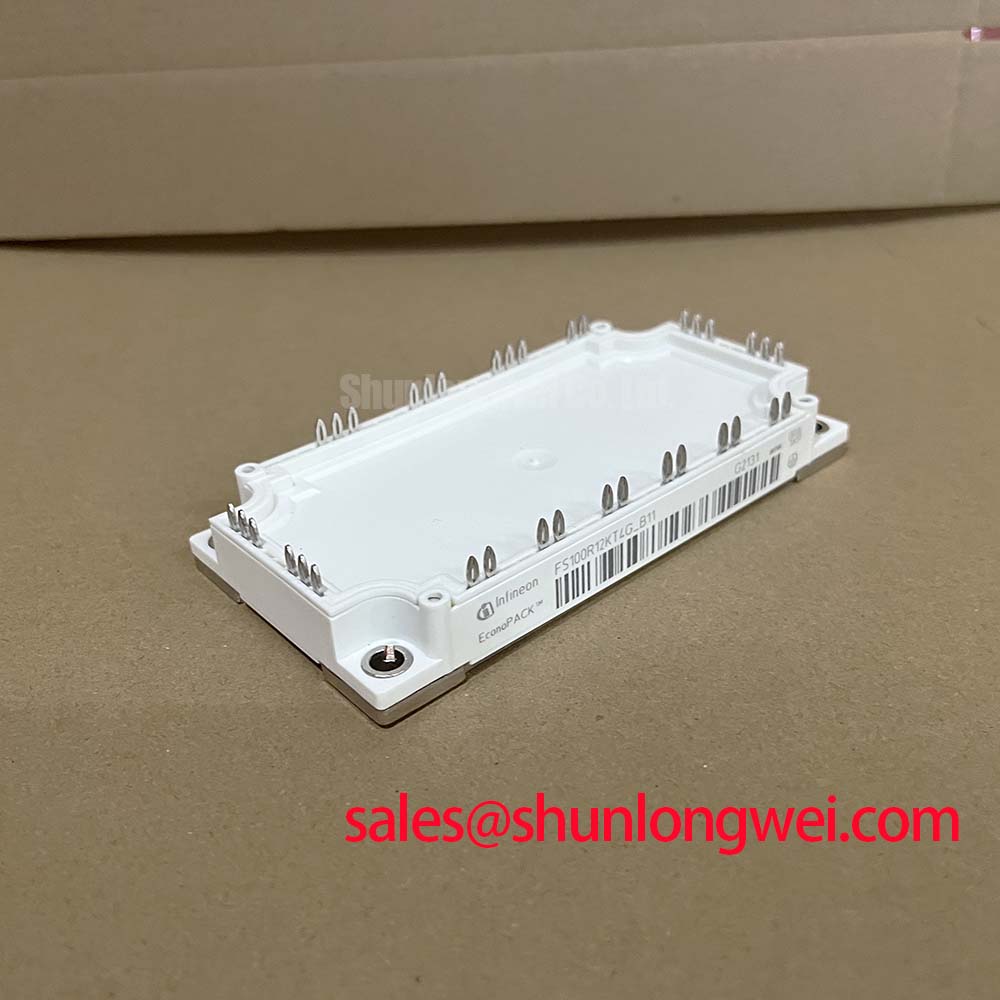
The Infineon FS100R12KT4G_B11 is a power module that integrates a full H-bridge (four-pack) configuration using TRENCHSTOP™ IGBT4 and emitter-controlled diode technology. This single-module solution streamlines the design of compact and efficient power conversion systems by incorporating four IGBTs and four freewheeling diodes. It is particularly well-suited for building single-phase solar inverters and four-quadrant motor drives, reducing both complexity and system size.
- Core Specifications: 1200V | 100A | VCE(sat) (typ.) 1.70V
- Key Advantages: Simplifies inverter topology, reliable solder-free assembly with PressFIT pins.
Download the Official Datasheet (PDF)

Technical Analysis of Engineering Advantages
The primary value of the FS100R12KT4G_B11 lies in its integrated H-bridge topology. By housing a complete single-phase inverter stage in one EconoPACK™ 3 package, it significantly reduces the physical footprint and simplifies the power busbar design compared to using two separate half-bridge modules. This integration leads to lower overall stray inductance, which is a critical factor in minimizing voltage overshoots during high-speed switching and improving system reliability.
Performance is anchored by Infineon’s TRENCHSTOP™ IGBT4 technology, which provides a balanced trade-off between conduction and switching losses. The typical collector-emitter saturation voltage (VCE(sat)) is 1.70V at nominal current (100A, 25°C). You can think of VCE(sat) as the toll an electric current pays to pass through the switch; a lower value means less power is converted into waste heat during the ‘on’ state. This directly translates to higher inverter efficiency and reduced requirements for the cooling system.
For manufacturing and long-term reliability, the module features PressFIT control pins. This technology enables a solder-free assembly process, forming a gas-tight, cold-welded connection to the PCB. It eliminates the thermal stress associated with soldering and improves production throughput. Furthermore, the module includes an integrated NTC thermistor, providing a direct method for junction temperature monitoring, which is essential for implementing effective over-temperature protection.


Optimized Application Scenarios
- Motor Drives: The integrated H-bridge is ideal for four-quadrant DC motor controllers and single-phase AC servo drives, enabling precise control over motor speed and direction with a simplified power stage.
- Solar Inverters: Its topology is a direct fit for the DC/AC conversion stage in single-phase, grid-tied solar inverters. The 1200V blocking voltage provides ample safety margin for photovoltaic systems.
- Uninterruptible Power Supplies (UPS): In online UPS systems, this module can function as the core of the inverter, converting DC battery power to a stable AC output with high efficiency.
- Welding Power Supplies: The module’s robust current and voltage ratings make it suitable for the high-frequency inverter stages found in modern welding equipment.
This module is best matched for mid-power applications requiring a compact, reliable, and thermally efficient 1200V H-bridge inverter stage.
Key Specifications of the FS100R12KT4G-B11
| Absolute Maximum Ratings | ||
|---|---|---|
| Collector-Emitter Voltage (V_CES) | 1200 V | |
| Continuous Collector Current (I_C) @ T_C = 80°C | 100 A | |
| Gate-Emitter Peak Voltage (V_GES) | +/-20 V | |
| Total Power Dissipation (P_tot) @ T_C = 25°C | 515 W | |
| Electrical & Thermal Characteristics (T_vj = 25°C unless otherwise specified) | ||
| Collector-Emitter Saturation Voltage (V_CE(sat)) @ I_C = 100A, V_GE = 15V | 1.70 V (Typ.) | |
| Gate Threshold Voltage (V_GE(th)) | 5.2V to 6.4V | |
| Diode Forward Voltage (V_F) @ I_F = 100A | 1.75 V (Typ.) | |
| Thermal Resistance, Junction-to-Case (R_thJC, per IGBT) | 0.27 K/W (Max.) | |
| Operating Junction Temperature (T_vj op) | -40°C to +150°C | |
Engineer’s FAQ
What are the main advantages of using the FS100R12KT4G_B11 H-bridge module over two separate half-bridge modules?
A single H-bridge module simplifies the PCB and busbar layout, which reduces parasitic inductance. This leads to cleaner switching waveforms and lower voltage overshoots. It also ensures better thermal and electrical symmetry between the inverter legs and reduces overall assembly complexity.
What is the specified mounting torque, and why is it critical?
The datasheet specifies a mounting torque of 3.0 to 6.0 Nm for the M5 screws. Applying the correct torque is crucial for establishing a low-resistance thermal path to the heatsink. Insufficient torque leads to poor cooling, while excessive torque can cause mechanical stress on the module’s ceramic substrate, potentially leading to cracks and premature failure.
How should the integrated NTC thermistor be used for temperature monitoring?
The NTC has a nominal resistance of 5.00 kΩ at 25°C and a B-constant (B25/50) of 3375 K. These parameters can be used in the standard NTC resistance-temperature formula to accurately calculate the module’s temperature. This data is vital for implementing over-temperature protection in the system’s control logic.
What are the considerations for the gate drive circuit for this module?
A gate driver capable of providing +/-15V is recommended for optimal performance. The driver should have sufficient peak current capability to charge and discharge the IGBT’s input capacitance (C_ies ≈ 6.3 nF) effectively. A low-inductance connection between the driver and the module, potentially utilizing a gate driver optocoupler for isolation, is essential for reliable switching.
Design Enablement
The FS100R12KT4G-B11 provides an efficient and highly integrated foundation for engineers tasked with developing robust mid-power inverter systems. By combining a full H-bridge topology with the proven performance of TRENCHSTOP™ IGBT4 technology and assembly-friendly PressFIT pins, this module enables the creation of more compact, reliable, and thermally manageable power electronic designs.