Fuji 2DI75D-100 Power Transistor Module: A Technical Analysis and Application Guide
Fuji 2DI75D-100 1000V 75A Power Transistor Module
Introduction and Core Highlights
The Fuji Electric 2DI75D-100 is a dual Darlington power transistor module engineered for high-power switching applications. Its primary value is delivering robust performance through high current gain and a durable, electrically isolated package. This simplifies the driver circuit design and enhances the thermal management of the overall system. With substantial voltage and current ratings, this module provides a solid foundation for building reliable, high-current control circuits for demanding industrial loads.
- Core Specifications: 1000V | 75A | hFE of 100 (Min)
- Key Advantages: High DC current gain simplifies gate drive requirements. The isolated mounting base streamlines thermal design and assembly.
- Application Focus: The module’s high voltage rating makes it a strong candidate for industrial motor controllers and power conversion systems operating on 400V/480V mains.
Download Official Datasheet (PDF)
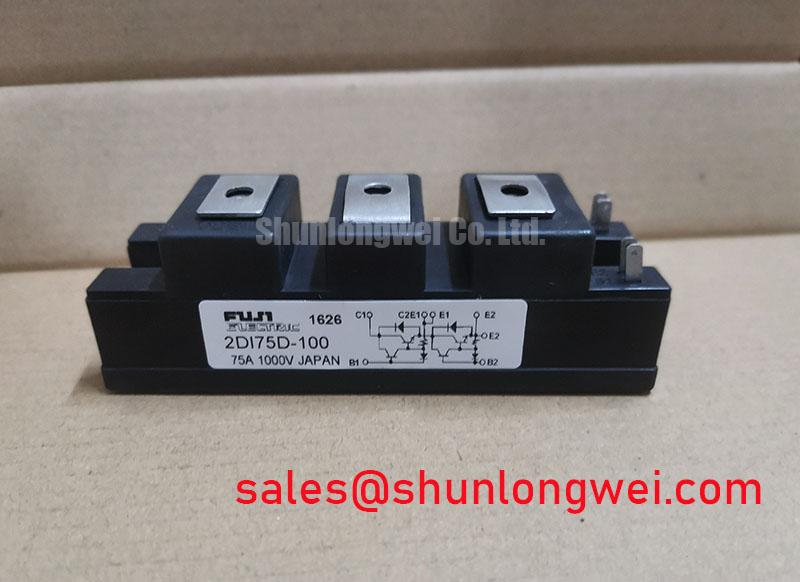

Technical Analysis of the 2DI75D-100
A defining characteristic of the 2DI75D-100 is its Darlington pair configuration, which results in a high DC current gain (hFE) of at least 100. This feature significantly reduces the amount of current required from the control circuit to switch the main 75A load. For design engineers, this translates into a less complex and lower-power base driver stage, saving both component count and board space. It is a crucial parameter for ensuring the transistor is fully saturated during the ‘on’ state, minimizing conduction losses.
The module’s thermal performance is central to its reliability in high-power systems. The specified maximum thermal resistance from junction to case (Rth(j-c)) is 0.25°C/W per transistor. Think of thermal resistance like the width of a pipe; a lower value means a wider pipe, allowing heat to escape more easily from the active silicon die to the heatsink. This low thermal resistance is critical for preventing the junction temperature from exceeding its 150°C maximum rating, a key factor in long-term operational stability. Effective thermal management is essential for preventing premature device failure.
Furthermore, the module is constructed with an isolated mounting base, providing 2500V of AC isolation between the electrical terminals and the mounting plate for one minute. This built-in isolation simplifies assembly by allowing the module to be mounted directly to a common chassis or heatsink without needing separate, often fragile, insulating pads. This not only improves mechanical stability but also ensures more consistent thermal transfer, a critical element in achieving calculated performance. Understanding the role of an isolated baseplate is fundamental to high-voltage system design.
Optimized Application Scenarios
The 2DI75D-100 is specified for applications that demand robust control over high voltage and current. Its characteristics make it suitable for:
- AC Motor Controls: The 1000V collector-base voltage rating provides a substantial safety margin for inverters driving 400V or 480V AC motors.
- DC Motor Controls (Choppers): Its 75A continuous collector current capability is well-suited for controlling large DC motors in industrial machinery.
- High-Power Switching Regulators: The module can be used as the primary switching element in large-scale uninterruptible power supplies (UPS) and switched-mode power supplies (SMPS).
- Welding Power Supplies: The device’s ability to handle high power dissipation (up to 500W) makes it a viable option for power control circuits in welding equipment.
This module is best matched for legacy system repairs or new designs requiring straightforward, high-gain control of high-power industrial loads.
Key Specification Parameters for 2DI75D-100
| Absolute Maximum Ratings (Tc=25°C) | |
|---|---|
| Collector-Base Voltage (VCBO) | 1000 V |
| Collector-Emitter Voltage (VCEO) | 1000 V |
| Emitter-Base Voltage (VEBO) | 10 V |
| Collector Current (IC) | 75 A |
| Collector Power Dissipation (PC) | 500 W |
| Electrical Characteristics (Tj=25°C) | |
| Collector-Emitter Saturation Voltage (VCE(sat)) | 2.5 V (Max) @ IC=75A |
| DC Current Gain (hFE) | 100 (Min) @ IC=75A, VCE=5V |
| Turn-On Time (ton) | 4.0 µs (Typ) |
| Turn-Off Time (toff) | 15.0 µs (Typ) |
| Isolation Voltage (Visol) | 2500 V (AC, 1 min.) |
Engineer FAQ
1. What are the primary thermal considerations when using the 2DI75D-100?
The main consideration is ensuring the junction temperature stays below the 150°C maximum. Given the thermal resistance of 0.25°C/W, a properly sized heatsink is essential. A thermal compound should be applied evenly to the baseplate to minimize contact thermal resistance. The datasheet recommends a mounting torque of 2.5-3.5 N·m for the mounting screws to ensure optimal thermal contact without inducing mechanical stress.
2. What does the Darlington configuration mean for my design?
The Darlington pair uses two bipolar transistors configured to act as a single transistor with much higher current gain. This means the 2DI75D-100 requires significantly less base current to switch the main load current compared to a single transistor. This simplifies the driver circuit, but it also results in a higher saturation voltage (VCE(sat)) and slower switching speeds than a comparable IGBT or MOSFET.
3. How does the VCE(sat) of 2.5V impact system efficiency?
The collector-emitter saturation voltage (VCE(sat)) directly determines the conduction loss (Power Loss = VCE(sat) × IC). At a full load of 75A, the conduction loss per transistor would be approximately 2.5V * 75A = 187.5W. This heat must be dissipated by the cooling system. While higher than modern IGBTs, this was a typical value for this class of device and is a critical input for thermal design calculations.
4. Can this module be used in high-frequency applications?
With typical turn-on and turn-off times of 4.0µs and 15.0µs respectively, the 2DI75D-100 is best suited for low-frequency applications, such as line-frequency motor control and power supplies. Switching losses would become excessive at higher frequencies, typically above a few kHz.
Enabling Robust Power Designs
The Fuji Electric 2DI75D-100 provides a proven solution for high-current power control. Its architecture, centered on high gain and an integrated, isolated package, allows engineers to implement powerful and thermally stable control systems for industrial applications where reliability and straightforward design are paramount.