Fuji 2MBI300HH-120: A Technical Analysis for High-Frequency Applications
Fuji 2MBI300HH-120 IGBT Module | 1200V 300A High-Speed
Introduction and Core Highlights
The Fuji Electric 2MBI300HH-120 is a half-bridge IGBT module engineered for high-frequency power conversion systems. Its primary value lies in the balance between fast switching characteristics and low conduction losses, enabling designers to improve system efficiency and power density. By minimizing switching energy loss, this module is an effective solution for applications requiring operation at higher frequencies, which can lead to more compact system designs with smaller magnetic components.
- Core Specifications: 1200V | 300A | VCE(sat) 2.3V (typ)
- Key Advantages: Reduced switching losses for higher frequency operation, integrated NTC for precise temperature monitoring.
Download the Official 2MBI300HH-120 Datasheet (PDF)
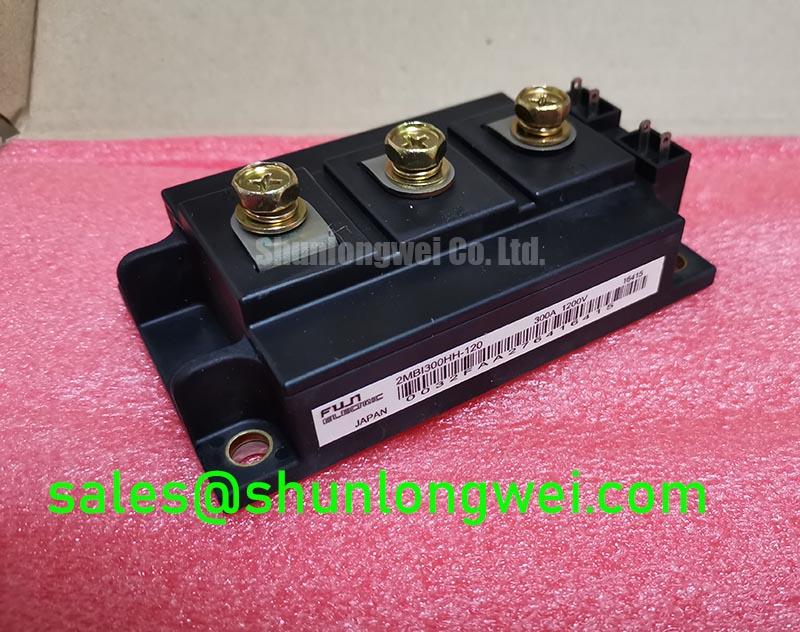
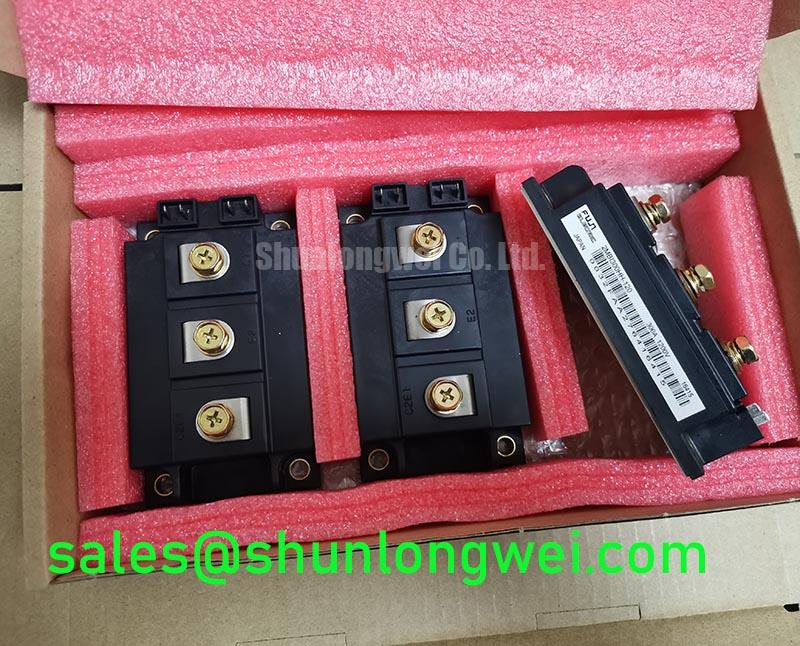
Technical Analysis for High-Frequency Systems
The defining feature of the 2MBI300HH-120 is its designation as a high-speed module. The datasheet specifies a typical turn-off time (toff) of 0.55 µs and a reverse recovery time (trr) of 0.15 µs for the free-wheeling diode. These rapid transitions are critical in reducing switching losses (Eon and Eoff), which are a primary source of heat in power converters. For engineers developing systems like high-frequency inverters or switch-mode power supplies, this speed allows for an increase in operating frequency without incurring excessive thermal penalties.
A crucial design trade-off in any IGBT is between switching speed and on-state voltage drop. The 2MBI300HH-120 achieves a commendable balance with a typical collector-emitter saturation voltage (VCE(sat)) of 2.3V at its nominal 300A current. This figure directly impacts conduction losses—the power dissipated while the switch is closed. A lower VCE(sat) translates to less wasted energy and a reduced thermal load on the heatsink, a critical factor for maintaining system reliability under continuous operation.
Effective thermal management is fundamental to leveraging the module’s performance. The thermal resistance from junction to case (Rth(j-c)) for the IGBT is documented at 0.085 °C/W. Think of thermal resistance as the width of a pipe for heat flow; a lower value indicates a wider pipe, allowing heat to escape the semiconductor die more easily. This efficient heat transfer capability is essential for preventing the device from exceeding its maximum junction temperature of 150°C, ensuring robust performance across demanding load cycles.

Optimized Application Scenarios
The electrical and thermal characteristics of the 2MBI300HH-120 make it a strong candidate for several high-power applications:
- Welding Power Supplies: Its fast switching capability is ideal for inverter-based welders that require precise, high-frequency control of the welding arc.
- Uninterruptible Power Supplies (UPS): The module’s high current rating (300A DC) and efficiency are well-suited for the inverter stage of a high-capacity UPS, ensuring reliable power delivery.
- High-Power Motor Drives: In Variable Frequency Drives (VFDs), its performance enables smooth and efficient control of large industrial motors.
- Solar and Wind Inverters: The 1200V rating provides the necessary voltage headroom for grid-tied renewable energy systems, while its efficiency maximizes energy harvest.
For systems requiring a 1200V half-bridge topology with an emphasis on switching speeds above 10kHz, this module presents a technically sound component choice.
Key Specifications of the 2MBI300HH-120
| Absolute Maximum Ratings (Tc = 25°C unless otherwise noted) | |
|---|---|
| Collector-Emitter Voltage (VCES) | 1200 V |
| Continuous Collector Current (IC) | 300 A (at Tc = 80°C) |
| Gate-Emitter Voltage (VGES) | ±20 V |
| Collector Power Dissipation (PC) | 1470 W per IGBT |
| Operating Junction Temperature (Tj) | +150 °C |
| Electrical Characteristics (Tj = 25°C unless otherwise noted) | |
| Collector-Emitter Saturation Voltage (VCE(sat)) | 2.3 V (typ), 2.8 V (max) at IC=300A, VGE=15V, Tj=125°C |
| Turn-off Switching Time (toff) | 0.55 µs (typ) at IC=300A, VCC=600V, Tj=125°C |
| FWD Forward Voltage (VF) | 2.1 V (typ), 2.6 V (max) at IF=300A, VGE=0V, Tj=125°C |
| Thermal Resistance, Junction to Case (Rth(j-c)) | 0.085 °C/W (IGBT), 0.16 °C/W (FWD) |
Engineer’s FAQ
- Is the 2MBI300HH-120 suitable for high-frequency applications over 20kHz?
- Yes, its “H-Series” designation indicates it is designed for high-speed operation. With a typical turn-off time of 0.55 µs, it is well-suited for frequencies in the 20 kHz range. However, designers must carefully calculate total power losses (conduction + switching) and ensure the thermal management system can maintain the junction temperature below the 150°C maximum.
- What are the recommended mounting torque specifications?
- The datasheet specifies a mounting torque of 3.5 to 4.5 N·m for the M6 mounting screws and 3.5 to 4.5 N·m for the M8 terminal screws. Adhering to these values is critical to ensure low thermal resistance to the heatsink and to prevent mechanical stress on the module’s substrate.
- How should the integrated NTC thermistor be used?
- The built-in NTC thermistor allows for real-time monitoring of the module’s case temperature. Its resistance characteristics are provided in the datasheet (e.g., 5 kΩ at 25°C). This feedback should be used by the system’s controller to trigger alarms, reduce power output (derating), or initiate a shutdown if the temperature exceeds safe limits, preventing catastrophic IGBT failures.
- What is the recommended gate-emitter voltage (VGE) for operation?
- The datasheet specifies electrical characteristics based on a recommended VGE of +15V for turn-on. A negative voltage is not strictly required for turn-off, but a 0V to -15V range is typical to ensure noise immunity. The absolute maximum VGE is ±20V.
Enabling Efficient Power Conversion
The Fuji 2MBI300HH-120 provides a robust, technically sound solution for power electronics engineers. By delivering a well-balanced profile of high-speed switching, moderate conduction losses, and effective thermal characteristics, it enables the development of reliable and power-dense converters. This module is a fitting choice for designs where minimizing switching losses is a primary objective.