Fuji 4MBI900VB-12R1-61: A Technical Analysis of a 900A High-Power IGBT Module
## Fuji 4MBI900VB-12R1-61 V-Series IGBT Module
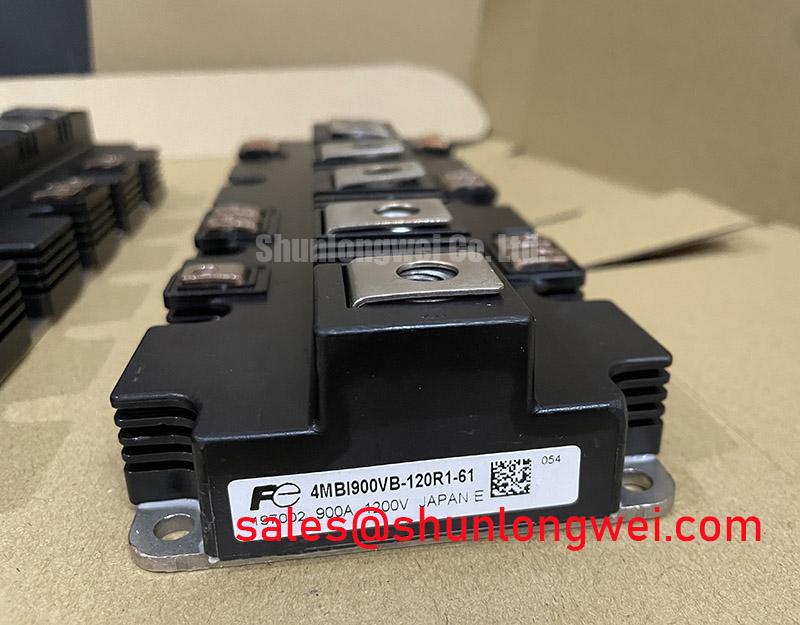
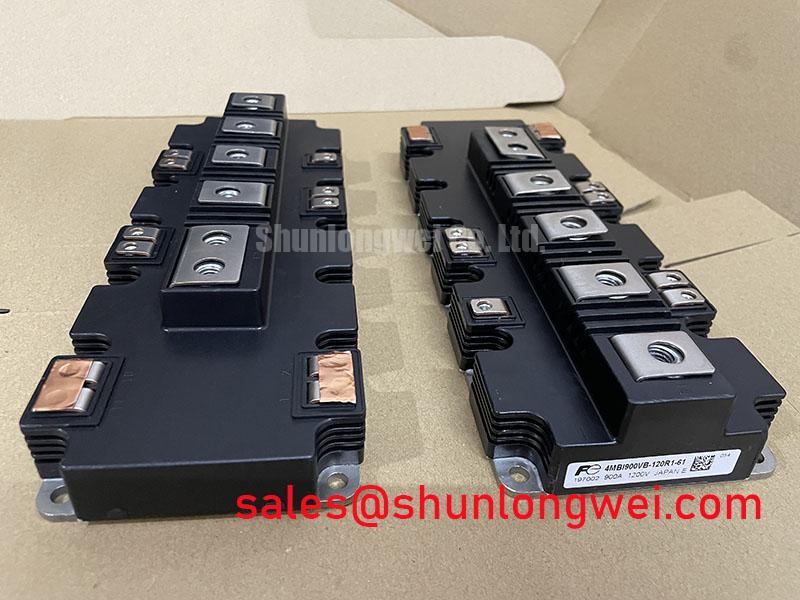
The Fuji Electric 4MBI900VB-12R1-61 is a high-current 4-in-1 IGBT module from the V-Series, engineered for high-power converter applications requiring robust thermal performance and efficiency. It integrates four IGBTs, including two standard IGBTs and two Reverse-Blocking IGBTs (RB-IGBTs), creating an advanced T-type Neutral-Point-Clamped (AT-NPC) 3-level topology. This architecture provides a foundation for building high-power, efficient, and reliable power conversion systems.
* **Core Specifications:** 1200V / 900A
* **Key Technology:** V-Series with AT-NPC 3-Level Topology
* **Primary Advantages:** High power density, reduced system-level losses, and enhanced thermal stability.
Download Official Datasheet (PDF)
### Technical Analysis
The 4MBI900VB-12R1-61 is built upon Fuji Electric’s V-Series technology, which focuses on reducing power losses and increasing reliability. The module’s 900A continuous collector current rating allows it to manage substantial power levels, making it a suitable component for systems in the megawatt class. The integration of standard and Reverse-Blocking IGBTs into a single package simplifies the implementation of advanced 3-level inverter topologies. This can lead to lower harmonic distortion and improved output waveform quality compared to standard 2-level designs.
A critical parameter for a high-current device is its thermal resistance (junction-to-case), which is specified as 0.034 °C/W for the inverter IGBT and 0.038 °C/W for the AC switch RB-IGBT. Think of thermal resistance as the width of a pipe; a lower value represents a wider pipe that allows heat to escape the semiconductor chip more effectively. This low thermal resistance, combined with a high maximum junction temperature of 175°C, provides significant thermal headroom. This enables more robust operation under heavy loads or the potential to design more compact cooling systems, a key consideration for mastering IGBT thermal design.
The collector-emitter saturation voltage (Vce(sat)) is a direct indicator of conduction losses. For this module, the inverter IGBT has a typical Vce(sat) of 1.70V at its nominal current. This low on-state voltage minimizes the power dissipated as heat during operation, which directly contributes to higher overall system efficiency. For engineers, this means less energy is wasted, reducing both operational costs and the burden on the thermal management system.
### Optimized Application Scenarios
The unique configuration and high power rating of the 4MBI900VB-12R1-61 make it well-suited for specific, demanding applications:
* **High-Power Solar and Wind Inverters:** The 3-level topology enabled by this module is ideal for renewable energy systems, as it can improve efficiency and reduce the size of output filters.
* **Uninterruptible Power Supplies (UPS):** Its high current capability and robust thermal performance ensure reliable power delivery for critical data centers and industrial facilities.
* **Large-Scale Motor Drives:** The module can efficiently control multi-megawatt motors used in industrial processing, transportation, and resource extraction.
* **Power Conditioners:** The advanced T-type circuit helps maintain high-quality power in sensitive grid applications.
This module is best matched for 3-level inverter designs targeting high efficiency and power density in systems operating above several hundred kilowatts.
### Key Specifications of the 4MBI900VB-12R1-61
| Absolute Maximum Ratings (Tj = 175°C, Tc = 25°C unless otherwise specified) | ||
|---|---|---|
| Parameter | Symbol | Value |
| Inverter Collector-Emitter Voltage | VCES | 1200 V |
| AC Switch Collector-Emitter Voltage | VCES | ±900 V |
| Continuous Collector Current (Tc=80°C) | IC | 900 A |
| Peak Collector Current (1ms) | ICP | 1800 A |
| Gate-Emitter Voltage | VGES | ±20 V |
| Maximum Power Dissipation (Inverter IGBT, Tc=25°C) | PC | 3950 W |
| Operating Junction Temperature | Tj, op | -40 to +175 °C |
| Isolation Voltage (AC, 1 min) | Viso | 4000 V |

### Engineer FAQ
**Q1: What is the main advantage of the AT-NPC 3-level topology in the 4MBI900VB-12R1-61?**
The primary advantage is improved efficiency and reduced output harmonics. By switching between three voltage levels (+Vdc, 0, -Vdc), the output waveform is a better approximation of a sine wave. This reduces the need for large, costly, and lossy output filters, a significant benefit in applications like high-power solar inverters and UPS systems.
**Q2: What are the critical thermal design considerations for a 900A module?**
For a 900A module, effective thermal management is paramount. The low thermal resistance (Rth(j-c)) of 0.034°C/W is a strong starting point, but a high-performance heatsink is required. The mounting surface must be perfectly flat, and an appropriate thermal interface material (TIM) must be used to minimize the contact thermal resistance (Rth(c-f)). Finally, the main terminals must be torqued to the specified 8.0 – 10.0 Nm to ensure low-resistance electrical and thermal connections.
**Q3: The datasheet specifies a maximum operating junction temperature (Tj, op) of 175°C. How does this improve system design?**
A higher maximum Tj provides a larger safety margin. It allows the module to withstand higher temporary temperature spikes without degradation, enhancing system robustness. It also gives designers more flexibility: they can either push the power output higher for a given cooling system or design a smaller, more cost-effective heatsink while maintaining a safe operating temperature well below the 175°C limit to ensure long-term reliability.
**Q4: How do the Reverse-Blocking IGBTs (RB-IGBTs) in this module simplify the design?**
In a traditional 3-level T-type inverter, the AC switch requires two standard IGBTs in a common-emitter configuration or an IGBT with a series diode. The integrated RB-IGBTs in the 4MBI900VB-12R1-61 can block voltage in both directions, allowing a single device to perform the AC switching function. This reduces component count, simplifies the gate drive circuitry, and lowers overall conduction losses in the AC switch path.
### Empowering High-Power Designs
The Fuji Electric 4MBI900VB-12R1-61 is a highly integrated power component that enables engineers to move beyond the constraints of conventional 2-level topologies. By combining high current capacity with the inherent efficiencies of a 3-level architecture in a single, thermally efficient package, this module provides a direct path to developing more powerful, compact, and reliable inverters and motor drives. This accelerates the design cycle for next-generation systems in renewable energy and industrial automation.