Infineon FF100R12KS4 IGBT: A Technical Deep Dive into Efficiency and Reliable Paralleling
## Infineon FF100R12KS4 1200V 100A Chopper IGBT Module
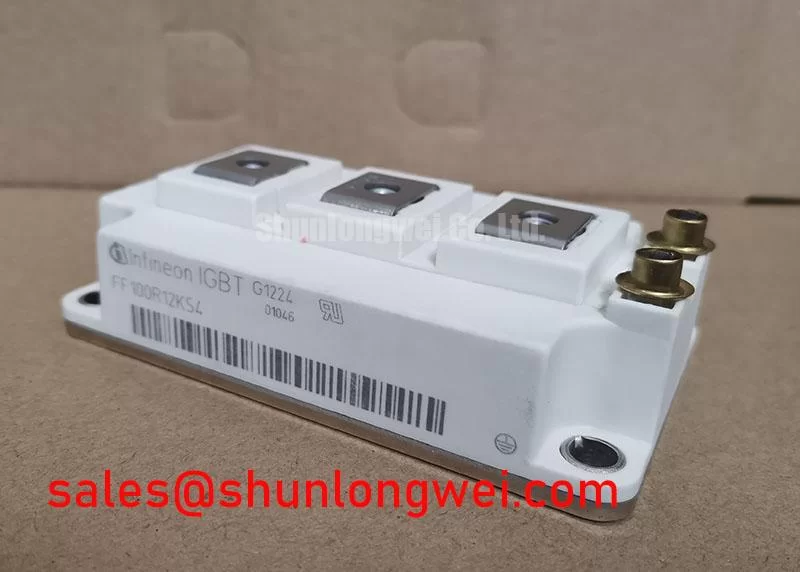
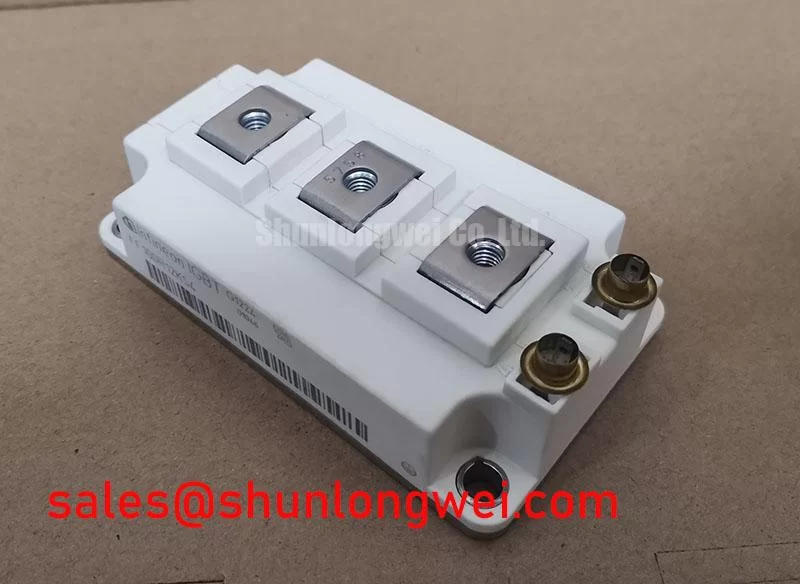
The Infineon FF100R12KS4 is a 1200V, 100A Chopper-IGBT module that leverages TRENCHSTOP™ IGBT3 technology to deliver a combination of low conduction losses and high operational robustness. This module’s key engineering advantage is its VCE(sat) with a positive temperature coefficient, which inherently simplifies current sharing in paralleled configurations, enhancing the reliability of high-power systems. It is engineered for designers seeking efficient and dependable performance in demanding power conversion applications.
* **Core Specifications:** 1200V | 100A | 1.70V VCE(sat) (typ. @ 25°C)
* **Key Advantages:** Enables straightforward and reliable paralleling; High short-circuit capability enhances system durability.
* **Application Focus:** The positive temperature coefficient of its on-state voltage ensures stable operation when multiple modules are used in parallel, preventing thermal runaway by naturally balancing current distribution.
Download Official Datasheet (PDF)


Technical Analysis: Efficiency and Paralleling
At the core of the FF100R12KS4 is Infineon’s TRENCHSTOP™ IGBT3 technology. This structure is instrumental in achieving a low collector-emitter saturation voltage (VCE(sat)) of 1.70V (typical, at 25°C and 100A). A lower VCE(sat) directly corresponds to reduced conduction losses, which means less energy is wasted as heat during operation. For system designers, this translates to improved overall efficiency and can lead to smaller, more cost-effective thermal management solutions, such as reduced heatsink requirements. Explore more about the evolution of these technologies in our guide to modern IGBT architectures.
A critical feature for high-power designs is the module’s positive temperature coefficient of VCE(sat). This characteristic provides an inherent self-balancing mechanism when multiple modules are connected in parallel to handle higher currents. You can think of this feature as a built-in traffic controller for electrons. If one module begins to carry slightly more current and its temperature rises, its on-state voltage drop also increases. This increased “resistance” naturally encourages current to flow through the other, cooler modules, ensuring a stable and even current distribution across the array without requiring complex external measurement and control circuits.
Optimized Application Scenarios
The specific characteristics of the FF100R12KS4 make it highly suitable for several power conversion applications:
* **Motor Drives:** The module’s robustness and high short-circuit withstand time (10 µs) provide the durability needed to handle the demanding load cycles and potential fault conditions in industrial motor controls.
* **UPS Systems:** Low conduction and switching losses contribute to higher system efficiency, a critical metric for uninterruptible power supplies where energy conservation and reliability are paramount.
* **Solar Inverters:** The 1200V blocking voltage is well-suited for the high DC bus voltages found in grid-tied solar applications, while its thermal efficiency ensures reliable energy harvesting.
* **Welding Power Supplies:** The module can reliably handle the high-current pulses characteristic of modern inverter-based welding equipment due to its high short-circuit capability.
Its blend of efficiency and robust paralleling capability makes this module an excellent fit for motor drives and power converters requiring reliable, scalable performance.
Key Specification Parameters
| Parameter | Value | Conditions |
|---|---|---|
| Collector-Emitter Voltage (VCES) | 1200 V | Tvj = 25°C |
| Continuous DC Collector Current (IC) | 100 A | TC = 80°C |
| Collector-Emitter Saturation Voltage (VCE(sat)) | 1.70 V (typ.) | IC = 100A, VGE = 15V, Tvj = 25°C |
| Gate-Emitter Threshold Voltage (VGE(th)) | 5.8 V (typ.) | IC = 4.0 mA, VCE = VGE, Tvj = 25°C |
| Short Circuit Withstand Time (tpsc) | 10 µs | VGE ≤ 15V, VCC = 800V, Tvj = 150°C |
| Thermal Resistance, Junction-to-Case (RthJC) | 0.27 K/W | per IGBT |
| Integrated NTC Resistance (R25) | 5.00 kΩ | T = 25°C |
Engineer’s FAQ
1. How does the FF100R12KS4 behave when paralleled with other units?
The FF100R12KS4 is well-suited for paralleling due to the positive temperature coefficient of its VCE(sat). As a module’s temperature increases, its on-state voltage drop also rises, which naturally forces current to be shared with cooler, parallel modules. This helps prevent thermal runaway and ensures stable, balanced current distribution without requiring complex external balancing circuits.
2. What are the primary thermal management considerations for this module?
The module specifies a thermal resistance from junction-to-case (RthJC) of 0.27 K/W per IGBT. To operate reliably up to the maximum junction temperature of 150°C, effective heat dissipation is crucial. This involves selecting an appropriate heatsink and using a high-quality thermal interface material to minimize the thermal resistance between the module’s baseplate and the heatsink. A proper understanding of the Zth curve is essential for transient thermal analysis.
3. What is the function of the integrated NTC thermistor?
The integrated NTC (Negative Temperature Coefficient) thermistor provides a means for real-time temperature monitoring of the module’s baseplate. This feedback can be used by the system’s control unit to implement over-temperature protection, trigger cooling adjustments, or derate the power output, significantly enhancing overall system safety and reliability. The role of the integrated NTC is key to module safety.
4. What does the “Chopper” configuration mean?
The datasheet specifies this module in a “Chopper” or half-bridge topology, containing one IGBT and one freewheeling diode. This configuration is a fundamental building block for various power converter circuits, including buck or boost converters and the legs of a multi-phase inverter.
For engineers building high-power converters, the FF100R12KS4 provides a foundation for efficient and dependable systems. It directly addresses the design challenges of thermal management and parallel operation through the inherent material and structural advantages of its TRENCHSTOP™ IGBT3 technology.