IXYS MCC132-16io1 Thyristor Module: A Comprehensive Technical Review
IXYS MCC132-16io1 Thyristor Module | 1600V, 139A
Introduction and Core Highlights
The IXYS MCC132-16io1 is a high-reliability thyristor module that integrates two thyristors in a common cathode configuration. It provides robust AC power control through its high blocking voltage and superior thermal management capabilities. The module’s construction, featuring a Direct Copper Bonded (DCB) ceramic baseplate, offers excellent electrical isolation and efficient heat dissipation, which is critical for maintaining performance in demanding industrial environments. This design simplifies the thermal interface to a heatsink, facilitating more compact and reliable system assembly.
- Core Specifications: 1600V Repetitive Peak Voltage | 139A Average On-State Current | 3600V~ Isolation Voltage
- Key Advantages: High operational reliability due to planar passivated chips, simplified thermal management via an isolated baseplate.
- Application Focus: Suited for line-frequency phase control in AC motor drives and controlled rectifiers.
Download the Official MCC132-16io1 Datasheet (PDF)
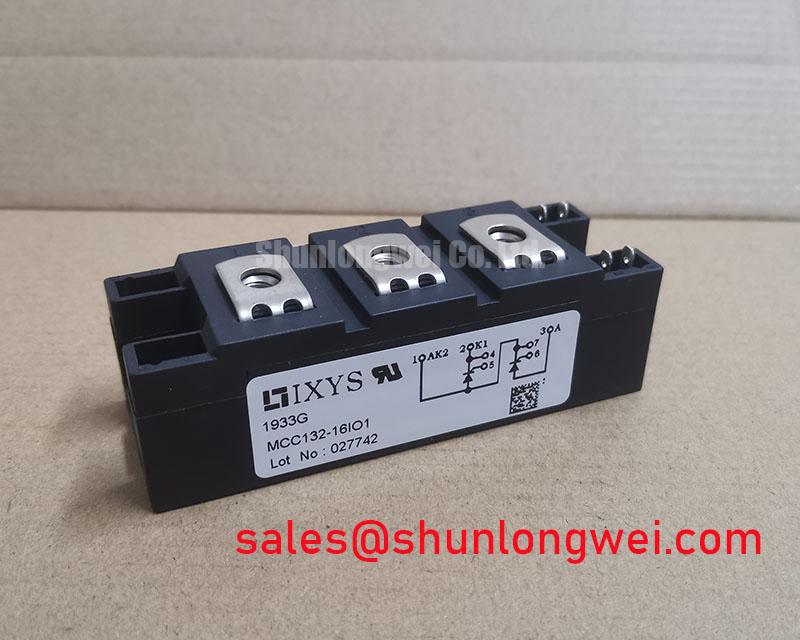

Technical Analysis of Core Features
The MCC132-16io1 is engineered around two central performance pillars: high electrical isolation and efficient thermal transfer. The specified isolation voltage (VISOL) of 3600V~ provides a substantial safety margin for systems connected to industrial mains, insulating control circuits from high-voltage power stages. This is achieved through the use of a DCB alumina (Al2O3) baseplate, which separates the active silicon from the mounting surface while maintaining a strong thermal path. This construction allows for the direct mounting of multiple modules onto a single heatsink, streamlining mechanical design and assembly.
Effective thermal management is further enabled by the module’s low junction-to-case thermal resistance (RthJC) of 0.16 K/W for each thyristor. Think of thermal resistance as the narrowness of a pipe carrying heat away from the component. The MCC132-16io1’s low value signifies a very wide pipe, allowing heat generated during operation to flow easily from the silicon die to the heatsink. This efficiency is crucial for preventing overheating, ensuring the component operates within its safe temperature limits and contributes to the long-term reliability of the end application, such as an industrial power semiconductor system.
Optimized Application Scenarios
The electrical and thermal characteristics of this module make it a strong candidate for specific high-power control circuits.
- AC Motor Soft Starters: The 1600V blocking capability provides ample headroom for use on 400V and 480V AC lines, allowing for precise phase-angle control to limit inrush current and reduce mechanical shock during motor startup.
- Industrial Heater and Light Control: Its high average current rating (ITAVM = 139A) enables the proportional control of high-power resistive loads, offering fine-tuned temperature or brightness regulation.
- Controlled Rectifiers: The common cathode configuration is well-suited for building phase-controlled rectifiers used in battery charging systems and DC power supplies that require adjustable output voltage.
- AC Static Switches: For solid-state relays and contactors, the module provides a robust solution for switching high-current AC loads with high reliability and no mechanical wear.
Its high voltage rating and superior thermal management make it a prime candidate for industrial AC control applications operating on mains up to 480V.
Key Specification Parameters for the MCC132-16io1
| Absolute Maximum Ratings (TC = 25°C unless otherwise specified) | |
|---|---|
| Repetitive Peak Off-State Voltage (VDRM) / Repetitive Peak Reverse Voltage (VRRM) | 1600 V |
| Average On-State Current (ITAVM) | 139 A (TC = 85°C) |
| RMS On-State Current (ITRMS) | 220 A |
| Peak Forward Surge Current (ITSM, t=10ms, 50Hz, sine) | 2200 A |
| Operating Junction Temperature Range (TVJ) | -40 to +125 °C |
| Electrical & Gating Characteristics | |
| Gate Trigger Current (IGT) | max. 150 mA (TVJ = 25°C) |
| Gate Trigger Voltage (VGT) | max. 1.5 V (TVJ = 25°C) |
| Thermal and Mechanical Characteristics | |
| Thermal Resistance, Junction to Case (RthJC) | 0.16 K/W (per thyristor) |
| Isolation Voltage (VISOL, 50/60 Hz, RMS, t=1min) | 3600 V~ |
| Mounting Torque (Terminals) | 1.8 – 2.2 Nm (16 – 19 lb.in.) |
| Mounting Torque (Module to Heatsink) | 4.5 – 5.5 Nm (40 – 48 lb.in.) |
Engineer’s Frequently Asked Questions (FAQ)
What makes the MCC132-16io1 suitable for AC motor soft starters?
Its 1600V rating provides a high safety margin for voltage transients on 480V AC industrial lines. The high surge current capability (2200A) allows it to withstand the initial inrush current typical during motor startup, making it a reliable choice for robust motor control applications.
What is the recommended mounting torque, and why is it important?
The datasheet specifies 4.5 – 5.5 Nm for mounting the module to a heatsink and 1.8 – 2.2 Nm for the electrical terminals. Applying the correct torque is critical. Insufficient torque on the heatsink mount results in a poor thermal interface, leading to overheating. Excessive torque can damage the ceramic baseplate, compromising both thermal performance and electrical isolation.
How does the DCB (Direct Copper Bonded) baseplate benefit the design?
The DCB construction fuses a ceramic layer (Alumina) directly between two copper layers. This creates a single, integrated substrate that offers high electrical isolation and excellent thermal conductivity. It eliminates the need for a separate insulating pad and improves long-term reliability by matching the thermal expansion characteristics of the internal components more closely.
Can two MCC132-16io1 modules be configured for a single-phase AC controller?
Yes. While a single module contains two thyristors in a common cathode arrangement, a full single-phase AC controller (or AC switch) requires two anti-parallel SCRs. This can be constructed using two separate MCC132-16io1 modules or by combining this module with a corresponding common-anode thyristor module.
Enabling Robust Power Control Systems
The MCC132-16io1 thyristor module provides a foundation for durable and thermally stable power control circuits. Its combination of high-voltage capability, excellent isolation, and a low thermal resistance path empowers engineers to design compact and reliable systems for demanding industrial automation and power conversion tasks.