LVH200G1201: High-Performance 1200V 200A Dual IGBT Module Technical Overview
LVH200G1201 | 1200V 200A Dual IGBT Module Technical Overview
Advanced Trench-FS Technology for Industrial Power Conversion
The LVH200G1201 is an industrial-grade Half-Bridge IGBT Module designed for high-efficiency power conversion in demanding environments. This module utilizes Trench Field-Stop (Trench-FS) technology to achieve an optimal balance between conduction losses and switching speed. By integrating a soft-recovery freewheeling diode, the LVH200G1201 minimizes electromagnetic interference (EMI) while providing high robustness against short-circuit events. It is a fundamental building block for engineers looking to maximize power density in medium-to-high power applications.
- Core Specifications: 1200V | 200A | VCE(sat) typical 1.9V
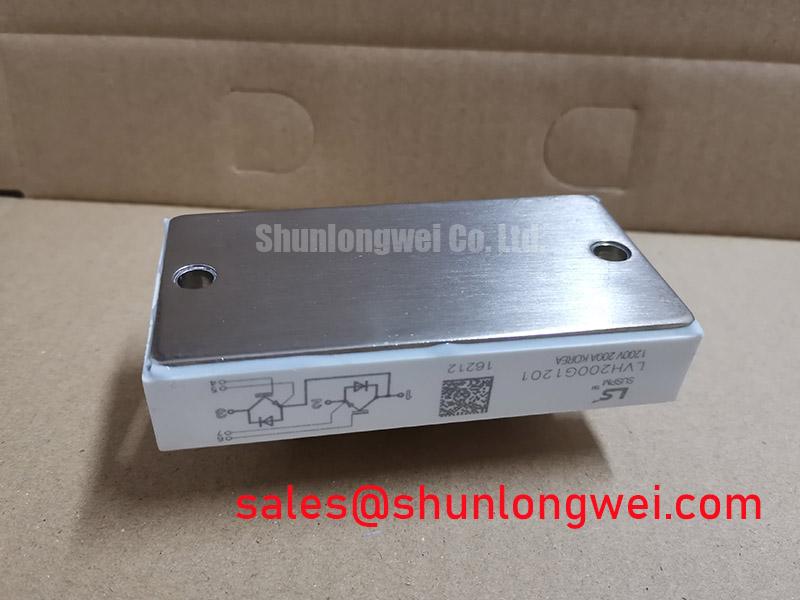
- Key Advantage 1: Enhanced thermal cycling capability via advanced copper-baseplate bonding, extending service life in variable-load scenarios.
- Key Advantage 2: Low parasitic inductance internal layout, which is critical for reducing voltage overshoots during high-speed switching.
Download Official LVH200G1201 Datasheet (PDF)
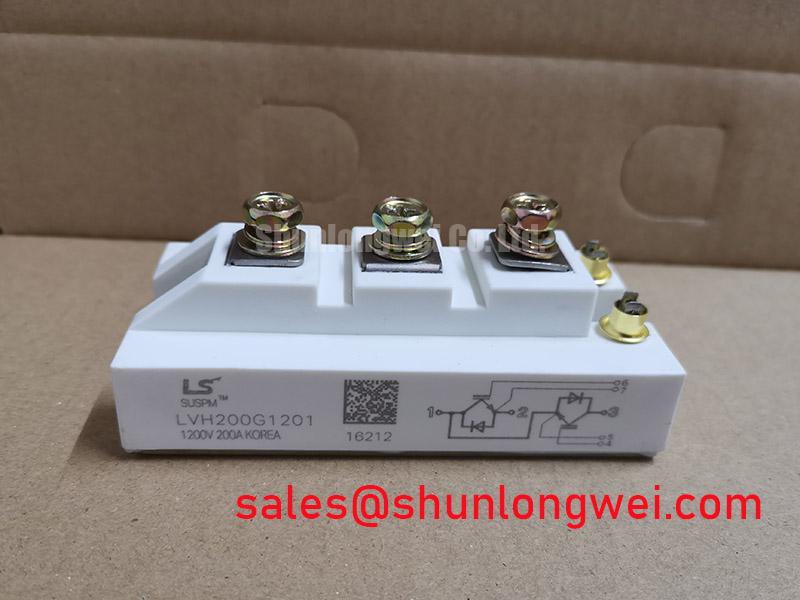
Precision Engineering for Enhanced System Reliability
The technical architecture of the LVH200G1201 is centered around its Trench Field-Stop structure. Unlike older planar technologies, this design allows for a thinner wafer, which directly translates to a lower collector-emitter saturation voltage (VCE(sat)). In practical engineering terms, a lower VCE(sat) means that less power is dissipated as heat while the device is in the “on” state. This efficiency is paramount for power semiconductors used in continuous-duty cycles.
Thermal management is another area where the LVH200G1201 excels. To understand the significance of the module’s thermal resistance ($R_{thJC}$), one can use a simple analogy: think of thermal resistance as the width of a drainage pipe. A pipe with a larger diameter (lower resistance) allows water (heat) to flow out much faster, preventing the system (the IGBT junction) from overflowing (overheating). With a junction-to-case thermal resistance optimized for 200A operation, this module ensures that heat is efficiently transferred to the heatsink, maintaining a safe operating temperature even under peak loads.
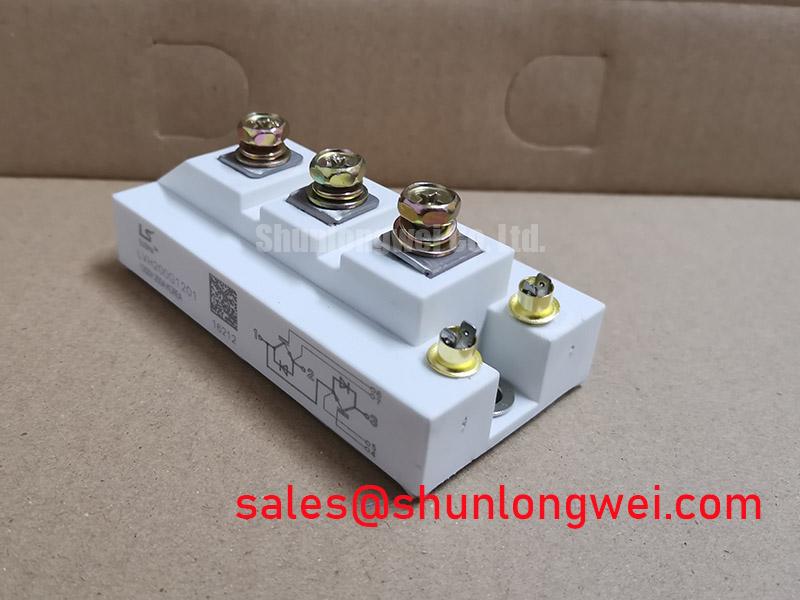
Furthermore, the inclusion of a soft-recovery freewheeling diode addresses the common challenge of reverse recovery current spikes. By controlling the $di/dt$ during the diode turn-off phase, the LVH200G1201 reduces the stress on the complementary IGBT and the surrounding circuitry. This characteristic simplifies the design of intelligent IGBT drivers, as the gate drive parameters do not need to be overly aggressive to compensate for diode-induced noise.
Optimized Application Scenarios
The LVH200G1201 is engineered for versatility across several industrial sectors. Its 1200V rating makes it suitable for systems operating on 400V to 690V AC lines.
- Variable Frequency Drives (VFD): The high current handling capacity and rugged SCSOA (Short Circuit Safe Operating Area) allow for reliable motor control under heavy starting torques.
- Solar Inverters: High efficiency at partial loads ensures maximum energy yield in photovoltaic power conversion systems.
- Uninterruptible Power Supplies (UPS): Low switching losses facilitate higher PWM frequencies, which can reduce the size of output filters and magnetic components.
- Welding Power Supplies: Superior thermal cycling performance enables the module to withstand the rapid load fluctuations typical in industrial welding applications.
Best Match Conclusion: The LVH200G1201 is best suited for 3-phase inverter topologies where high thermal stability and low conduction losses are the primary design priorities.
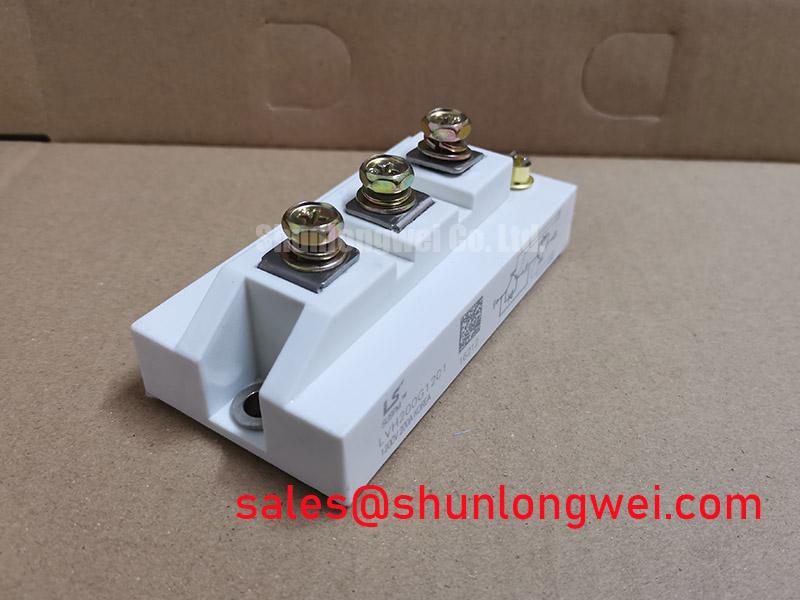
Key Specifications and Ratings
| Parameter Group | Symbol | Typical Value / Limit |
|---|---|---|
| Absolute Maximum Ratings | $V_{CES}$ (Collector-Emitter Voltage) | 1200 V |
| $I_C$ (Continuous Collector Current) | 200 A ($T_C = 80^{circ}C$) | |
| $T_{vj(op)}$ (Operating Junction Temp) | -40 to +150 $^{circ}C$ | |
| Electrical Characteristics | $V_{CE(sat)}$ (Saturation Voltage) | 1.9 V (at $I_C = 200A, T_{vj} = 25^{circ}C$) |
| $V_{GE(th)}$ (Gate Threshold Voltage) | 5.0 to 6.5 V | |
| $C_{ies}$ (Input Capacitance) | 14.5 nF | |
| Thermal Characteristics | $R_{thJC}$ (Thermal Resistance, IGBT) | 0.16 K/W (per IGBT) |
| $R_{thCH}$ (Thermal Resistance, Case to Heatsink) | 0.05 K/W (with thermal grease) |
Engineer FAQ: Design and Integration
Q1: How should I calculate the heatsink requirements for the LVH200G1201?
A: To calculate the required heatsink thermal resistance ($R_{thHA}$), use the formula $R_{thHA} = ((T_{j,max} – T_A) / P_{total}) – R_{thJC} – R_{thCH}$. For the LVH200G1201, $R_{thJC}$ is 0.16 K/W. Ensure $T_{j,max}$ does not exceed 150°C during worst-case ambient temperatures and peak power dissipation.
Q2: Is it possible to parallel multiple LVH200G1201 modules for higher current?
A: Yes. The Trench-FS technology in the LVH200G1201 exhibits a positive temperature coefficient for $V_{CE(sat)}$, which inherently helps with current sharing. However, you must follow strict IGBT paralleling guidelines, including symmetrical busbar design and balanced gate resistances, to account for parasitic inductance effects.
Q3: What are the recommended gate drive voltages for optimal performance?
A: For most industrial applications, a gate-emitter voltage ($V_{GE}$) of +15V is recommended for turn-on to ensure the lowest $V_{CE(sat)}$. For turn-off, a negative bias of -5V to -15V is advised to prevent parasitic turn-on caused by high $dv/dt$ through the Miller capacitance.
Q4: How does the short-circuit withstand time impact system protection design?
A: The LVH200G1201 typically provides a 10µs short-circuit withstand time ($t_{sc}$) at $V_{GE} = 15V$ and $T_{vj} = 125^{circ}C$. Your protection circuitry (desaturation detection) must be calibrated to trigger and shut down the module within this window to prevent catastrophic failure.
The LVH200G1201 provides a robust and thermally efficient solution for high-current industrial switching. By prioritizing low conduction losses and predictable switching behavior, it enables engineers to design more compact and reliable power stages that meet the rigorous demands of modern motion control and renewable energy infrastructure.