Mitsubishi CM300DY-12HE IGBT Module: A Technical Review and Analysis
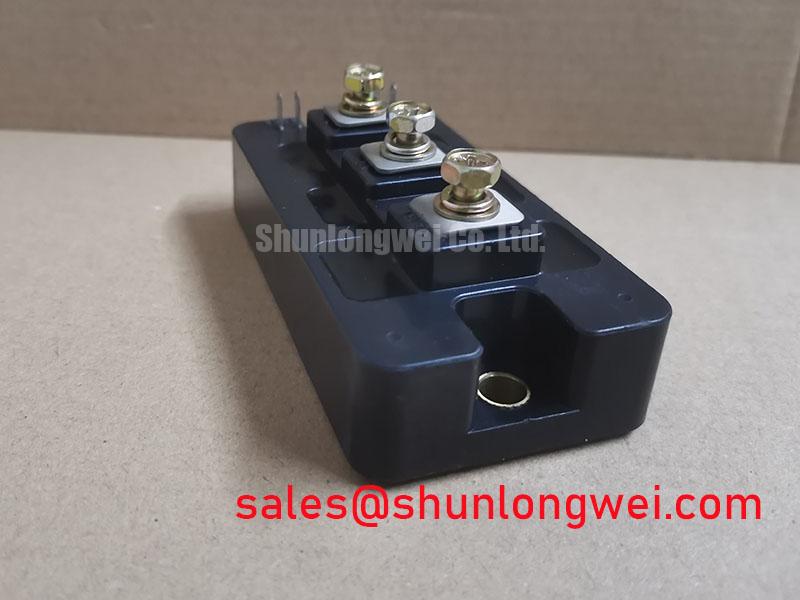
Mitsubishi CM300DY-12HE 600V/300A Dual IGBT Module
Introduction and Core Highlights
The Mitsubishi CM300DY-12HE is a dual IGBT module from the H-Series, engineered for reliable and efficient power switching in high-power industrial applications. This module integrates two IGBTs in a half-bridge configuration, providing a robust foundation for building compact and effective power stages. Its design achieves a proficient balance between conduction and switching losses, making it a staple component for designers prioritizing long-term system reliability. This makes it an excellent choice for developing variable frequency drives where performance and durability are critical.
- Core Specifications: 600V | 300A | VCE(sat) 2.8V (max)
- Key Strengths: Low saturation voltage for reduced heat, isolated baseplate for simplified thermal assembly.
- Configuration: Features a dual (2-in-1) half-bridge circuit, streamlining the design of three-phase inverter bridges.
Download the Official CM300DY-12HE Datasheet (PDF)

Technical Analysis for System Integration
The engineering value of the CM300DY-12HE is evident in its balanced electrical and thermal characteristics. The maximum collector-emitter saturation voltage (VCE(sat)) of 2.8V at a nominal current of 300A is a critical parameter. This low on-state voltage directly minimizes conduction losses, which are a significant source of heat in motor drives and other applications with high duty cycles. Lower heat generation allows for smaller heatsink designs or higher operational current within a given thermal budget, improving overall system power density.
Effective thermal management is further enabled by the module’s low junction-to-case thermal resistance (Rth(j-c)) of 0.11 °C/W per IGBT. You can visualize thermal resistance as the narrowness of a pipe; a lower value indicates a wider pipe that allows heat to flow away from the semiconductor junction more easily. This efficient heat extraction is fundamental to keeping the device within its maximum junction temperature of 150°C and ensuring operational stability under heavy or cyclic loads. For a deeper understanding of thermal design, explore this guide on the practical use of the Zth curve.
Each IGBT is paired with a discrete super-fast recovery free-wheel diode, a crucial element for inductive load applications. The diode’s performance ensures rapid turn-off and minimizes reverse recovery losses, which contributes to higher efficiency, especially in systems operating at moderate to high switching frequencies (up to 25kHz). The standard, isolated baseplate simplifies mounting and enhances electrical safety, making system assembly more straightforward.
Optimized Application Scenarios
The robust design and balanced performance metrics of the CM300DY-12HE make it well-suited for a range of demanding power conversion tasks:
- AC Motor Control & VFDs: Its 600V/300A rating is ideal for inverters driving 240V and 400V AC motors. The module’s thermal efficiency and ruggedness handle the dynamic loads common in these systems.
- Uninterruptible Power Supplies (UPS): The low VCE(sat) contributes to higher overall efficiency, a key requirement for UPS systems where minimizing standby power loss is critical.
- Welding Power Supplies: The ability to handle high peak currents and the module’s inherent robustness make it a reliable choice for the demanding pulse-load conditions found in modern welding equipment.
- Motion/Servo Control: The fast-recovery freewheeling diodes and predictable switching behavior allow for the precise current control necessary for high-performance servo drives.
This module is best matched for high-current industrial systems where proven reliability and balanced electrical and thermal performance are primary design requirements.
Key Specifications of the CM300DY-12HE
| Absolute Maximum Ratings (Tj = 25°C) | |
|---|---|
| Collector-Emitter Voltage (VCES) | 600V |
| Collector Current (IC) @ Tc=25°C | 300A |
| Peak Collector Current (ICM) | 600A |
| Gate-Emitter Voltage (VGES) | ±20V |
| Maximum Power Dissipation (Pc) | 1100W |
| Operating Junction Temperature (Tj) | -40 to +150°C |
| Electrical & Thermal Characteristics (Tj = 25°C unless noted) | |
| Collector-Emitter Saturation Voltage (VCE(sat)) @ 300A | 2.1V (typ), 2.8V (max) |
| Gate-Emitter Threshold Voltage (VGE(th)) | 4.5V to 7.5V |
| Thermal Resistance, Junction-to-Case (Rth(j-c)) per IGBT | 0.11 °C/W (max) |
| Isolation Voltage (Viso), AC 1 min. | 2500 Vrms |
Note: Specifications are based on the official datasheet and may vary. Always consult the latest manufacturer documentation for final design decisions.
Engineer’s FAQ
- What are the main factors for calculating the required heatsink for the CM300DY-12HE?
- To select a heatsink, you must first calculate the total power dissipation, which is the sum of conduction and switching losses under your specific operating conditions (current, duty cycle, frequency). Using the maximum thermal resistance from junction-to-case (0.11 °C/W per IGBT), and your maximum ambient temperature, you can determine the maximum allowable case-to-ambient thermal resistance for the heatsink to keep the junction temperature below 150°C.
- What is the recommended gate drive configuration?
- The datasheet specifies a gate-emitter voltage of +15V for turn-on. For reliable turn-off, especially in electrically noisy environments, using a negative gate voltage between -5V and -10V is recommended. This helps prevent parasitic turn-on caused by high dv/dt, a topic further explored in our guide to robust gate drive design.
- What is the benefit of the isolated baseplate?
- The module’s baseplate is electrically isolated from the internal semiconductor components, rated up to 2500 Vrms. This feature simplifies system assembly by allowing multiple modules to be mounted on a single, non-isolated heatsink without needing separate insulating pads, which improves thermal transfer and reduces assembly complexity.
Enabling Robust Power Designs
The CM300DY-12HE provides a proven, high-performance solution for power electronics engineers. Its combination of low conduction losses, robust thermal design, and an industry-standard package offers a reliable building block for developing efficient and durable power conversion systems. The module’s balanced characteristics empower designers to meet performance targets while simplifying thermal management and mechanical integration.