Mitsubishi CM75E3U-24F 1200V 75A Single IGBT Module: Technical Specifications and Application Guide
Mitsubishi CM75E3U-24F 1200V 75A Single IGBT Module Specs
Introduction and Core Technical Highlights
The Mitsubishi CM75E3U-24F is a high-performance, insulated-type single IGBT module designed for precision power control in industrial environments. Belonging to the renowned U-Series, this component provides a robust solution for engineers seeking a balance between high-speed switching efficiency and long-term thermal stability. With its integrated isolated baseplate, the module simplifies mounting onto heatsinks while maintaining high dielectric strength, ensuring safe operation in demanding high-voltage systems. It is primarily used in chopper circuits where minimizing electromagnetic interference (EMI) and conduction loss is paramount.
- Core Specifications: 1200V | 75A | Isolated Baseplate
- Key Advantage 1: Optimized U-Series architecture significantly reduces Collector-Emitter saturation voltage, directly lowering heat generation during continuous operation.
- Key Advantage 2: Low-inductance package design facilitates faster turn-on and turn-off transitions, crucial for high-frequency PWM applications.
A common inquiry among designers is whether this module requires a specific gate driver configuration to handle its 1200V rating. Based on the manufacturer data, the CM75E3U-24F is optimized for standard industrial drivers, though optimizing the gate resistor is essential to balance switching speed against transient voltage spikes.
Download Official CM75E3U-24F Datasheet (PDF)
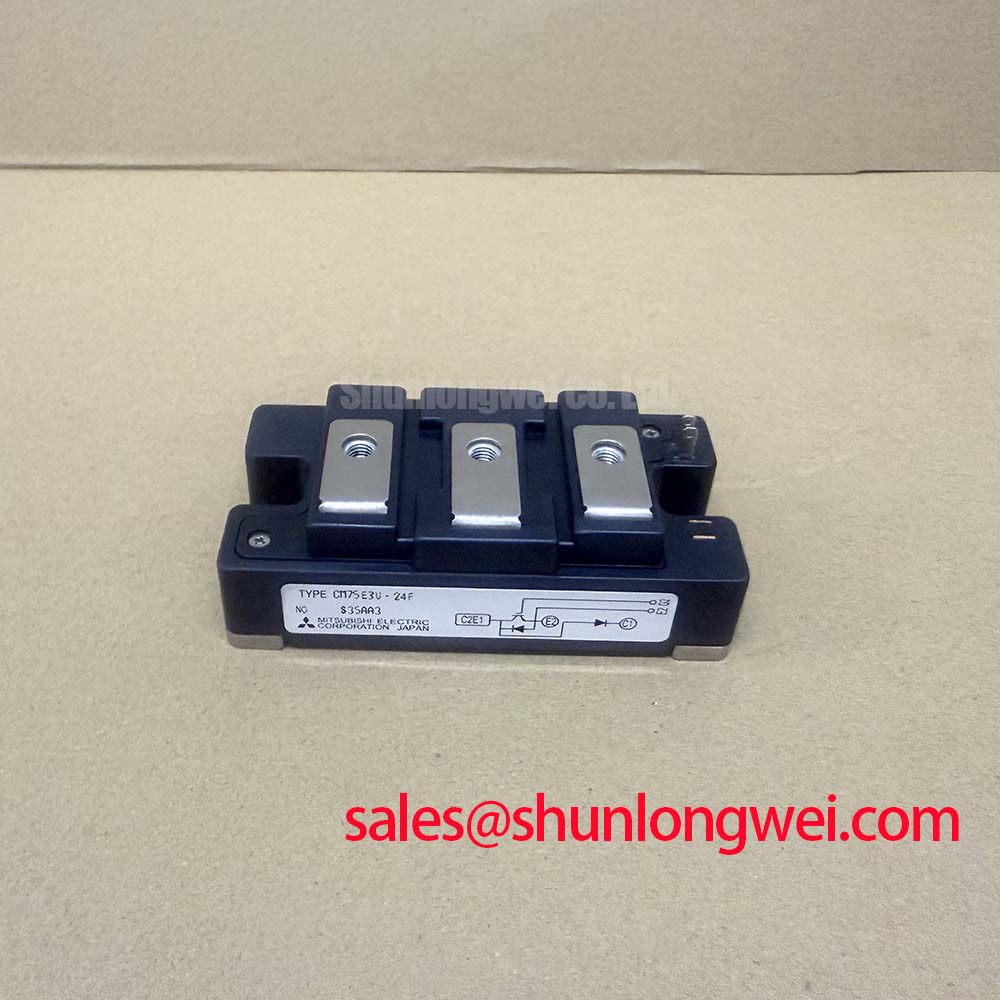

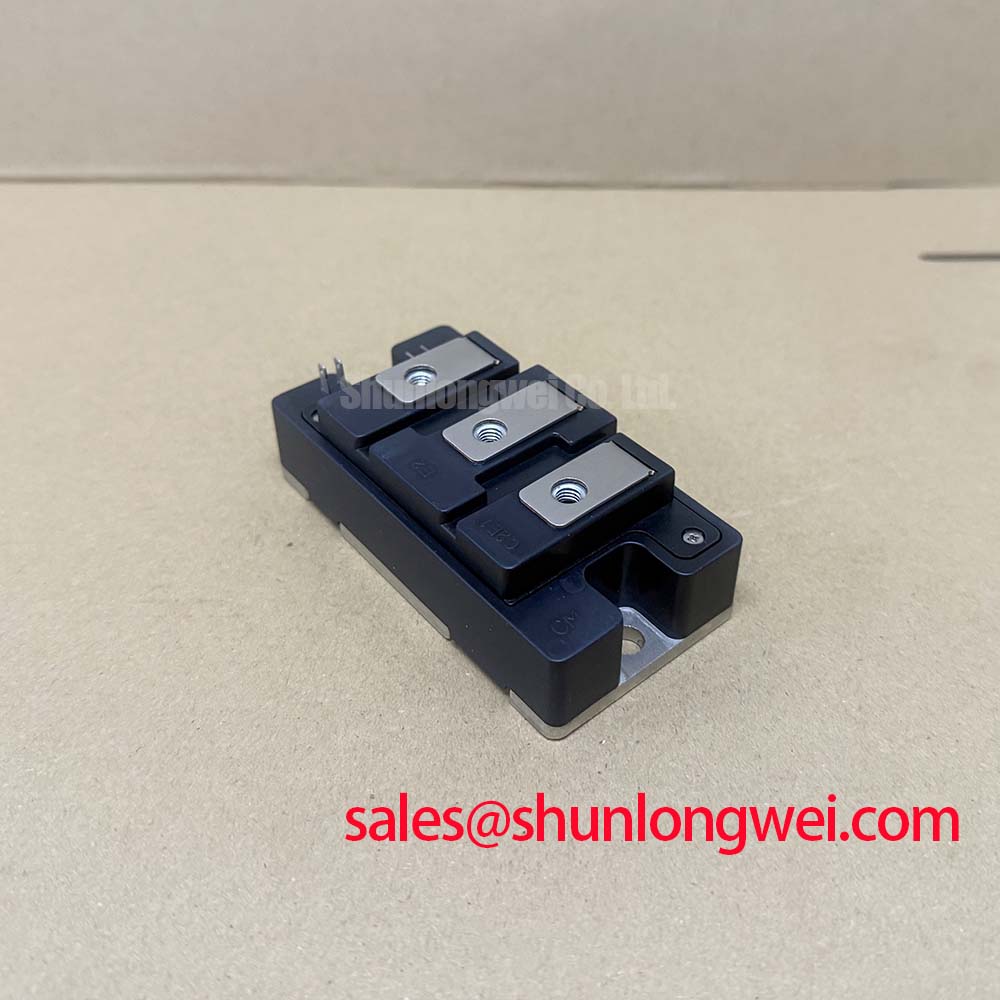

Technical Analysis of U-Series Architecture
The engineering value of the CM75E3U-24F lies in its refined Collector-Emitter Saturation Voltage ($V_{CE(sat)}$). In high-power semiconductors, the $V_{CE(sat)}$ represents the voltage drop across the device when it is fully “on.” By keeping this value low, Mitsubishi reduces the conduction losses that typically lead to overheating in 75A rated modules. This efficiency allows for smaller cooling solutions, which is critical in space-constrained inverter cabinets.
Switching performance is another standout feature of this module. It utilizes a low-inductance internal layout to mitigate parasitic oscillations during high $di/dt$ events. To maximize reliability, engineers must account for the Reverse Bias Safe Operating Area (RBSOA). Operating within these limits prevents the device from entering a latch-up state during hard-switching cycles. You can explore how these factors impact overall system longevity in our guide on IGBT failure root causes.
To better understand the thermal dynamics of the CM75E3U-24F, consider a simple analogy: thermal resistance ($R_{th(j-c)}$) is like the diameter of a water pipe. A wider pipe (lower resistance) allows heat to flow out of the semiconductor junction and into the heatsink with minimal “pressure” (temperature buildup). The CM75E3U-24F is designed with a high-conductivity ceramic substrate that acts as a wide pipe, ensuring that even at peak loads, the internal temperatures stay within the safe operating range defined by the manufacturer.
Optimized Application Scenarios
The technical characteristics of the CM75E3U-24F make it a preferred choice for several high-stakes industrial applications. Understanding the specific topology is key, and you can compare this single-switch approach with others in our analysis of IGBT half-bridge vs. H-bridge topologies.
- Industrial Chopper Circuits: Ideal for DC-DC converters where high-side or low-side switching at 1200V requires a single robust IGBT element.
- Uninterruptible Power Supplies (UPS): The low conduction loss characteristic of the U-Series ensures high energy efficiency during battery-to-AC conversion.
- Solar Inverters: The module’s 1200V rating provides the necessary headroom for high-voltage string inverter designs, handling grid transients effectively.
- Brake Choppers in VFDs: High peak current handling allows the module to dissipate excess energy from motor deceleration safely into braking resistors.
Best Match Conclusion: This module is the optimal choice for high-frequency 1200V systems where thermal headroom and switching precision are prioritied over high current density.
CM75E3U-24F Key Specifications
| Category | Parameter | Value (Typical/Max) |
|---|---|---|
| Absolute Maximum Ratings | Collector-Emitter Voltage ($V_{CES}$) | 1200V |
| Collector Current ($I_C$) | 75A (Continuous) | |
| Junction Temperature ($T_j$) | -40 to +150 °C | |
| Electrical Characteristics | Collector-Emitter Saturation Voltage | 2.1V (Typ at $I_C=75A$) |
| Gate-Emitter Threshold Voltage | 6.0V – 7.5V | |
| Input Capacitance ($C_{ies}$) | 13.5 nF | |
| Thermal & Mechanical | Thermal Resistance ($R_{th(j-c)}$) | 0.21 °C/W (IGBT part) |
| Isolation Voltage | 2500V AC (1 min) |
Engineer FAQ
Q1: What is the recommended mounting torque for the CM75E3U-24F terminals?
A: Proper mechanical installation is vital. For the M5 mounting screws and M5 main terminals, the manufacturer typically specifies a torque range of 2.5 to 3.5 N·m. Incorrect torque can lead to thermal runaway or mechanical stress on the housing. For more details, see our article on IGBT terminal torque risks.
Q2: How can I improve noise immunity in high $dv/dt$ environments with this module?
A: High-frequency switching generates significant noise that can cause parasitic turn-on. Implementing a negative gate voltage (typically -5V to -15V) during the “off” state effectively clamps the gate and prevents unintended activation.
Q3: Does the CM75E3U-24F require a snubber circuit?
A: Yes, in most high-speed switching applications, a snubber capacitor should be mounted as close to the Collector and Emitter terminals as possible to suppress voltage spikes caused by stray inductance during turn-off.
The Mitsubishi CM75E3U-24F serves as a cornerstone for reliable power electronics design, offering the high isolation and low loss necessary for modern industrial standards. By adhering to the datasheet parameters for thermal resistance and switching SOA, engineers can achieve consistent performance in 1200V systems.