SEMIX653GB176D: A Technical Analysis of a 1700V High-Power IGBT Module
SEMIX653GB176D: 1700V 650A Half-Bridge IGBT Module
Introduction and Core Highlights
The SEMIX653GB176D is a high-power, half-bridge IGBT module from Semikron, engineered for demanding high-voltage power conversion systems. This module leverages Semikron’s advanced Trench Gate IGBT technology to provide a robust solution for developers of renewable energy systems and industrial drives. It combines a high blocking voltage with efficient switching characteristics, enabling reliable operation in harsh electrical environments. The integrated anti-parallel CAL (Controlled Axial Lifetime) freewheeling diodes are optimized for soft switching, further reducing power losses.
- Core Specifications: 1700V | 650A (@ 25°C) | VCE(sat) 2.15V (typ)
- Key Advantages: High breakdown voltage for system safety, low conduction losses for enhanced thermal performance.
This technical overview provides key parameters to help determine if the SEMIX653GB176D’s thermal and electrical characteristics meet your specific application’s design margins. For complete specifications, please refer to the official documentation.
Download SEMIX Family Datasheet (PDF)
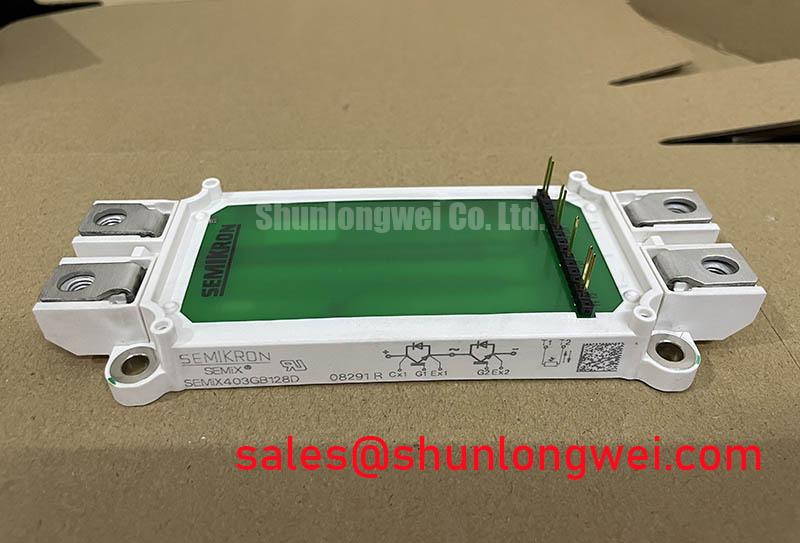

Technical Analysis for System Integration
The standout feature of the SEMIX653GB176D is its 1700V collector-emitter voltage (Vces) rating. This provides a substantial safety margin for applications operating on 800V to 1000V DC-link buses, which are common in large-scale solar inverters and wind turbine converters. This high voltage rating is crucial for ensuring system reliability against voltage transients and overshoots that can occur during switching operations, as detailed in guides on IGBT overvoltage protection.
The module’s conduction efficiency is defined by its collector-emitter saturation voltage (VCE(sat)), which has a typical value of 2.15V at its nominal current. VCE(sat) can be thought of as the voltage drop across the switch when it is fully “on.” A lower value signifies less power dissipated as heat during the conduction phase. This module’s VCE(sat) with a positive temperature coefficient simplifies the process of paralleling modules for higher power output, as it naturally balances current sharing between devices.
Optimized Application Scenarios
The electrical and thermal specifications of the SEMIX653GB176D make it a strong candidate for several high-power industrial applications:
- Wind Turbine Converters: The 1700V rating is well-suited for the high DC-link voltages required to handle the variable power output from wind generation.
- Central Solar Inverters: Its high current handling capability and efficiency are critical for converting DC power from large photovoltaic arrays to AC grid power with minimal loss.
- Industrial Motor Drives: For high-power AC motors, this module provides the necessary voltage and current control with the robustness required in industrial environments.
- Uninterruptible Power Supplies (UPS): The module ensures reliable power conversion in large-scale UPS systems, where uptime and efficiency are paramount.
Its combination of high voltage rating and robust thermal design makes it a best match for applications requiring high reliability under demanding operating conditions.

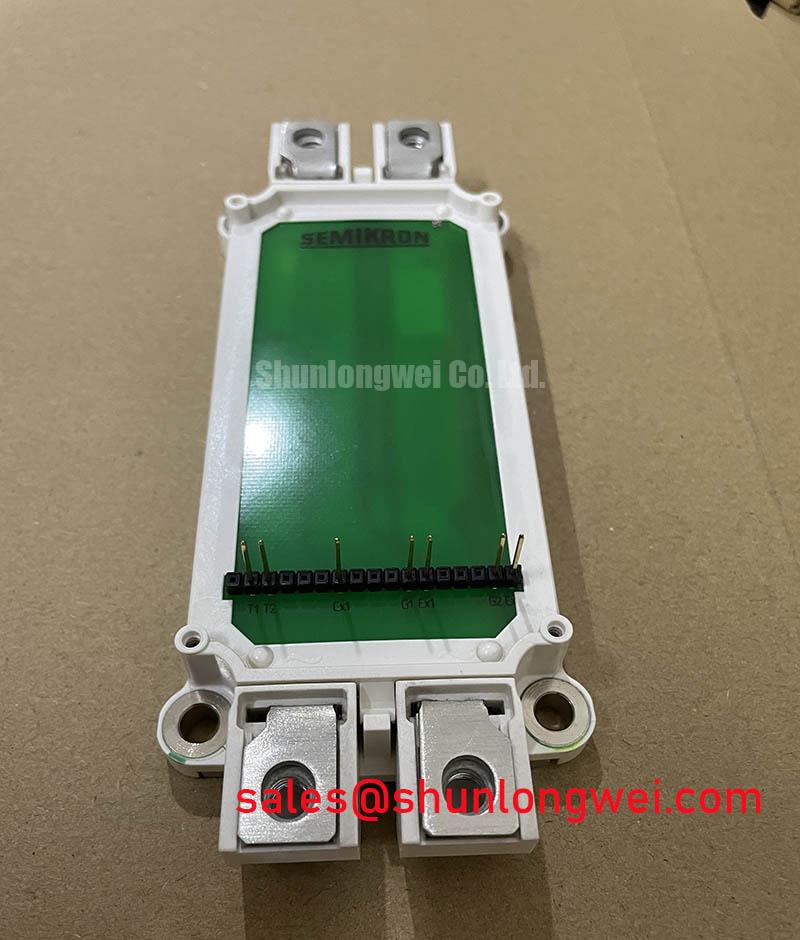
Key Specification Parameters
| Absolute Maximum Ratings (Tcase = 25°C) | |
|---|---|
| Collector-Emitter Voltage (Vces) | 1700V |
| Continuous Collector Current (Ic,nom) | 450A (Tcase = 80°C) |
| DC Collector Current (Ic) | 650A (Tcase = 25°C) |
| Gate-Emitter Voltage (Vges) | ±20V |
| Electrical & Thermal Characteristics (Tj = 125°C unless otherwise specified) | |
| Collector-Emitter Saturation Voltage (VCE(sat), typ.) | 2.15V (at Ic,nom) |
| Total Switching Energy (Ets, typ.) | 110 mJ (at Ic,nom, 1200V) |
| Thermal Resistance, Junction-to-Case (Rth(j-c)) per IGBT | 0.06 K/W |
| Short Circuit Withstand Time (tsc) | 10 µs (Vcc = 1200V, Vge ≤ 15V) |
| Integrated NTC Thermistor | Yes (R25 = 5 kΩ ±5%) |
Engineer’s FAQ
- What are the primary mounting and thermal interface considerations for the SEMIX653GB176D?
- Proper mounting is critical for effective thermal management. The module’s baseplate must be mounted to a heatsink with a specified flatness and roughness. A thermal interface material (TIM) should be applied evenly to minimize the thermal resistance (Rth(c-s)). The specified mounting torque for the electrical terminals and heatsink screws must be followed to ensure reliable, low-resistance connections without inducing mechanical stress.
- How does the integrated NTC thermistor improve system reliability?
- The integrated NTC thermistor provides a direct measurement of the module’s baseplate temperature. This allows the system’s control unit to monitor operating temperature in real-time. This feedback is essential for implementing over-temperature protection, preventing the IGBT junction temperature from exceeding its maximum limit and thus enhancing the long-term reliability of the power system.
- What are the typical gate drive requirements for this IGBT module?
- The datasheet specifies a recommended gate-emitter turn-on voltage of +15V and a turn-off voltage between -8V and -15V. A negative turn-off voltage is recommended to provide a higher immunity to dv/dt induced turn-on, especially in half-bridge configurations. The gate driver must be capable of supplying the peak gate current required to charge and discharge the gate capacitance efficiently to achieve the specified switching times.
Enabling High-Power System Design
The SEMIX653GB176D provides power electronics engineers with a foundational component for building efficient and reliable high-power inverters and converters. Its 1700V rating offers the design margin necessary for systems connected to demanding grids or operating with high DC-link voltages. The balance of low conduction losses and robust construction allows for simplified thermal management and a more compact system footprint, directly addressing the core challenges in high-density power conversion.