SKiiP38AC12T4V1: A Technical Review of a High-Reliability CIB Power Module
SKIIP38AC12T4V1: 1200V, 150A CIB Intelligent Power Module
Integrated Power Stage for Reliable Motor Drives
The Semikron SKiiP38AC12T4V1 is a SEMIKRON integrated intelligent Power (SKiiP) module that combines a three-phase rectifier, a three-phase inverter, and a brake chopper into a single, compact package. This CIB (Converter-Inverter-Brake) topology is engineered for high reliability and power density, leveraging advanced Trench Gate V4 IGBTs and CAL 4 freewheeling diodes. The integration of sintered chips and a solder-free pressure contact mounting system provides a robust solution for modern, high-performance power conversion systems, particularly compact variable frequency drives (VFDs).
- Core Specifications: 1200V | 150A (Nominal Current) | VCE(sat) 1.7V (typ.)
- Key Advantages: Enhanced thermal performance via sintered chip technology, simplified assembly with pressure contact mounting.
Download the official SKiiP38AC12T4V1 Datasheet (PDF)
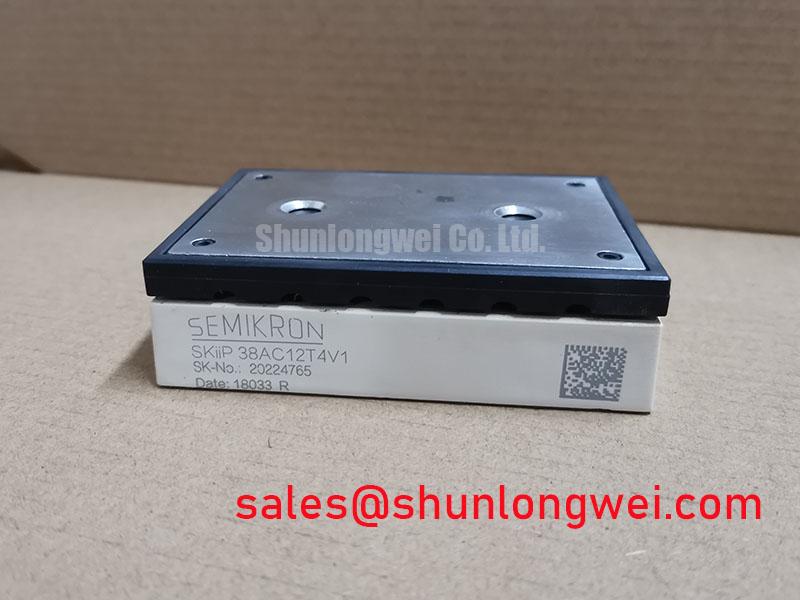
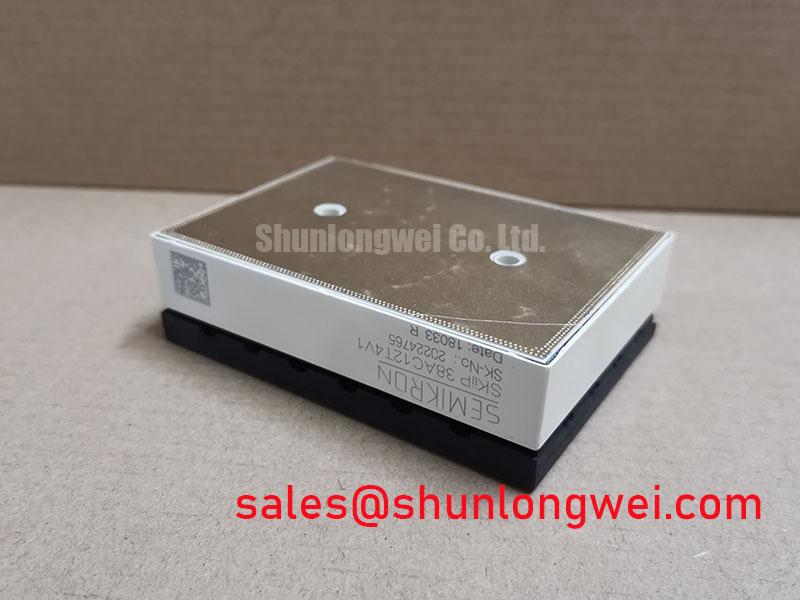
Technical Analysis of Core Features
The engineering value of the SKiiP38AC12T4V1 lies in its highly integrated and robust construction. The CIB configuration consolidates the entire power stage of a typical motor drive into one component. This directly reduces the bill of materials, minimizes PCB footprint, and lowers stray inductance between stages, which can mitigate voltage overshoot during switching. The module includes an integrated driver unit with protection features like Under-Voltage Lockout (UVLO), short-circuit, and over-temperature detection, further simplifying the external gate drive design and enhancing system safety.
A significant factor in the module’s long-term reliability is the use of advanced interconnect technologies. The chips are attached using sintering instead of soldering. You can think of thermal resistance like the width of a pipe for heat to escape; a lower value means a wider pipe. Sintering creates a bond with lower thermal resistance and superior resilience against temperature cycles compared to solder, which can degrade and crack over time. This, combined with the solder-free pressure contact system for heatsink mounting, eliminates two common failure mechanisms in high-power modules, contributing to extended operational life under demanding thermal loads.

Optimized Application Scenarios
This module’s characteristics make it a strong candidate for several power conversion applications:
- Variable Frequency Drives (VFDs): The all-in-one CIB topology is an ideal match, simplifying manufacturing and shrinking the inverter’s physical size.
- Servo Drives: The integrated current sensor provides precise feedback for motor control loops, a key requirement for servo applications.
- Uninterruptible Power Supplies (UPS): The low conduction losses (VCE(sat) of 1.7V) and integrated brake chopper are beneficial for efficiency and battery bus management.
- Solar Inverters: The CAL 4 diodes feature soft recovery characteristics, which helps to reduce electromagnetic interference (EMI) and switching losses at high frequencies.
Based on its integrated nature and robust thermal design, this module is best matched for applications requiring high power density and operational reliability.
Key SKIIP38AC12T4V1 Specifications
| Parameter | Value |
|---|---|
| Inverter Absolute Maximum Ratings (Tcase = 25°C) | |
| Collector-Emitter Voltage (VCES) | 1200 V |
| DC Collector Current (IC) | 200 A (Tj = 175°C) |
| Nominal Collector Current (ICnom) | 150 A |
| Inverter Electrical Characteristics (Tj = 25°C) | |
| Collector-Emitter Saturation Voltage (VCE(sat)) | 1.7 V (typ. at ICnom) |
| Turn-on Switching Energy (Eon) | 24.0 mJ (typ.) |
| Turn-off Switching Energy (Eoff) | 22.0 mJ (typ.) |
| Rectifier Absolute Maximum Ratings | |
| Repetitive Peak Reverse Voltage (VRRM) | 1600 V |
| Thermal Characteristics | |
| Thermal Resistance, Junction to Heatsink (Rth(j-s)) – Inverter | 0.12 K/W (per IGBT) |
| Operating Junction Temperature (Tj op) | -40 to +150 °C |
Engineer’s Frequently Asked Questions (FAQ)
1. What are the key considerations for mounting SKiiP pressure contact modules?
Proper mounting is critical for reliability. Unlike standard screw-on modules, the SKiiP38AC12T4V1 requires a specific mounting clamp to apply uniform pressure. The heatsink surface must be clean and meet a flatness tolerance specified in the datasheet (typically ≤ 20 µm over the module area) to ensure optimal thermal contact.
2. How does the sintered chip technology benefit the design’s lifetime?
Sintered silver provides a stronger, more thermally conductive bond between the semiconductor die and the substrate compared to traditional solder. This reduces thermal stress during power cycles (temperature swings), significantly improving the module’s resistance to fatigue and extending its operational lifetime in applications with frequent start/stop or load changes.
3. What do the integrated current and temperature sensors simplify?
These integrated sensors eliminate the need for external components like current shunts, Hall-effect sensors, and thermistors. This reduces PCB complexity, lowers assembly costs, and provides a tight feedback loop for the control system. The on-board sensors deliver direct, real-time data for implementing precise control, over-current protection, and thermal management.
Enabling Compact and Robust System Design
The SKiiP38AC12T4V1 provides a technically advanced foundation for power conversion systems. Its combination of a fully integrated CIB power stage, comprehensive protection, and reliability-focused technologies like chip sintering and pressure contact mounting allows engineers to develop more compact, efficient, and durable motor drives and inverters.