SKM100GAL123D: A Technical Analysis of a High-Efficiency IGBT Module
SKM100GAL123D IGBT Module for Efficient Power Conversion
Technical Analysis of the SKM100GAL123D SEMITRANS 2 Module
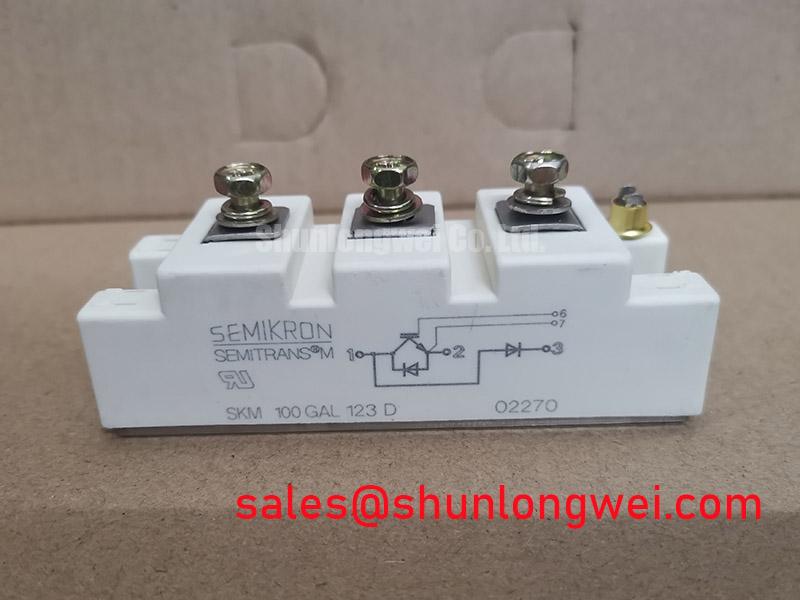
The Semikron SKM100GAL123D is a half-bridge IGBT module engineered for efficient and reliable operation in demanding power conversion systems. Its unique value proposition lies in the integration of Trench Gate Field-Stop IGBT technology with soft-recovery CAL (Controlled Axial Lifetime) freewheeling diodes. This combination delivers a superior balance between low on-state losses and controlled switching behavior, directly addressing the core needs of industrial power system designers.
- Core Specifications: 1200V | 100A (Nominal) | VCE(sat) 1.7V (typ)
- Key Advantages: Minimized conduction losses enhance thermal performance, while the integrated soft-recovery diode reduces voltage overshoots and electromagnetic interference (EMI).
- Design Simplification: An integrated NTC thermistor provides a direct path for temperature monitoring, simplifying the implementation of thermal protection schemes.
Download the Official SKM100GAL123D Datasheet (PDF)

A Deeper Look at Performance Characteristics
A critical parameter for efficiency in any power module is the collector-emitter saturation voltage (VCE(sat)). The SKM100GAL123D specifies a typical VCE(sat) of 1.7V at its nominal current of 100A (at Tj=25°C). This low on-state voltage is a direct result of its Trench Field-Stop IGBT structure. You can think of thermal resistance (Rth(j-c)) like the width of a pipe for heat; this module’s low value of 0.17 K/W per IGBT signifies a very wide pipe, allowing heat to escape efficiently from the semiconductor junction to the heatsink. This minimizes junction temperature rise and enhances system reliability. For more on thermal management, see our guide on mastering IGBT thermal design.
While low conduction loss is vital, switching performance is equally important. The module incorporates a CAL freewheeling diode, which exhibits a “soft” recovery characteristic. This feature is instrumental in suppressing voltage overshoots and oscillations during the diode’s turn-off phase. The result is a significant reduction in generated EMI, which can simplify the design of external snubber circuits and filtering components, saving both board space and cost. This controlled switching is a cornerstone of robust gate drive design.


Optimized Application Scenarios
The electrical and thermal characteristics documented in the datasheet indicate this module’s suitability for a range of medium-power industrial applications. The balance of efficiency and robustness makes it a strong candidate for systems where reliability is paramount.
- Variable Frequency Drives (VFDs): The soft-recovery diode minimizes EMI, crucial for motor control, while the low VCE(sat) reduces heat dissipation in the inverter stage.
- Uninterruptible Power Supplies (UPS): High efficiency directly translates to lower operating costs and reduced cooling requirements for the overall system.
- Solar Inverters: The module’s robust thermal cycling capability and efficient energy conversion help maximize the power harvested from photovoltaic arrays.
- Welding Equipment: The device’s specified short-circuit withstand time (tpsc) of 10 µs provides the necessary ruggedness for the demanding pulse-load conditions found in welding power supplies.
Its blend of low losses, controlled switching, and robust packaging makes the SKM100GAL123D a prime component for industrial inverters and power supplies.
Key Specifications of the SKM100GAL123D
| Parameter | Value | Conditions |
|---|---|---|
| Absolute Maximum Ratings | ||
| Collector-Emitter Voltage (VCES) | 1200 V | Tj = 25 °C |
| Continuous DC Collector Current (IC) | 140 A | Tcase = 25 °C |
| Nominal Collector Current (IC, nom) | 100 A | |
| IGBT Characteristics (per switch) | ||
| Collector-Emitter Saturation Voltage (VCE(sat)) | 1.7 V (typ), 2.15 V (max) | IC = 100 A, VGE = 15 V, Tj = 25 °C |
| Gate-Emitter Threshold Voltage (VGE(th)) | 5.8 V (typ) | |
| Thermal and Mechanical Characteristics | ||
| Thermal Resistance, Junction-to-Case (Rth(j-c)) | 0.17 K/W | per IGBT |
| Operating Junction Temperature (Tj, op) | -40 to +150 °C | |
Engineer’s Frequently Asked Questions
1. How is the thermal performance of the SKM100GAL123D managed in a system?
Effective thermal management is achieved through its low junction-to-case thermal resistance (0.17 K/W per IGBT) and the use of a Direct Copper Bonded (DCB) baseplate. For accurate real-time monitoring, the module includes an integrated NTC thermistor, allowing the control system to track operating temperature and implement over-temperature protection.
2. What are the recommended mounting torque specifications?
According to the datasheet, for reliable mechanical and thermal contact, the mounting screws (M5) should be tightened to a torque of 3 – 6 Nm. The power terminals (M6) require a torque of 3 – 5 Nm. Adhering to these values is critical to prevent damage and ensure optimal heat transfer.
3. What is the main advantage of the “CAL” diode technology used in this module?
The CAL (Controlled Axial Lifetime) freewheeling diode is engineered for a “soft” recovery characteristic. This means it has a lower peak reverse recovery current and a less abrupt turn-off. The primary engineering advantage is a significant reduction in voltage spikes and EMI, which simplifies system design and improves reliability, especially in applications like power semiconductors for motor drives.
This power module enables engineers to develop high-efficiency power converters with simplified thermal management and improved electromagnetic compatibility. The thoughtful integration of Trench IGBT and CAL diode technologies within the robust SEMITRANS 2 package delivers a component aligned with the demands of modern industrial systems.