SKM100GB12T4 IGBT Module: A Deep Dive into Performance and Integration
SKM100GB12T4: Semikron 1200V 100A IGBT Module Analysis
Introduction to the SKM100GB12T4 Half-Bridge Module
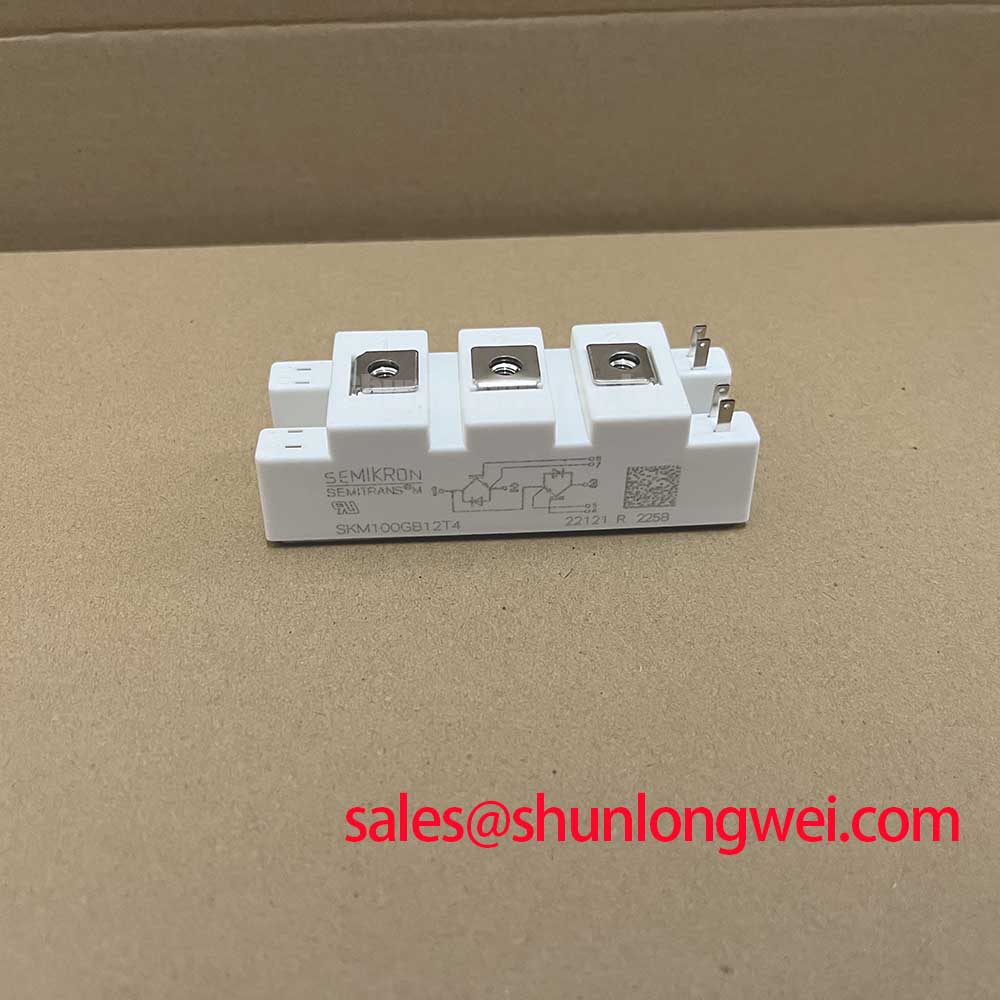
The Semikron SKM100GB12T4 is a SEMITRANS® 2 IGBT module that provides a robust half-bridge configuration for high-reliability power converters. It leverages Semikron’s Trench Gate 4 IGBT technology and complementary CAL 4 freewheeling diodes to establish a strong balance between conduction and switching performance. This design focuses on minimizing thermal losses and simplifying system-level thermal management. For engineers developing demanding industrial systems, this module offers a proven platform for efficient power switching.
- Core Specifications: 1200V | 100A (nominal) | VCE(sat) 1.7V (typ. @ 125°C)
- Key Advantages: Low conduction losses reduce heatsink requirements, and soft diode recovery characteristics minimize EMI.
The module’s low VCE(sat) is a direct result of its Trench Gate IGBT structure, which reduces power dissipation during operation, a critical factor in motor drive applications.
Download Official Datasheet (PDF)


Technical Analysis for System Integration
The engineering value of the SKM100GB12T4 is rooted in its chip technology. The use of 4th generation Trench Gate IGBTs directly contributes to a low collector-emitter saturation voltage (VCE(sat)) of 1.7V (typical at 100A, 125°C). This parameter is crucial for system efficiency. Think of VCE(sat) as the width of a pipe; a lower value signifies a wider pipe, allowing electrical current to flow with less “friction” or resistance. This translates directly to lower conduction losses and less waste heat, which can enable the use of smaller, more cost-effective heatsinks.
Complementing the IGBTs are the CAL 4 (Controlled Axial Lifetime) freewheeling diodes. These diodes are engineered for “soft” recovery, meaning they transition from a conducting to a blocking state smoothly. This characteristic reduces voltage spikes and high-frequency ringing (EMI) during switching. For design engineers, this can simplify or even eliminate the need for external snubber circuits, saving board space and component cost while helping to meet stringent EMC regulations. The module also includes a 10 µs short-circuit withstand time, providing a critical safety margin for robust system protection.
Reliable thermal performance is further supported by the module’s low thermal resistance from junction to case (Rth(j-c)) of 0.17 K/W per IGBT. This efficient thermal path is monitored by an integrated NTC thermistor. The NTC provides real-time temperature data to the system controller, enabling precise over-temperature protection and supporting predictive maintenance algorithms.
Optimized Application Scenarios
The SKM100GB12T4’s balanced feature set makes it well-suited for several industrial applications:
- AC Motor Drives: Its low VCE(sat) and efficient switching reduce overall losses in the inverter stage, improving drive efficiency and reliability. The half-bridge configuration is a fundamental building block for three-phase inverters.
- Uninterruptible Power Supplies (UPS): High efficiency is critical for minimizing standby power consumption, and the module’s proven reliability and short-circuit rating ensure dependable operation during power grid failures.
- Industrial Welders: The module’s fast switching capabilities (up to 20 kHz) and robust thermal design allow it to handle the high-frequency, high-current pulses common in modern welding power supplies.
- Solar Inverters: In solar applications, high conversion efficiency is paramount. The low total switching and conduction losses of this module help maximize the energy harvested from PV arrays.
With its efficient T4 IGBTs and soft-recovery diodes, this module is best matched for hard-switching inverter designs requiring robust performance and thermal stability.


Key Specifications of the SKM100GB12T4
| Parameter | Value | |
|---|---|---|
| Absolute Maximum Ratings (Tj = 25°C) | ||
| Collector-Emitter Voltage (VCES) | 1200 V | |
| Continuous DC Collector Current (IC @ Tc=80°C) | 100 A | |
| Repetitive Peak Collector Current (ICRM) | 200 A | |
| Short Circuit Withstand Time (t_psc) | 10 µs | |
| Electrical & Thermal Characteristics | ||
| VCE(sat) (IC=100A, VGE=15V, Tj=125°C) | 1.7 V (typ), 2.1 V (max) | |
| Gate-Emitter Threshold Voltage (VGE(th)) | 5.2V to 6.4V | |
| Total Switching Energy (E_on + E_off @ IC=100A, Tj=125°C) | 28.5 mJ (typ) | |
| Thermal Resistance, Junction to Case (Rth(j-c) per IGBT) | 0.17 K/W | |
| Isolation Voltage (Visol) | 2500 V (AC, 1 min) | |
Note: All specifications are sourced directly from the official Semikron datasheet. For detailed graphs and test conditions, refer to the document.
Engineer’s FAQ
- How do I calculate the required heatsink performance for the SKM100GB12T4?
- To perform a first-order thermal calculation, first determine the total power loss (P_total), which is the sum of conduction and switching losses under your operating conditions. The required heatsink thermal resistance (Rth_sa) can be estimated using the formula: Rth_sa ≤ [(Tj_max – Ta) / P_total] – Rth_jc – Rth_cs. Here, Tj_max is the maximum junction temperature (150°C), Ta is the ambient temperature, Rth_jc is the junction-to-case thermal resistance (0.17 K/W for the IGBT), and Rth_cs is the thermal resistance of the thermal interface material between the module and heatsink. For a more precise calculation, consult the transient thermal impedance curves in the datasheet.
- What is the purpose of the CAL 4 freewheeling diode?
- The CAL 4 (Controlled Axial Lifetime) diode is designed for soft switching recovery. This reduces voltage overshoot and oscillation (EMI) during the diode’s turn-off phase. This characteristic is particularly beneficial in hard-switched applications like motor drives and UPS, as it can reduce the need for external snubber circuits and simplify EMC filtering, leading to a more compact and cost-effective design. Learn more about how freewheeling diodes impact system performance.
- What are the mounting torque specifications for this SEMITRANS 2 module?
- According to Semikron’s mounting instructions for the SEMITRANS 2 package, the main power terminals (M5 screws) should be tightened to a torque of 2.5 – 5.0 Nm. The mounting screws for securing the module to the heatsink (M6 screws) require the same torque of 2.5 – 5.0 Nm. Applying the correct torque is critical to ensure low thermal resistance and prevent mechanical stress on the module’s ceramic substrate.
- Can the SKM100GB12T4 be connected in parallel?
- Yes, the datasheet indicates that the IGBTs have a positive temperature coefficient for VCE(sat). This feature promotes self-balancing of current between paralleled devices. However, successful paralleling requires careful attention to symmetrical PCB layout and busbar design to minimize differences in stray inductance. Uneven inductance can lead to current imbalance, especially during fast switching events.
Enabling Reliable Power Conversion
The SKM100GB12T4 provides a foundation for developing power electronic systems where efficiency and reliability are primary objectives. By combining low-loss Trench 4 silicon with soft-recovery CAL 4 diodes in a proven industrial package, this module empowers engineers to meet demanding thermal and electrical performance targets. Its characteristics facilitate simpler cooling system design and enhanced electromagnetic compatibility.