SKM2x75 GAH126D: A Technical Review of a High-Efficiency 1200V IGBT Module
SKM2x75 GAH126D | 1200V 275A Half-Bridge IGBT Module
Introduction and Core Highlights
The Semikron SKM2x75 GAH126D is a half-bridge IGBT module engineered for high-efficiency power conversion in demanding industrial applications. This module’s distinct value lies in its integration of Trench Field-Stop IGBTs with CAL (Controlled Axial Lifetime) freewheeling diodes, delivering a superior balance of low conduction losses and robust switching performance. It provides a reliable foundation for developing compact and thermally efficient power systems.
- Core Specifications: 1200 V | 275 A (at Tc=80°C) | VCE(sat) 1.9 V (typ)
- Key Advantages: Minimized power dissipation due to low on-state voltage. Enhanced reliability from the isolated copper baseplate construction.
- Application Focus: Well-suited for variable frequency drive (VFD) designs where minimizing thermal load under various operating conditions is critical.
Download Official Datasheet (PDF)
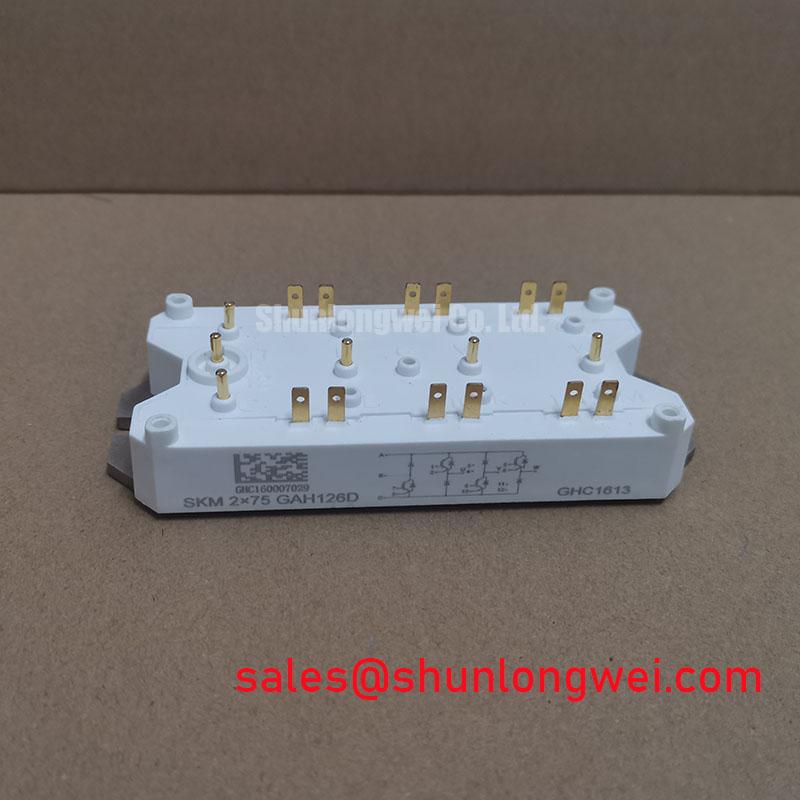

Technical Analysis: Efficiency and Robustness by Design
The engineering behind the SKM2x75 GAH126D focuses on minimizing total power losses. The module utilizes Trench Field-Stop IGBT technology, which is instrumental in achieving a low collector-emitter saturation voltage (VCE(sat)) of 1.9V under nominal current. This low VCE(sat) directly reduces conduction losses, a major source of heat in high-current applications. Think of thermal resistance as the width of a pipe for heat; the module’s low junction-to-case thermal resistance (0.09 K/W per IGBT) ensures the “pipe” is wide, allowing heat to escape efficiently from the silicon die to the heatsink. This prevents overheating and enhances system longevity.
Complementing the IGBTs are the integrated CAL freewheeling diodes. These diodes are optimized for soft recovery characteristics, which means they reduce voltage overshoots and oscillations during the IGBT turn-off phase. This behavior is crucial for minimizing switching losses and electromagnetic interference (EMI). For engineers, this translates into a more stable system that may require less complex gate drive and snubber circuits, streamlining the overall design process and improving reliability.

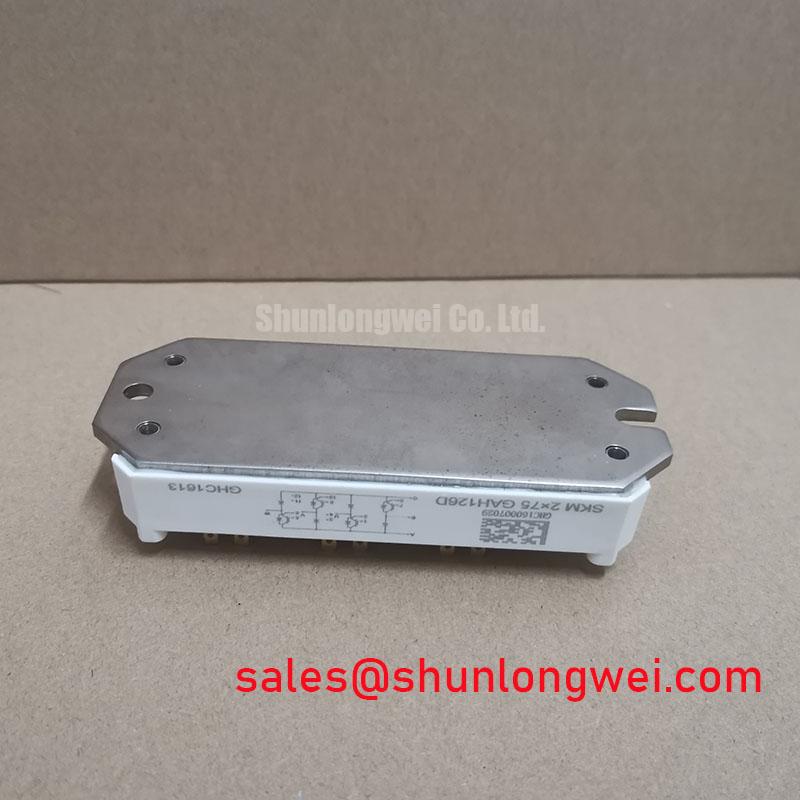
Optimized Application Scenarios
The specific characteristics of the SKM2x75 GAH126D make it a strong candidate for several power conversion applications:
- AC Inverter and Servo Drives: The module’s ability to handle high pulse currents and its efficient thermal dissipation are ideal for the dynamic load cycles inherent in motor control.
- Uninterruptible Power Supplies (UPS): Its low conduction losses contribute to higher overall system efficiency, a critical metric for backup power systems.
- Welding Power Supplies: The robust construction and proven reliability of the SEMITRANS package can withstand the harsh electrical and thermal stresses found in welding equipment.
- Solar Inverters: High efficiency is paramount for maximizing energy harvest. The low switching and conduction losses of this module contribute directly to this goal.
This module is an optimal match for three-phase inverter systems operating up to approximately 100 kW, where efficiency and thermal stability are primary design requirements.
Key Specification Parameters
| Electrical & Thermal Characteristics (Tj = 25 °C unless otherwise noted) | |
|---|---|
| Collector-Emitter Voltage (V_CES) | 1200 V |
| Continuous DC Collector Current (IC @ Tc = 80 °C) | 275 A |
| Collector-Emitter Saturation Voltage (V_CE(sat), typ. @ IC,nom, Tj = 125 °C) | 1.9 V |
| Gate-Emitter Threshold Voltage (V_GE(th)) | 5.0 V to 6.5 V |
| Total Power Dissipation (P_tot @ Tc = 25 °C) | 1650 W |
| Thermal Resistance, Junction to Case (R_th(j-c), per IGBT) | 0.09 K/W |
| Max. Junction Temperature (T_jmax) | 150 °C |
Engineer’s FAQ
- What are the recommended gate drive voltage levels for the SKM2x75 GAH126D?
- The datasheet specifies a recommended turn-on gate-emitter voltage (Vge) of +15V and a turn-off voltage between -8V and -15V. Using a negative turn-off voltage provides a higher noise margin against parasitic turn-on events caused by high dv/dt.
- How important is mounting torque for this module’s thermal performance?
- Proper mounting is critical. The datasheet specifies a mounting torque for the main terminals and for securing the module to the heatsink. Applying the correct torque ensures uniform contact between the module’s copper baseplate and the heatsink, minimizing thermal interface resistance and preventing mechanical stress on the housing.
- Can this module be used in parallel for higher current applications?
- Yes, but careful design is required. The positive temperature coefficient of VCE(sat) helps with thermal balancing between parallel modules. However, engineers must ensure symmetrical layout for the DC link and gate drive connections to minimize stray inductance and ensure current shares evenly, a topic further explored in parasitic inductance analysis.
- What is the primary benefit of the integrated NTC thermistor?
- The integrated NTC allows for real-time monitoring of the module’s baseplate temperature. This data is essential for the control system to implement over-temperature protection, preventing the IGBTs from exceeding their maximum junction temperature and significantly improving system safety and long-term reliability.
Enabling Efficient and Reliable Power Designs
The SKM2x75 GAH126D IGBT module provides a robust, high-performance solution for power electronics engineers. By combining low-loss Trench-Gate technology with a thermally efficient package, it enables the development of systems that are not only powerful but also reliable and compact. This component is a technically sound choice for advancing the performance benchmarks of modern power conversion systems.