StarPower GD200HFL120C8SNH: A Technical Analysis for High-Efficiency Power Systems
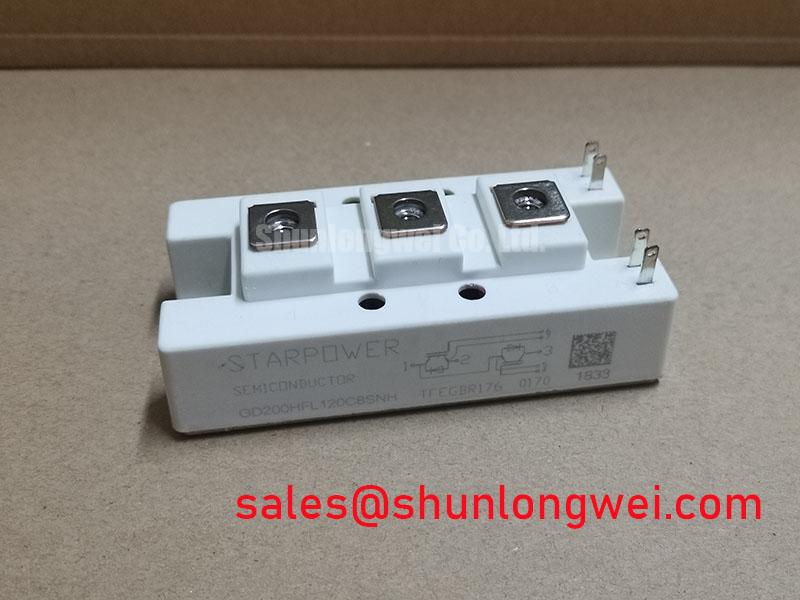
StarPower GD200HFL120C8SNH 1200V 200A IGBT Module
Introduction and Core Highlights
The StarPower GD200HFL120C8SNH is a half-bridge IGBT power module that delivers a balance of low conduction losses and robust operational reliability. This module leverages an advanced trench field-stop IGBT structure alongside a soft and fast-recovery freewheeling diode, making it a well-suited component for high-frequency power conversion systems. It provides engineers a platform for developing power stages with improved thermal performance and power density.
- Core Specifications: 1200V | 200A | VCE(sat) (typ) 1.85V
- Key Advantages: Low conduction and switching losses, integrated NTC for temperature monitoring.
Download the Official GD200HFL120C8SNH Datasheet (PDF)


Technical Analysis for System Optimization
A primary attribute of the GD200HFL120C8SNH is its low collector-emitter saturation voltage (VCE(sat)), specified at a typical value of 1.85V at its nominal current and a junction temperature of 125°C. This parameter is crucial as it directly dictates the amount of power dissipated as heat during the on-state. Think of VCE(sat) as the friction in a mechanical system; lower friction results in less wasted energy and heat generation. This characteristic enables designers to potentially reduce the size and cost of the required heatsink, contributing to a more compact and cost-effective overall system design.
The module integrates a fast and soft-recovery freewheeling diode (FWD) co-packaged with the IGBT. The “soft” recovery characteristic of the diode is engineered to reduce voltage overshoots and oscillations during turn-off, which mitigates electromagnetic interference (EMI). For engineers, this can simplify the design and qualification process by reducing the need for extensive snubber circuits and other EMI filtering components, leading to a more streamlined and reliable gate drive design.

Optimized Application Scenarios
The technical specifications of the GD200HFL120C8SNH align it with several demanding power conversion applications:
- Industrial Motor Drives: The module’s ability to handle 200A continuously, combined with its efficient thermal transfer, makes it suitable for AC servo and variable frequency drives (VFDs) that require precise motor control and high reliability.
- Solar Inverters: In solar inverter applications, low switching and conduction losses are paramount for maximizing energy harvest. This IGBT’s efficiency helps increase the overall energy conversion rate from the photovoltaic array to the grid.
- Uninterruptible Power Supplies (UPS): The module’s robust short-circuit withstand time of 10μs provides a critical safety margin, enhancing the reliability of high-capacity UPS systems designed to protect critical infrastructure.
- Welding Equipment: The fast switching performance supports the high-frequency operation required in modern inverter-based welding power supplies, enabling finer control and improved weld quality.
This module is an optimal match for systems where minimizing power loss and ensuring stable operation under load are primary design objectives.
Key Specification Parameters
| Absolute Maximum Ratings (TC = 25°C unless otherwise noted) | |
|---|---|
| Collector-Emitter Voltage (VCES) | 1200V |
| Continuous Collector Current (IC) @ TC=100°C | 200A |
| Gate-Emitter Voltage (VGES) | ±20V |
| Short Circuit Withstand Time (tsc) | 10μs |
| Electrical & Thermal Characteristics (Tj = 125°C unless otherwise noted) | |
| Collector-Emitter Saturation Voltage (VCE(sat)) (Typical) | 1.85V @ IC=200A, VGE=15V |
| Total Switching Energy (Ets) (Typical) | 18.5 mJ @ IC=200A, VCC=600V |
| Thermal Resistance, Junction-to-Case (Rth(j-c)) per IGBT | 0.21 °C/W |
| Maximum Junction Temperature (Tvjmax) | 175°C |
Engineer’s FAQ
- What is the purpose of the integrated NTC thermistor?
- The GD200HFL120C8SNH includes an NTC (Negative Temperature Coefficient) thermistor to provide real-time temperature feedback from the module’s baseplate. This allows the system’s control unit to monitor operating temperature, implement over-temperature protection, and optimize performance, which is a key factor for IGBT module safety and reliability.
- How should I approach thermal design for this 200A module?
- Effective thermal management is critical. First, calculate the total power loss (conduction and switching losses) based on your specific application’s duty cycle and frequency. Using the Rth(j-c) value of 0.21 °C/W from the datasheet, along with the thermal resistance of your thermal interface material (TIM) and heatsink, you can determine the required heatsink performance to keep the junction temperature below the 175°C maximum rating.
- What are the recommended gate drive voltage settings?
- The datasheet specifies the electrical characteristics with a gate-emitter voltage (VGE) of ±15V. A positive voltage of +15V is recommended for turning the IGBT on to ensure it is fully saturated and achieves the low VCE(sat) value. A negative voltage of -15V is recommended for turn-off to provide a strong noise margin against parasitic turn-on.
- Is this module suitable for paralleling?
- The datasheet indicates that the VCE(sat) has a positive temperature coefficient. This characteristic is beneficial for paralleling multiple modules, as it helps to ensure natural current sharing between devices. As one module heats up, its on-state resistance increases slightly, encouraging current to flow through the cooler, parallel modules, thus promoting a balanced thermal load.
Enabling Efficient and Robust Power Systems
The GD200HFL120C8SNH IGBT module provides the core performance characteristics required for modern power conversion systems. Its design focuses on reducing total power losses and enhancing operational robustness, allowing engineers to develop systems that meet stringent efficiency targets while maintaining high reliability over the operational lifetime.