SKM400GB123D: A Technical Analysis for High-Power Applications
SKM400GB123D: 1200V 400A Half-Bridge IGBT Module
Introduction and Core Highlights
The Semikron SKM400GB123D is a half-bridge IGBT module that integrates Trench Gate and Field Stop technologies with a CAL (Controlled Axial Lifetime) freewheeling diode. This design achieves a highly effective balance between conduction and switching losses, providing a robust solution for high-power inverter and converter applications. Its architecture is focused on delivering high efficiency and reliable thermal performance for demanding industrial systems.
- Core Specifications: 1200V | 400A (Nominal) | VCE(sat) 2.5V (typ.)
- Key Advantages: Low conduction losses reduce heatsink requirements, and the soft-recovery CAL diode minimizes EMI and voltage overshoot.
For engineers evaluating thermal management strategies, the module’s specified thermal resistance is a critical parameter for ensuring system reliability under load. For complete specifications, download the official datasheet (PDF).
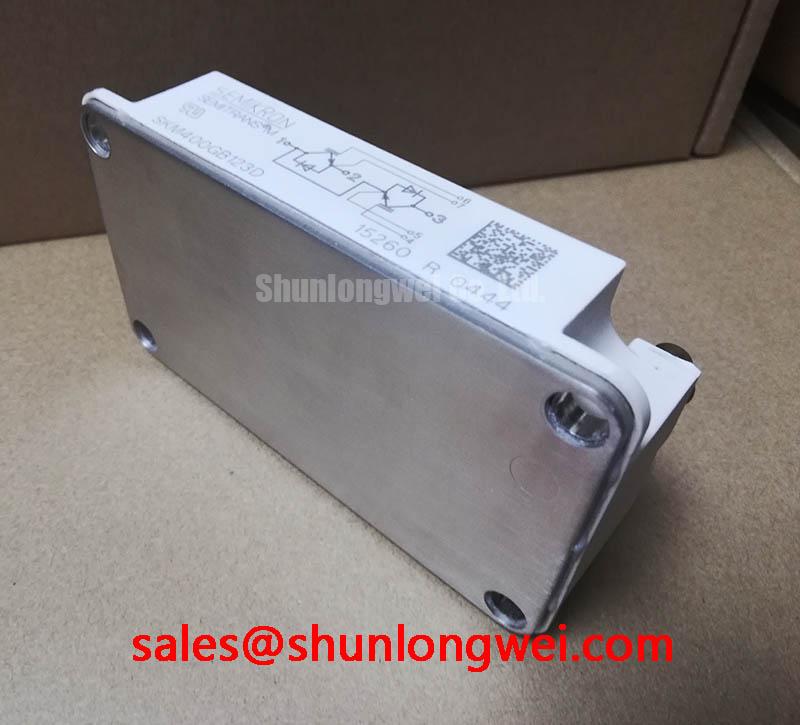

Technical Analysis: Efficiency and Robustness
The engineering value of the SKM400GB123D lies in its specific combination of silicon technologies. The use of Trench Gate IGBTs creates a higher channel density on the die, which directly lowers the on-state resistance. This results in a low collector-emitter saturation voltage (VCE(sat)) of 2.5V at the nominal 300A current. A lower VCE(sat) directly translates to lower conduction power loss (P = VCE(sat) * Ic), meaning less heat is generated and thermal management is simplified. Think of VCE(sat) as the friction on a moving part; lower friction means less energy is wasted as heat, allowing the system to run more efficiently.
Complementing the IGBT is the integrated CAL freewheeling diode. In hard-switching applications like motor drives, the diode’s recovery characteristic is critical. A “snappy” or fast-recovery diode can cause significant voltage overshoots and ringing, which generates EMI and stresses the IGBT. The CAL diode is engineered for a “soft” recovery, controlling the turn-off behavior to reduce these transients. This inherent softness can reduce the need for external snubber circuits, saving board space and component cost while improving system reliability.

Optimized Application Scenarios
The SKM400GB123D’s electrical and thermal characteristics make it a strong candidate for several high-power applications:
- AC Motor Drives: Its high current capability (up to 390A at a case temperature of 25°C) and robust diode are well-suited for the inductive loads and dynamic switching conditions found in variable frequency drives (VFDs).
- Uninterruptible Power Supplies (UPS): The module’s low thermal resistance from junction to case (0.05 K/W per IGBT) ensures efficient heat extraction, a critical factor for maintaining reliability in high-availability UPS systems.
- Solar and Wind Inverters: The 1200V breakdown voltage provides a safe operating margin for grid-tied inverters that operate with high DC bus voltages, while the efficient design helps maximize energy conversion.
- Welding Power Supplies: The module’s ability to handle high pulse currents and its robust thermal design are beneficial for the demanding, cyclical loads characteristic of industrial welding equipment.
This module is best suited for three-phase inverter designs operating in the 150 kW to 250 kW range, where efficiency and thermal stability are primary design requirements.
Key Specifications of the SKM400GB123D
| Parameter | Value | Conditions |
|---|---|---|
| Collector-Emitter Voltage (VCES) | 1200 V | Tj = 25 °C |
| Continuous Collector Current (IC) | 390 A / 260 A | Tc = 25 °C / 80 °C |
| Collector-Emitter Saturation Voltage (VCE(sat)) | 2.5 V (typ.), 3.0 V (max.) | IC = 300 A, VGE = 15 V, Tj = 25 °C |
| Gate-Emitter Threshold Voltage (VGE(th)) | 4.5 V to 6.5 V | IC = 12 mA |
| Diode Forward Voltage (VF) | 2.0 V (typ.) | IF = 300 A, VGE = 0 V, Tj = 25 °C |
| Thermal Resistance, Junction-Case (Rth(j-c)) | 0.05 K/W | Per IGBT |
| Isolation Voltage (Visol) | 2500 V | AC, 1 minute |
Engineer’s FAQ
- What is the primary consideration for the thermal design when using the SKM400GB123D?
- The primary consideration is the total power loss (conduction + switching) and the thermal resistance path to the ambient air. Using the Rth(j-c) of 0.05 K/W for the IGBT and Rth(j-c)D of 0.125 K/W for the diode, you must calculate the junction temperature based on your load profile. Ensure your chosen heatsink, combined with thermal interface material, has a low enough thermal resistance (Rth(c-s) + Rth(s-a)) to keep the maximum junction temperature below the 150°C limit.
- What are the recommended mounting torque specifications?
- The datasheet specifies a mounting torque of 3 to 5 Nm for the M6 heatsink mounting screws. Applying the correct torque is critical for ensuring low thermal resistance between the module baseplate and the heatsink. Insufficient torque leads to poor thermal contact, while excessive torque can cause mechanical stress and damage the module’s isolated baseplate. The electrical terminals also use M6 screws with a specified torque.
- What advantage does the CAL diode provide in a motor drive application?
- In motor drives, the CAL diode’s “soft” recovery characteristic is highly beneficial. When the IGBT turns on, the diode in the opposite switch must turn off. A soft recovery reduces the rate of current change (di/dt), which minimizes induced voltage overshoots across the IGBT. This improves reliability and reduces electromagnetic interference (EMI), which is a common challenge in power system design.
- Can this module be used in high-frequency applications?
- The SKM400GB123D is optimized for a balance between conduction and switching losses, making it suitable for typical motor drive frequencies (a few kHz up to ~15 kHz). While the turn-on (Eon) and turn-off (Eoff) energies are specified (38 mJ and 40 mJ respectively at 300A, 125°C), they become the dominant source of power loss at higher frequencies. For applications significantly above 20 kHz, a different IGBT technology or a SiC module might be more appropriate.
Design Enablement
The SKM400GB123D provides a dependable and efficient building block for high-power conversion systems. Its integration of a low-loss Trench Gate IGBT with a soft-recovery CAL diode allows engineers to develop power stages with simplified thermal management, improved reliability, and lower system-level EMI. This component is engineered to support the construction of robust and efficient industrial power electronics.