Semikron SKT240/12E: A Technical Guide to Industrial Power Control
SKT240/12E Thyristor Module for Industrial Power Control
Reliable AC Power Regulation with the Semikron SKT240/12E
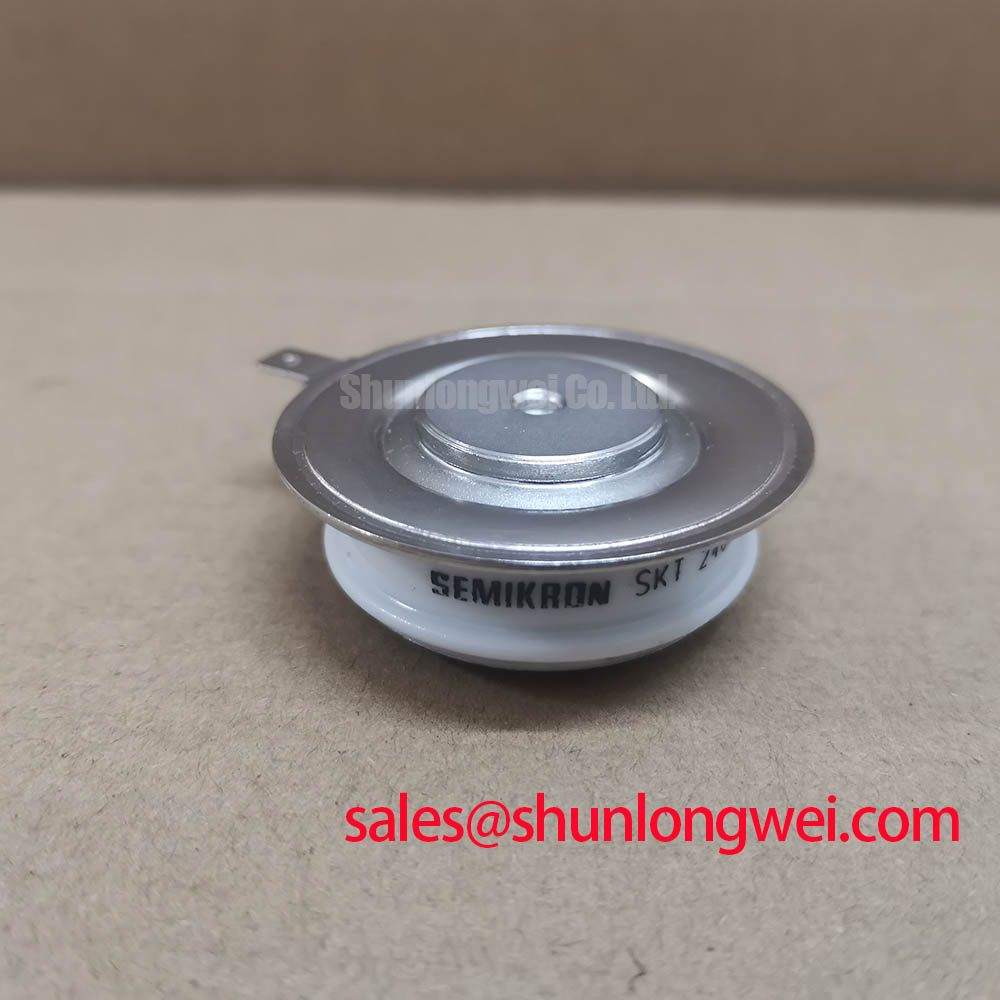
The Semikron SKT240/12E is a thyristor module engineered for robust performance in line-frequency power control systems. This device integrates a thyristor and a diode in a series configuration within a rugged SEMIPACK® 2 capsule package. Its core value proposition is delivering high operational reliability and efficient thermal management, facilitated by its hard-soldered internal construction and electrically isolated copper baseplate. This makes the module a durable component for demanding industrial environments.
- Core Specifications: 1200V VRRM | 240A ITAV | Tvj -40 to +130°C
- Key Advantages: High surge current capability, simplified cooling due to isolated baseplate.
- Design Benefit: The SKT240/12E’s design with glass-passivated chips ensures stable blocking characteristics throughout its service life.
Download the Official SKT240/12E Datasheet (PDF)

Technical Analysis for System Integration
The engineering of the SKT240/12E focuses on long-term stability in industrial settings. A key feature is the use of glass-passivated thyristor chips. This process seals the active silicon junction with a layer of glass, protecting it from moisture and contaminants that could otherwise degrade blocking voltage capability over time. This construction ensures predictable performance, a critical factor in power systems where device failure can lead to significant downtime.
Another integral aspect of its design is its thermal efficiency. The module’s low thermal resistance from junction to case (Rth(j-c)) is specified at 0.12 °C/W for the thyristor. This parameter can be imagined as the width of a pipeline for heat; a lower value signifies a wider pipe, allowing heat to flow easily away from the active silicon to the heatsink. The SEMIPACK® 2 housing, with its isolated copper baseplate, simplifies the mounting process onto a heatsink, eliminating the need for additional insulating materials and ensuring an effective thermal interface. This robust thermal management is essential for maintaining reliability under heavy current loads.
Optimized Application Scenarios
The SKT240/12E is specified for applications where control of line-frequency AC power is the primary requirement.
- AC Motor Soft Starters: The module’s ability to handle high inrush currents (ITSM up to 7500A) makes it ideal for gradually ramping up voltage to large induction motors, reducing mechanical and electrical stress.
- Controlled Rectifiers: For battery chargers and DC power supplies, this module allows for the creation of efficient and controllable single-phase or three-phase rectifier bridges.
- Industrial Heater Control: Its precise phase-angle control capability enables accurate temperature regulation in industrial ovens and furnaces, optimizing energy consumption.
- Lighting Dimmers: Suitable for high-power architectural and stage lighting systems, providing smooth control of illumination levels.
This module is a best-fit for systems needing dependable, low-frequency power control with simplified thermal design and a long operational lifespan.
Key Specifications of the SKT240/12E
| Absolute Maximum Ratings | |
|---|---|
| Repetitive Peak Reverse Voltage (VRRM) | 1200 V |
| On-state Current (ITAV, Tc=85°C) | 240 A |
| Peak Surge On-state Current (ITSM, 10 ms) | 7500 A |
| Electrical & Thermal Characteristics (Tvj=25°C unless otherwise specified) | |
| On-state Voltage (VT(TO)) | ≤ 1.05 V |
| Gate Trigger Current (IGT) | ≤ 150 mA |
| Thermal Resistance, Junction to Case (Rth(j-c)) | ≤ 0.12 °C/W (per thyristor) |
| Isolation Test Voltage (VISOL, 50 Hz, 1 min.) | 3000 V~ |
Engineer’s FAQ for the SKT240/12E
1. What is the recommended mounting procedure for the SKT240/12E to ensure proper thermal contact?
According to the datasheet, the module should be mounted to a heatsink with a mounting torque of 5 Nm (±10%) using M6 screws. A thin layer of thermal grease (0.1-0.2 mm) must be applied to the baseplate to ensure minimal thermal resistance. Proper torque is critical to avoid damaging the module’s ceramic substrate while ensuring a void-free thermal interface.
2. How does the internal thyristor/diode configuration benefit a single-phase AC controller design?
This module contains one thyristor and one diode in series. For a basic single-phase AC controller (half-wave control), this single module can control one half-cycle of the AC waveform. For full-wave control, two of these modules would be connected in an anti-parallel configuration, simplifying the overall circuit compared to using four discrete devices for a full bridge.
3. Is a snubber circuit required for the SKT240/12E?
While the datasheet specifies a critical rate of rise of off-state voltage (dv/dt)cr of at least 500 V/µs, the manufacturer generally recommends using a snubber circuit (e.g., an RC network) in practical applications. This is especially important in environments with high inductive loads to prevent spurious triggering of the thyristor due to voltage transients.
4. What is the advantage of the SEMIPACK® 2 case?
The Semikron SEMIPACK® 2 is an industry-standard power module housing known for its durability. Its key advantages include an electrically isolated baseplate, which simplifies assembly and enhances safety, and screw terminals for reliable, high-current connections. This standardized footprint allows for easy mechanical integration and potential second-sourcing.
Enabling Robust Power Systems
The SKT240/12E thyristor module provides a foundation for reliable and efficient control in high-power industrial applications. Its combination of a durable, isolated package, glass-passivated silicon, and well-defined thermal characteristics allows engineers to develop power control systems with predictable performance and an extended operational life. This focus on fundamental robustness makes it a sound choice for critical infrastructure.