Fuji 7MBR100VX120-50: A Technical Analysis of an Integrated IGBT Power Module
Fuji 7MBR100VX120-50 1200V 100A PIM IGBT Module
Introduction to an Integrated Power Solution
The Fuji Electric 7MBR100VX120-50 is a Power Integrated Module (PIM) that consolidates a three-phase converter, a three-phase inverter, and a dynamic brake circuit into a single, compact package. This module leverages Fuji’s V-series IGBT technology to deliver a balance of low conduction loss and robust thermal performance, streamlining the design of high-efficiency power conversion systems.
- Core Specifications: 1200V | 100A (Inverter) | VCE(sat) 2.20V (Typ.)
- Key Advantages: Simplifies PCB layout and assembly, reduces overall system size.
- Integrated Monitoring: Features an internal NTC thermistor for direct temperature feedback.
Engineers can achieve a smaller system footprint by replacing multiple discrete components with this single module, reducing both stray inductance and assembly complexity.
Download Official Datasheet (Link)
Technical Analysis: Integration and Efficiency
The primary value of the 7MBR100VX120-50 lies in its high level of integration. By incorporating the rectifier, inverter, and brake chopper into one housing, designers can significantly reduce the bill of materials (BOM) and simplify the manufacturing process. This integration also minimizes the parasitic inductance between power stages, an important factor in reducing voltage overshoot during high-speed switching operations. The module’s design facilitates more predictable and reliable system performance compared to solutions built from discrete components.
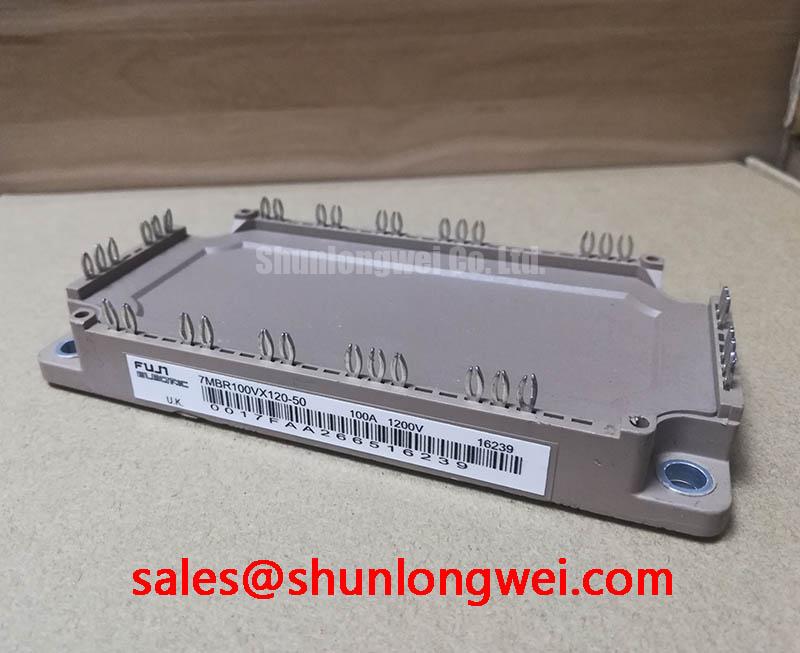

At the core of the inverter and brake sections are Fuji’s V-Series IGBTs, which are engineered for a low collector-emitter saturation voltage (VCE(sat)) of 2.20V at a 100A collector current. This parameter is critical for minimizing conduction losses, which directly impacts the module’s overall energy efficiency and heat generation. The thermal resistance from junction to case (Rth(j-c)) for the inverter section is specified at 0.24 °C/W per device. This value can be compared to the width of a pipe for heat flow; a lower thermal resistance allows heat to escape the semiconductor die more effectively, keeping the junction temperature lower and enhancing the module’s long-term reliability.
Optimized Application Scenarios
The specific feature set of the 7MBR100VX120-50 makes it an excellent fit for several medium-power industrial applications.
- AC and DC Servo Drives: The integrated brake circuit is essential for controlling motor deceleration and regenerating energy, making this PIM a complete power stage solution for precision motion control.
- Inverters for Motor Drives: For general-purpose variable frequency drives (VFDs), the 7-in-1 configuration dramatically shrinks the inverter’s physical size and cost.
- Uninterruptible Power Supplies (UPS): The module’s high efficiency and compact form factor are advantageous in UPS systems where power density and minimal energy loss are key design requirements.
This module is best matched for systems requiring a complete, tested power stage to accelerate development time and improve manufacturing consistency.
Key Specification Parameters
| Parameter | Symbol | Inverter Section | Brake Section | Converter Section | Unit | |
|---|---|---|---|---|---|---|
| Collector-Emitter Voltage | VCES | 1200 | 1200 | – | V | |
| Continuous Collector Current (Tc=100°C) | IC | 100 | – | – | A | |
| Collector-Emitter Saturation Voltage (Typ) | VCE(sat) | 2.20 (at 100A) | 2.20 (at 75A) | – | V | |
| Repetitive Peak Reverse Voltage | VRRM | 1200 (Diode) | 1200 (Diode) | 1600 | V | |
| Max. Junction Temperature | Tj max | 175 | 175 | 150 | °C | |
| Isolation Voltage (AC, 1 min.) | Viso | 2500 | VAC | |||
Engineer’s FAQ
What is the main benefit of using a PIM like the 7MBR100VX120-50 over discrete components?
The primary advantage is system simplification. A PIM integrates a full power stage (rectifier, inverter, brake) into a single, thermally optimized, and electrically characterized component. This reduces assembly time, simplifies the supply chain, lowers stray inductance, and shrinks the overall equipment size.
How should thermal management be approached for this module?
Effective thermal management starts with selecting an appropriate heatsink based on the calculated power losses and the module’s thermal resistance values provided in the datasheet. The datasheet specifies a mounting torque of 2.5-3.5 Nm for the M5 screws. Proper application of thermal interface material (TIM) and ensuring the specified mounting torque is crucial for minimizing contact thermal resistance and achieving the expected thermal performance.
What is the purpose of the integrated NTC thermistor?
The built-in NTC thermistor provides a means for real-time temperature monitoring close to the IGBT chips. The gate driver or system controller can use this analog feedback to implement over-temperature protection, trigger cooling fan speed adjustments, or scale back system power to prevent thermal runaway, thus improving system safety and reliability.
Does this module comply with RoHS?
Yes, the datasheet for the 7MBR100VX120-50 explicitly states that it is a RoHS compliant product.
Enabling Compact Power Designs
For engineers developing motor drives, servo amplifiers, and UPS systems, the Fuji 7MBR100VX120-50 offers a direct path to a more compact, reliable, and efficient design. Its 7-in-1 integration of V-series technology provides a pre-validated power stage, allowing design teams to focus on system-level innovation rather than the complexities of discrete power component layout and power semiconductor matching.