Semikron SKiM304GD12T4D 1200V 300A Baseplate-less IGBT Module: Overview and Technical Analysis
Semikron SKiM304GD12T4D 1200V 300A IGBT Module
Introduction and Core Highlights
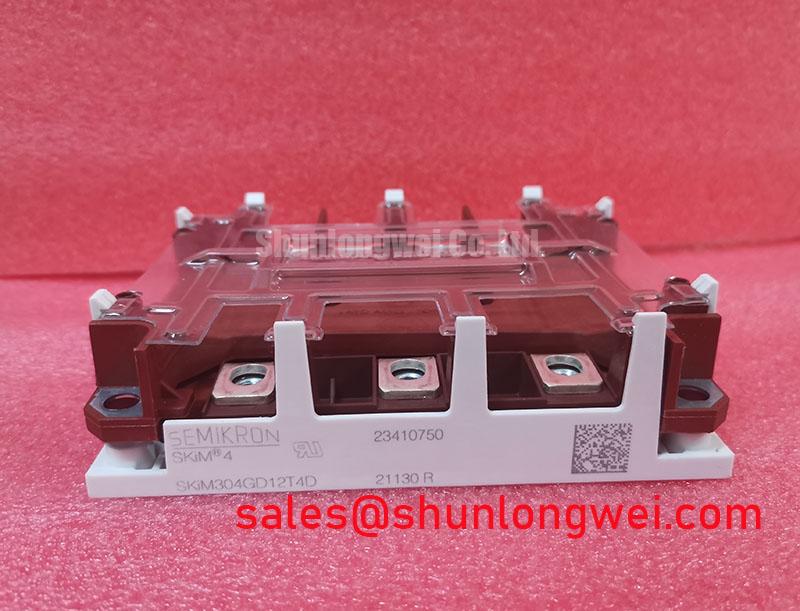
The Semikron SKiM304GD12T4D is a baseplate-less, three-phase bridge IGBT Module utilizing Trench IGBT4 technology. By eliminating the traditional copper baseplate and implementing pressure contact technology, this module mitigates the mechanical stresses associated with thermal cycling. For engineers sourcing high-reliability components, it answers the critical question of how to maximize power cycling lifetime under demanding industrial loads.
- Core Ratings: 1200V | 300A nominal ($I_C$) | $V_{CE(sat)}$ typ. 1.80V (at $T_j = 25^circtext{C}$)
- Engineering Benefits: Solder-free spring contacts for simplified driver assembly and reduced thermal interface resistance.
Download Official Datasheet (PDF)


Technical Analysis and Unique Value Proposition
The primary advantage of the SKiM304GD12T4D lies in its baseplate-less architecture. Standard modules mount silicon chips onto a ceramic substrate, which is soldered to a copper baseplate. Because copper and ceramics expand at different rates when heated, thermal cycling degrades the solder layer over time. By using pressure contact technology directly onto the heatsink, this module eliminates the large copper baseplate entirely. You can read a detailed breakdown of this design approach in our guide to baseplate-less IGBT modules.
To explain this thermal path, think of thermal resistance ($R_{th(j-s)}$) as a narrow bottleneck in a water pipe. The narrower the bottleneck (or the more layers the heat must pass through), the slower the water flows. Removing the copper baseplate and its associated solder layer is like widening the pipe. This allows thermal energy to flow directly from the ceramic substrate to the heatsink. This configuration yields a low junction-to-sink thermal resistance ($R_{th(j-s)}$ of 0.088 K/W per IGBT), keeping junction temperatures within safe limits.
Electrical performance is driven by Trench IGBT4 technology paired with Semikron’s soft-switching CAL Diode. The system features a low collector-emitter saturation voltage $V_{CE(sat)}$ of 1.80V at nominal currents. This minimizes conduction losses, while the integrated gate-emitter spring contacts ensure consistent signal transmission without solder fatigue. Safety monitoring is handled by an integrated NTC thermistor, providing real-time temperature feedback directly from the substrate.
Optimized Application Scenarios
- Industrial Motor Drives: The 1200V rating provides voltage headroom for 400VAC three-phase industrial motor control systems.
- Solar Inverters: Low switching losses improve the overall power conversion efficiency of grid-tied photovoltaic systems.
- Uninterruptible Power Supplies (UPS): Fast switching capability helps maintain clean output voltage waveforms under non-linear loads.
Best-Match Verdict: Factual datasheet parameters position this 1200V/300A module as a reliable choice for high-duty cycle industrial motor drives and solar inverter systems.
Key Specifications Table
| Absolute Maximum Ratings ($T_c = 25^circtext{C}$ unless specified) | ||
|---|---|---|
| Collector-Emitter Voltage | $V_{CES}$ | 1200 V |
| Continuous Collector Current | $I_C$ ($T_s = 25^circtext{C} / 80^circtext{C}$) | 340 A / 262 A |
| Nominal Collector Current | $I_{C(nom)}$ | 300 A |
| Electrical Characteristics (Typical at $T_j = 25^circtext{C}$) | ||
| Collector-Emitter Saturation Voltage | $V_{CE(sat)}$ ($I_C = 300text{A}$) | 1.80 V (2.20 V at $T_j = 150^circtext{C}$) |
| Gate Threshold Voltage | $V_{GE(th)}$ | 5.8 V (min 5.0 V, max 6.5 V) |
| Turn-on Delay Time | $t_{d(on)}$ ($R_{G(on)} = 1.5Omega$) | 175 ns |
| Turn-off Delay Time | $t_{d(off)}$ ($R_{G(off)} = 1.5Omega$) | 515 ns |
| Thermal & Sensor Specifications | ||
| IGBT Thermal Resistance (Junction to Sink) | $R_{th(j-s)}$ | 0.088 K/W |
| NTC Rated Resistance | $R_{100}$ (at $T_c = 100^circtext{C}$) | 493 $Omega$ ($pm 5%$) |
Engineer’s FAQ
Q: How do you calculate the thermal resistance for the heatsink using baseplate-less modules?
A: Because there is no baseplate, the thermal resistance path is measured directly from the junction to the sink ($R_{th(j-s)}$). When designing the cooling system, thermal paste thickness must be kept thin (typically 20-30 $mutext{m}$) to avoid increasing thermal resistance.
Q: What mounting challenges exist with the SKiM304GD12T4D solderless spring contacts?
A: The spring contacts rely on uniform pressure from the mechanical housing. Mounting screws must be tightened using a specific torque sequence to prevent uneven contact force, which can cause gate driver signal integrity issues.
Q: Does the SKiM304GD12T4D support high-frequency switching applications?
A: The Trench IGBT4 technology is optimized for switching frequencies between 4 kHz and 15 kHz. Operating beyond this range requires careful analysis of the gate drive loop to manage the Miller plateau and switching losses.
Closing Statement
The Semikron SKiM304GD12T4D provides a baseplate-less, 1200V, 300A solution for industrial power semiconductors. Its pressure contact design and solder-free control terminals reduce mechanical stress points. This configuration helps engineers meet long-term system reliability targets in challenging thermal cycling environments.