EL640.200-SK: A Rugged TFEL Display Engineered for Extreme Environments
EL640.200-SK ICEBrite™ TFEL Display for Extreme Environments
Unmatched Readability and Durability in Demanding Conditions
The EL640.200-SK is an ICEBrite™ Thin Film Electroluminescent (TFEL) display module engineered for exceptional visual performance and operational integrity in harsh environmental conditions. Its core value proposition is delivering unwavering reliability and clarity where conventional displays fail, particularly in applications subject to extreme temperatures and high mechanical stress. With its solid-state construction, this display provides instant-on performance and a blur-free viewing experience across its entire operational range, addressing the critical need for dependable human-machine interfaces in rugged systems.
- Core Specifications: 640×200 Resolution | -40°C to +65°C Operating Temperature | 100 g Shock Resistance
- Key Advantages: Instant-on performance in extreme cold, exceptional readability in high ambient light.
- Primary Applications: Avionics, industrial control, marine instrumentation, and ruggedized portable devices.
Download Official Datasheet (PDF)
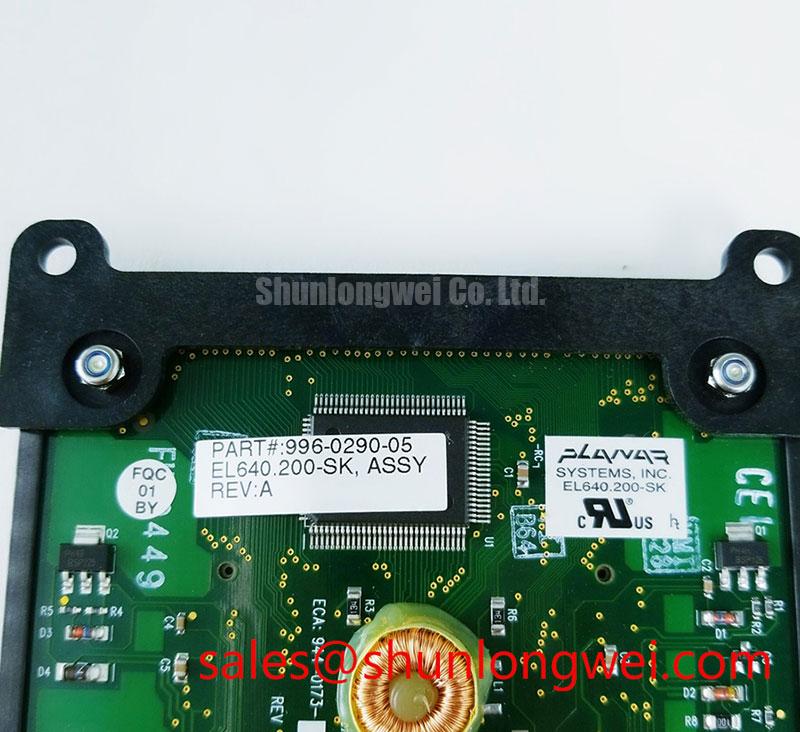

Technical Analysis of Performance Under Stress
The engineering value of the EL640.200-SK is rooted in its intrinsic TFEL technology. Unlike liquid crystal displays, this module has no liquid components that can freeze or lose performance in sub-zero conditions. The specified operating temperature range of -40°C to +65°C is a direct result of its solid-state, inorganic structure. Furthermore, the unit is rated to withstand a 100 g, 4 ms half-sine shock pulse. This level of mechanical resilience makes it suitable for equipment mounted on vehicles or heavy machinery where constant vibration and sudden impacts are common. For more details on engineering for such conditions, see our guide to vibration and shock resistance for industrial displays.
Visual performance is equally robust. A key parameter is the contrast ratio, specified as greater than 50:1 in a 500 lux ambient environment. This high-contrast output ensures crisp, legible characters and graphics, even under direct, bright light. The display’s response time is another critical factor. At less than 1 millisecond, the pixel response time ensures that fast-moving graphics or scrolling text are displayed without motion blur or ghosting. To use an analogy, a sub-1ms response time is like a high-speed camera shutter; it freezes motion perfectly, whereas a slower response would create a blurry streak. This clarity is essential for applications like avionics and real-time process monitoring.

Optimized Application Scenarios
The specific characteristics of the EL640.200-SK make it a superior choice for several demanding fields:
- Avionics and Ground Vehicles: The wide operating temperature range and documented resistance to shock and vibration ensure reliability in cockpits and vehicle-mounted systems.
- Industrial Control Panels: Its immunity to EMI and high contrast make it ideal for factory floors with high ambient light and electrical noise. Explore related HMI specifications in our article on smart factory HMI.
- Marine and Offshore Equipment: The greater than 160° viewing angle allows multiple crew members to view critical data from different positions on a ship’s bridge.
- Medical Diagnostic Systems: The fast response time and blur-free imaging are essential for displaying real-time patient data, such as ECG waveforms, with absolute clarity.
This module is the optimal choice for systems where operational failure is not an option and visual performance under stress is paramount.
Key Specifications for the EL640.200-SK
| Optical and Mechanical Specifications | |
|---|---|
| Resolution | 640 x 200 pixels |
| Active Area | 195.1 mm x 62.3 mm |
| Typical Brightness | 52 cd/m² |
| Contrast Ratio (in 500 lux) | > 50:1 |
| Viewing Angle | > 160° |
| Response Time | < 1 ms |
| Environmental and Reliability Ratings | |
| Operating Temperature | -40°C to +65°C |
| Storage Temperature | -50°C to +105°C |
| Shock Resistance | 100 g, 4 ms, half sine |
| Mean Time Between Failures (MTBF) | > 50,000 hours |
Engineer’s Frequently Asked Questions
1. What makes the EL640.200-SK suitable for extreme cold and high-shock environments where standard LCDs might fail?
Its Thin Film Electroluminescent (TFEL) technology is inherently solid-state. Unlike LCDs, it contains no liquid crystal material that can freeze or suffer from slow response times at low temperatures. Its inorganic glass construction provides superior rigidity, enabling it to withstand the documented 100 g shock rating.
2. What are the primary power supply requirements for integrating the EL640.200-SK?
The module requires two primary DC voltages as specified in the datasheet: a +5 VDC supply for logic and a +12 VDC supply. The datasheet provides detailed specifications on current draw, ripple, and regulation for proper system design.
3. What is the typical lifespan and reliability of this TFEL display?
The datasheet specifies a Mean Time Between Failures (MTBF) exceeding 50,000 hours. The brightness half-life, which is the time until the display reaches 50% of its initial brightness, is typically greater than 30,000 hours under standard operating conditions. For further reading, see this article on industrial display reliability.
4. How does the viewing angle of this TFEL display compare to standard TN-type LCDs?
The EL640.200-SK offers a viewing angle of over 160°, meaning the image remains clear and consistent with minimal contrast or color shift from almost any viewing direction. This is a significant advantage over many traditional TN-film TFT-LCDs, which typically have much narrower viewing angles that can lead to image degradation when viewed off-axis.
Enabling Data Clarity in Unforgiving Environments
For engineers developing systems that must perform flawlessly in the most demanding physical and thermal environments, the EL640.200-SK provides a proven, solid-state display solution. Its intrinsic durability and consistent visual clarity deliver critical data without compromise, ensuring operational reliability when it matters most.