2MBI450VH-120-50 IGBT Module: A Technical Analysis for High-Power Systems
2MBI4S-120-060 Dual IGBT Module: Technical Analysis
The 2MBI4S-120-060 is a 600V, 450A dual IGBT module from Fuji Electric’s V-Series, engineered for high-performance power conversion systems. This module integrates two IGBTs in a half-bridge configuration, providing a compact and efficient solution for demanding applications. Its core value propositions are a high maximum junction temperature of 175°C and low saturation voltage, which together enable enhanced power density and superior thermal performance. This design allows engineers to develop more compact systems without compromising on reliability or efficiency.
- Core Specifications: 1200V | 450A | VCE(sat) 2.20V (max)
- Key Advantages: High thermal headroom, reduced conduction losses.
- Engineering Focus: Optimized for reliability in high-power motor drives and inverters.
For complete specifications, download the official 2MBI450VH-120-50 datasheet (PDF).
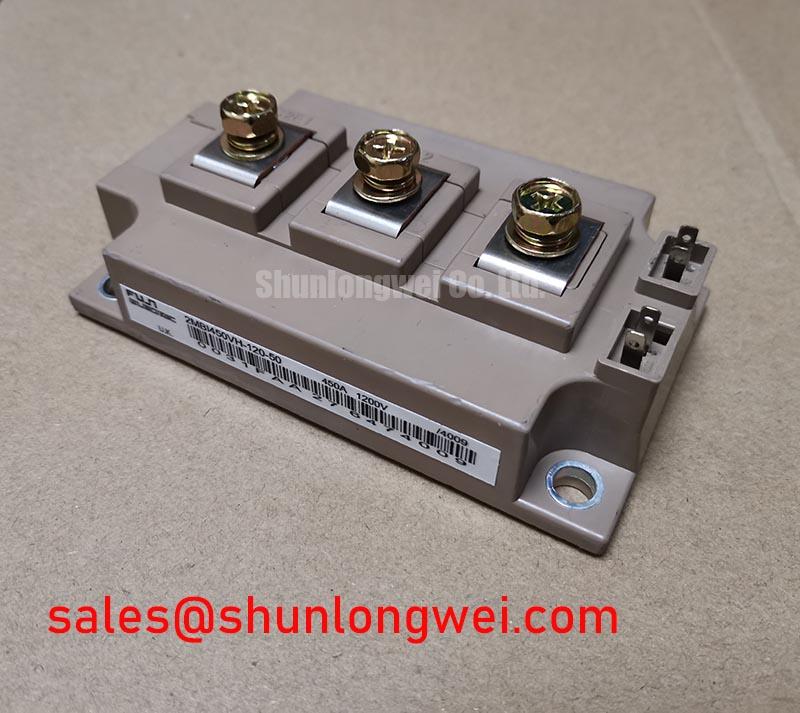

Technical Analysis for System Integration
The standout feature of the 2MBI450VH-120-50 is its maximum junction temperature (Tj) of 175°C. This high thermal limit provides a significant design margin, allowing the module to operate reliably under heavy loads or in elevated ambient temperatures. For system designers, this translates into the potential for smaller heatsinks and more compact overall system dimensions. The module’s thermal resistance from junction to case (Rth(j-c)) is specified at 0.050 K/W per IGBT, a critical parameter for accurate thermal modeling and ensuring long-term reliability. A detailed understanding of these thermal characteristics is crucial, as explored in guides on mastering IGBT thermal design.
Efficiency in power conversion is directly impacted by the collector-emitter saturation voltage, VCE(sat). For the 2MBI450VH-120-50, this is specified with a typical value of 1.70V and a maximum of 2.20V (at Tj=125°C, Ic=450A). This low on-state voltage minimizes conduction losses, which are a primary source of heat generation in high-current applications. Think of VCE(sat) as a valve’s resistance to flow; a lower value means less energy is wasted pushing current through the device. This focus on reducing on-state voltage is a key aspect of modern power semiconductor design, as detailed in the evolution of trench gate technology.

Optimized Application Scenarios
The electrical and thermal characteristics of the 2MBI450VH-120-50 make it a strong candidate for several high-power industrial applications:
- Inverters for Motor Drives: Its 450A current rating and thermal stability are ideal for controlling large AC induction motors in manufacturing and automation.
- Uninterruptible Power Supplies (UPS): The module’s low conduction losses contribute to higher overall UPS efficiency, reducing operating costs and cooling requirements for data centers and critical facilities.
- AC and DC Servo Drive Amplifiers: The fast and soft switching characteristics ensure precise control and dynamic response required in high-performance servo systems.
- Renewable Energy Systems: Suitable for use in large-scale solar inverters and wind power converters where efficiency and reliability under fluctuating load conditions are essential.
This module is best matched for systems requiring a robust 1200V half-bridge stage where high thermal performance and efficiency are primary design drivers.
Key Technical Specifications
| Absolute Maximum Ratings (Tc=25°C unless otherwise specified) | ||
|---|---|---|
| Collector-Emitter Voltage (VCES) | 1200 V | |
| Gate-Emitter Voltage (VGES) | ±20 V | |
| Continuous Collector Current (Ic at Tc=100°C) | 450 A | |
| Collector Power Dissipation (Pc, 1 device) | 2500 W | |
| Junction Temperature (Tj) | 175 °C | |
| Electrical Characteristics (IGBT) | ||
| Collector-Emitter Saturation Voltage (VCE(sat)) (Max, at Tj=125°C) | 2.20 V | |
| Gate-Emitter Threshold Voltage (VGE(th)) (Typ) | 6.5 V | |
| Thermal Characteristics | ||
| Thermal Resistance, Junction to Case (Rth(j-c)) (IGBT) | 0.050 K/W | |
| Thermal Resistance, Junction to Case (Rth(j-c)) (FWD) | 0.083 K/W | |
Engineer’s FAQ
What is the main advantage of the 175°C maximum junction temperature?
A 175°C Tj rating provides a larger safety margin for thermal management. It allows the module to handle higher power dissipation or operate reliably in hotter ambient conditions compared to standard 150°C modules. This can lead to more compact heatsink designs and increased power density.
What is the recommended mounting torque for this module?
The datasheet specifies a mounting screw torque of 6.0 N·m. Applying the correct torque is critical to ensure proper thermal contact between the module’s baseplate and the heatsink. Insufficient torque can lead to poor heat dissipation, while excessive torque can cause mechanical stress. For more information, refer to this guide on the critical role of terminal torque.
How does the low VCE(sat) of this module benefit my design?
The low VCE(sat) of 1.70V (typical) directly reduces conduction power loss (P = VCE(sat) * Ic). This improves the overall energy efficiency of the inverter or converter, generates less waste heat, and reduces the demand on the cooling system, enabling a more compact and cost-effective thermal solution.
What is the internal configuration of the 2MBI450VH-120-50?
This is a “2-in-one” module, containing two IGBTs connected in a half-bridge (chopper) configuration. This is a common topology for building three-phase inverters, DC-DC converters, and other power switching applications.
Enabling Efficient High-Power Designs
The Fuji Electric 2MBI450VH-120-50 provides a robust foundation for high-current power electronics. By leveraging Fuji’s V-Series technology, this module delivers a compelling combination of low conduction losses and high-temperature operational capability. These characteristics empower engineers to meet stringent efficiency targets and achieve higher power density, particularly in industrial motor control and large-scale power conversion systems where performance and reliability are non-negotiable.