Fuji 7MBP100TEA060-52: A Technical Review of the 7-in-1 IGBT Power Module
Fuji 7MBP100TEA060-52 600V 100A IGBT PIM Module Analysis
Integrated 7-in-1 Design for Compact Power Systems
The Fuji Electric 7MBP100TEA060-52 is a highly integrated Power Integrated Module (PIM) that combines a three-phase rectifier, a brake chopper, and a three-phase IGBT inverter into a single, compact P28 package. This 7-in-1 topology provides a streamlined solution for motor control systems by minimizing component count and simplifying power stage design, directly addressing the need for smaller, more reliable power conversion architectures.
- Core Specifications: 600V | 100A (Inverter & Brake Chopper)
- Key Advantages: Reduces assembly complexity and system size, improves thermal performance with an integrated NTC.
- Engineering Value: Low collector-emitter saturation voltage (VCE(sat)) reduces conduction losses, leading to higher operational efficiency.
Download the Official 7MBP100TEA060 Datasheet (PDF)
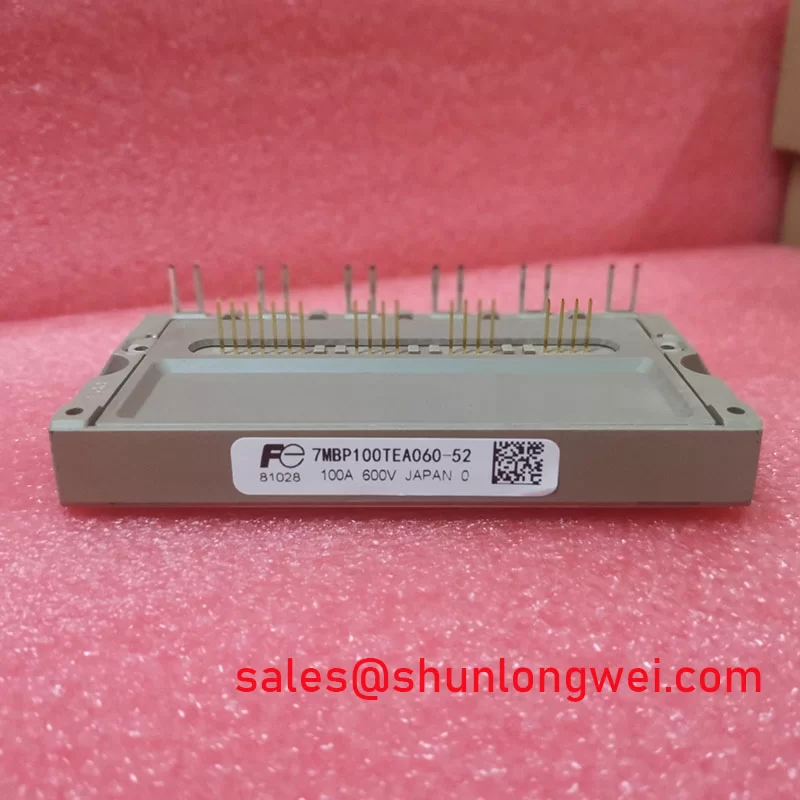

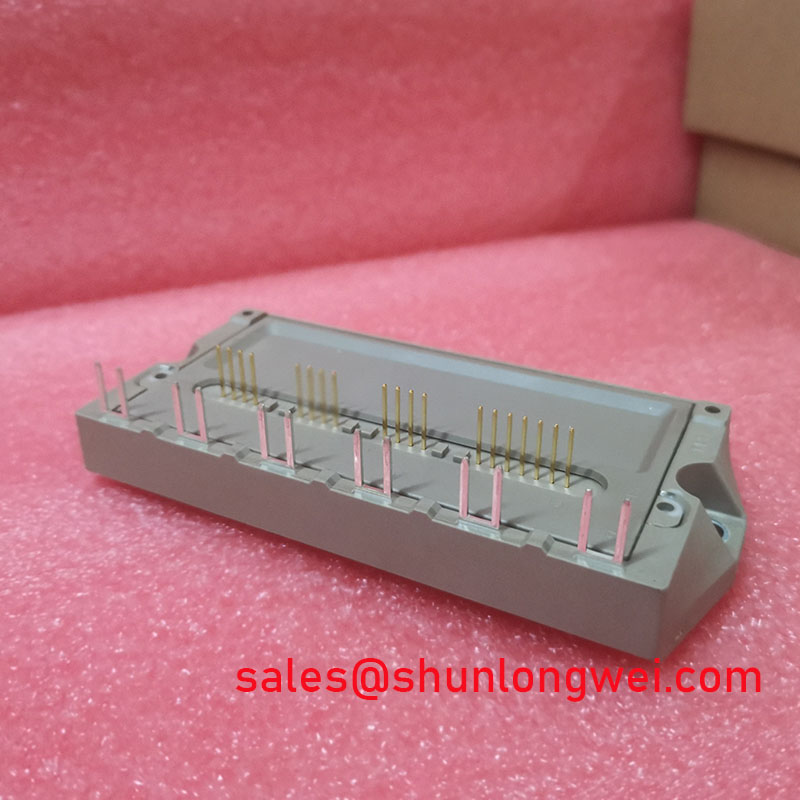

Technical Analysis of the 7-in-1 Topology
The primary engineering advantage of the 7MBP100TEA060-52 is its functional density. By integrating the input rectification stage, the dynamic braking circuit, and the final inverter stage, the module eliminates the need for multiple discrete components. This consolidation significantly reduces the PCB footprint and simplifies the bus bar structure, which in turn lowers stray inductance. Lower parasitic inductance is critical for minimizing voltage overshoots during high-speed switching, contributing to improved system reliability and reduced EMI generation. This level of integration accelerates the development and assembly process for complete drive systems.
Thermal Efficiency and Monitoring
Effective thermal management is central to the performance of any power module. This device features a low collector-emitter saturation voltage (VCE(sat)) of 2.1V (typical) for the inverter IGBTs at their rated current. This parameter directly impacts conduction losses; a lower VCE(sat) means less power is converted into waste heat, allowing for a smaller heatsink or operation at higher ambient temperatures. The module’s thermal resistance, Rth(j-c), can be compared to the width of a pipe for heat flow. The low specified value of 0.28°C/W per IGBT ensures an efficient thermal path from the semiconductor junction to the case. Furthermore, the integrated NTC thermistor provides a direct method for monitoring the module’s substrate temperature, enabling precise over-temperature protection and enhancing the overall safety and longevity of the system.
Optimized Application Scenarios
The specifications of the 7MBP100TEA060-52 make it a strong candidate for several power conversion applications:
- AC Motor Drives: Its all-in-one structure provides the complete power stage for compact Variable Frequency Drives (VFDs), ideal for motors up to approximately 30 kW.
- Servo Amplifiers: The low conduction losses and compact footprint are beneficial in high-precision servo systems where space and efficiency are critical.
- Uninterruptible Power Supplies (UPS): The integrated converter and inverter stages form the core of a line-interactive or online UPS system.
- General-Purpose Inverters: The module simplifies the design of small-scale industrial inverters for various loads.
This module is best matched for applications requiring a complete, thermally efficient motor drive power stage in a space-constrained design.
Key Specifications of the 7MBP100TEA060-52
| Absolute Maximum Ratings (Ta=25°C) | |
|---|---|
| Collector-Emitter Voltage (V_CES) | 600V |
| Gate-Emitter Voltage (V_GES) | ±20V |
| Collector Current (I_C) @ Tc=80°C | 100A |
| Collector Power Dissipation (P_C) per IGBT | 440W |
| Electrical Characteristics (Inverter Part, Ta=25°C) | |
| Collector-Emitter Saturation Voltage (V_CE(sat)) @ 100A | 2.1V (Typ.), 2.7V (Max.) |
| Forward Voltage of FWD (V_F) @ 100A | 2.0V (Typ.), 2.5V (Max.) |
| Thermal Characteristics | |
| Thermal Resistance (Rth(j-c)) per IGBT | 0.28 °C/W |
| Operating Junction Temperature (T_j) | +150°C |
Engineer FAQ
1. What is the primary function of the integrated brake chopper in a motor drive application?
The integrated brake chopper is used for dynamic braking. When a motor decelerates, it acts as a generator, sending regenerative energy back to the DC bus. The brake chopper rapidly switches a resistor across the DC bus to dissipate this excess energy as heat, preventing the DC bus voltage from rising to damaging levels.
2. How do I use the Rth(j-c) value for thermal design?
The junction-to-case thermal resistance (Rth(j-c)) is a critical parameter for heatsink selection. First, calculate the total power loss (conduction and switching). Then, use the formula: Case Temperature (Tc) = Junction Temperature (Tj) – (Power Loss * Rth(j-c)). You must select a heatsink that can maintain Tc below the maximum specified operating temperature under worst-case conditions.
3. What are the recommended gate drive conditions for this module?
The datasheet specifies the electrical characteristics with a gate voltage (V_GE) of +15V for turn-on and -10V for turn-off. Adhering to these voltages is recommended to achieve the specified VCE(sat) and switching performance while ensuring a firm turn-off state to prevent parasitic turn-on.
4. What is the purpose of the built-in NTC thermistor?
The NTC (Negative Temperature Coefficient) thermistor provides a means for real-time temperature feedback from the module’s substrate. Its resistance decreases predictably as temperature increases. A control circuit can monitor this resistance to trigger alerts, reduce power, or shut down the system if the module approaches its maximum operating temperature, thereby preventing thermal damage.
Enabling Efficient and Integrated Power Designs
The Fuji Electric 7MBP100TEA060-52 provides a robust, all-in-one power stage that enables engineers to develop more compact and efficient motor drives and inverters. Its combination of high integration, low conduction losses, and integrated thermal protection offers a clear path to reducing system complexity and enhancing operational reliability in demanding industrial applications.