NEC NL6448BC20-20: A 6.5″ VGA Display Engineered for Industrial Longevity
“`html
NEC NL6448BC20-20: 6.5″ VGA Display for Industrial Longevity
Technical Analysis of the NL6448BC20-20 TFT-LCD Module
The NEC NL6448BC20-20 is a 6.5-inch amorphous silicon TFT-LCD module engineered for sustained performance in industrial environments. Its defining value is a combination of strong optical characteristics and a design focused on long-term serviceability, particularly through its replaceable backlight system. This makes it a sound component choice for systems requiring reliable visual interfaces over extended operational lifetimes.
- Core Specifications: 6.5-inch Diagonal | 640×480 VGA Resolution | 400 cd/m² Brightness
- Key Advantages: High visibility in typical industrial lighting conditions, field-replaceable backlight for extended service life.
Engineers often ask how to manage the proactive management of industrial LCD backlight lifespan. The NL6448BC20-20 directly addresses this with a user-replaceable CCFL lamp, a critical feature for minimizing downtime and total cost of ownership in legacy systems.
Download the NL6448BC20-20 Tentative Datasheet (PDF)
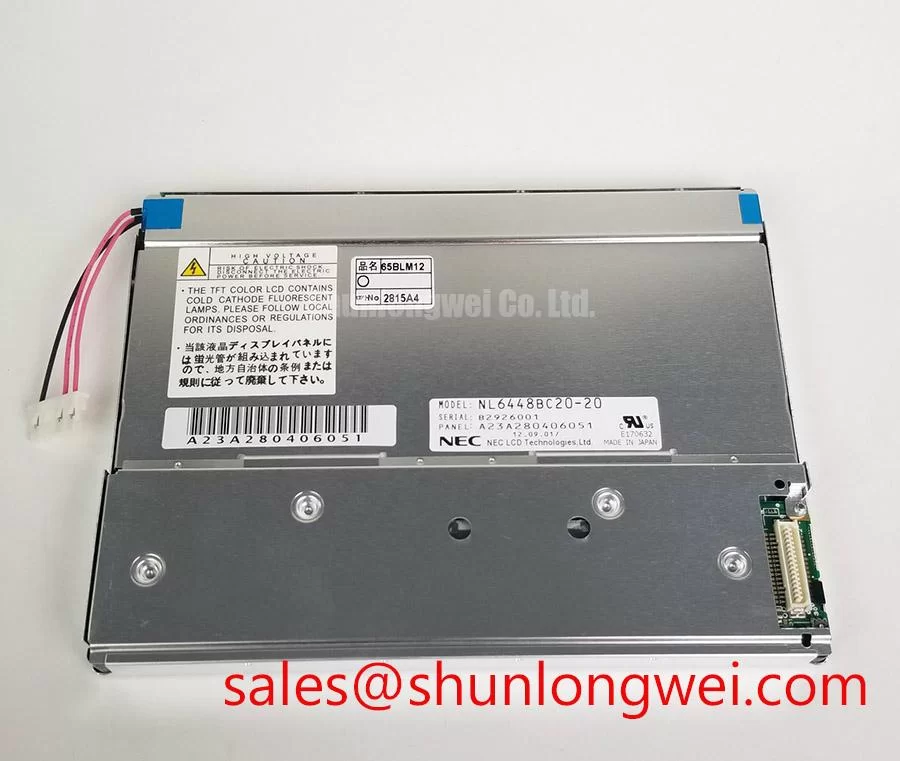

Engineered for Clarity and Maintainability
The engineering value of the NL6448BC20-20 is evident in its balanced optical performance. A typical brightness of 400 cd/m² combined with a 600:1 contrast ratio ensures that graphical data and text are clearly legible under the varied lighting conditions found in control rooms and factory floors. This level of luminance is sufficient to overcome moderate ambient light, reducing operator error and eye strain.
The specified viewing angles are critical for applications where an operator may not be positioned directly in front of the screen. With a horizontal range of 80° left and 80° right (CR>10), and a vertical range of 60° up and 80° down, the display maintains color and contrast consistency from multiple viewpoints. Consider the viewing cone as the effective area of a spotlight; the wide horizontal cone of this display ensures that information is accessible to multiple personnel or a moving operator without significant image degradation.

Perhaps its most significant feature for long-term industrial use is the replaceable backlight assembly. The CCFL backlight has a specified typical lifetime of 50,000 hours to half-brightness. The ability to replace only the lamp holder, rather than the entire TFT-LCD panel, dramatically extends the usable life of the host equipment. This design choice provides a practical solution for system maintenance and reduces long-term operational costs.
Optimized Application Scenarios
The feature set of this module makes it a strong candidate for specific industrial roles where reliability and clear visuals are paramount.
- Industrial HMI Panels: The standard VGA resolution and 6-bit LVDS interface are compatible with a wide range of industrial controllers, while its brightness and viewing angles ensure clear machine status feedback.
- Test and Measurement Equipment: Its compact 6.5-inch form factor is well-suited for benchtop or portable diagnostic tools that require a durable, easy-to-read graphical interface.
- Process Control Systems: For monitoring applications, the anti-glare surface treatment minimizes reflections, and the wide operating temperature range (-10 to +70°C) allows for deployment in non-climate-controlled environments.
- Legacy System Sustainment: The replaceable backlight makes it an ideal drop-in component for extending the life of existing machinery that utilizes 6.5″ VGA displays, avoiding costly system redesigns.
For systems requiring a compact, serviceable, and visually consistent VGA display, the NL6448BC20-20 offers a well-balanced, data-driven solution for long-term deployment.
Key Specifications of the NL6448BC20-20
| Parameter | Specification |
|---|---|
| Display Characteristics | |
| Screen Size | 6.5 inches (16 cm) |
| Resolution | 640 (H) x 480 (V) pixels |
| Pixel Pitch | 0.207 (H) x 0.207 (V) mm |
| Active Area | 132.48 (H) x 99.36 (V) mm |
| Display Mode | Normally White, Transmissive |
| Optical Characteristics (Ta = 25°C) | |
| Luminance | 400 cd/m² (Typical) |
| Contrast Ratio | 600:1 (Typical) |
| Viewing Angle (CR > 10) | Up: 60°, Down: 80°, Left: 80°, Right: 80° (Typical) |
| Response Time (Ton + Toff) | 25 ms (Typical) |
| Electrical & Environmental | |
| Interface | LVDS (6-bit RGB) |
| Logic Supply Voltage (VDD) | 3.3 V |
| Power Consumption | 3.9 W (Typical, Logic and Backlight) |
| Operating Temperature | -10°C to +70°C |
| Storage Temperature | -20°C to +80°C |
Engineer’s FAQ
1. How can I maximize the operational life of the NL6448BC20-20 in my system?
The datasheet specifies a backlight life of 50,000 hours (typ.) to 50% brightness. The key advantage of this model is that the backlight is field-replaceable. To maximize overall life, operate the module within its specified temperature range of -10°C to +70°C and ensure adequate ventilation to prevent overheating, a key factor in long-term reliability.
2. What are the specific power requirements for this display?
The module requires a single 3.3V supply for its logic board, drawing a typical current of 190 mA. The CCFL backlight is driven by a separate inverter (not included), which typically draws around 2.7 W. The total power consumption is approximately 3.9 W under typical conditions.
3. Is the NL6448BC20-20 suitable for outdoor or direct sunlight applications?
With a brightness of 400 cd/m², this display is best suited for indoor industrial or controlled outdoor environments. It is not a fully sunlight-readable panel. For applications with high ambient light, additional shielding or optical bonding would be necessary to maintain acceptable contrast.
4. What is the physical mounting and connection interface?
The module has four mounting holes, one in each corner of the bezel. The data and logic power are handled via a single 20-pin connector (FI-SEB20P-HFE) for the LVDS interface. The backlight connects via a separate 2-pin connector (BHSR-02VS-1) to the CCFL inverter.
Enabling Reliable Visual Systems
The NL6448BC20-20 provides a durable and practical display solution for industrial equipment. Its combination of solid optical performance and a maintainability-focused design allows engineers to build or sustain systems where long-term operational uptime and clarity are primary objectives.
“`