Mitsubishi PM75CS1D060: A Technical Review of the 7-in-1 Intelligent Power Module
Mitsubishi PM75CS1D060: 600V 75A CIB Intelligent Power Module
Introduction and Core Highlights
The Mitsubishi PM75CS1D060 is a highly integrated Intelligent Power Module (IPM) that consolidates a complete three-phase converter, inverter, and brake (CIB) power stage into a single compact, flat-base package. This 7-in-1 module streamlines the design of motor control systems by integrating the power switches, freewheeling diodes, and dedicated drive and protection circuits. The result is a robust solution that simplifies board layout, reduces component count, and accelerates development time for demanding industrial applications.
- Core Specifications: 600V | 75A | VCE(sat) 1.7V (Typ)
- Key Advantages: Drastically reduced PCB footprint and simplified assembly. Comprehensive built-in protection enhances system reliability.
For engineers wondering how to simplify the design of compact motor drives, the PM75CS1D060 provides an answer by replacing dozens of discrete components with one verified power stage. Download the Official Datasheet (PDF)
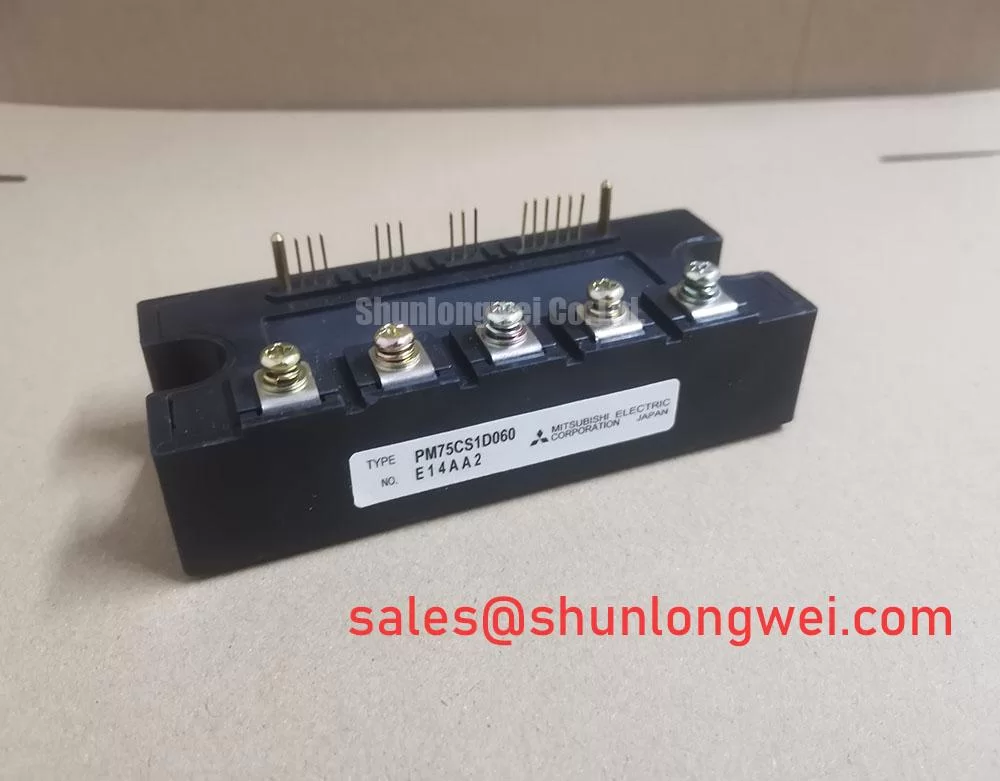
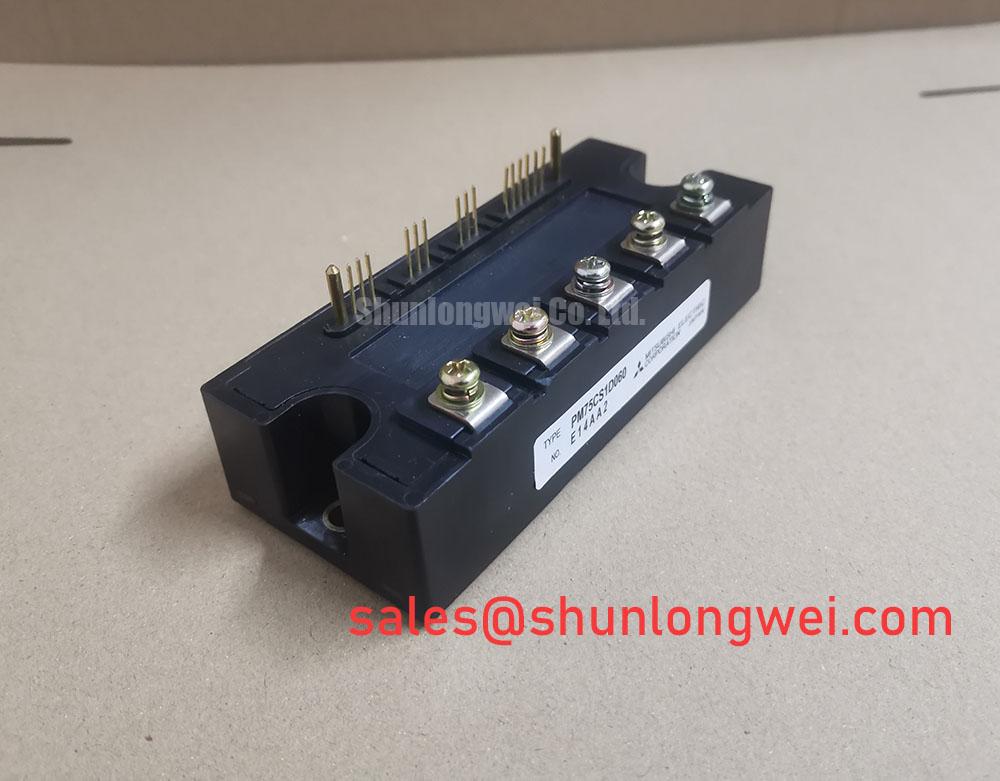
Technical Analysis: Integration and Reliability
The primary value of the PM75CS1D060 lies in its high level of integration. It incorporates a three-phase diode bridge converter, a three-phase IGBT inverter, and a brake chopper IGBT with its associated freewheeling diode. This CIB topology is a cornerstone of modern Variable Frequency Drive (VFD) design. By co-packaging these elements, Mitsubishi minimizes the parasitic inductance between stages, a frequent source of voltage overshoot and EMI in discrete designs. This simplifies the often complex task of PCB layout in high-power systems.
A key feature of this IPM is its built-in intelligence, which includes dedicated gate drive circuits and robust protection functions. The module provides short-circuit (SC) protection, control supply under-voltage (UV) lockout, and an over-temperature (OT) fault signal. These integrated safety mechanisms offload critical monitoring tasks from the system’s microcontroller and reduce the need for external sensing components. This not only saves board space but also provides a faster, more reliable response to fault conditions, directly contributing to overall system longevity and safety.
Efficient Thermal Management
Effective heat dissipation is critical for the reliability of any power module. The PM75CS1D060 specifies the junction-to-case thermal resistance (Rth(j-c)) for each key component, with the inverter IGBT rated at 0.38°C/W. This value is fundamental for thermal design. You can think of thermal resistance like the narrowness of a pipe; a lower value represents a wider pipe, allowing heat to flow away from the semiconductor junction more easily. This predictable thermal performance simplifies heatsink selection and enables designers to build more compact and cost-effective cooling systems while ensuring the device operates within its safe temperature limits, a topic further explored in guides to IGBT thermal design.
Optimized Application Scenarios
- General-Purpose Inverters: The module’s 600V/75A rating and integrated CIB structure make it a strong candidate for general-purpose motor drives up to 30kW, simplifying manufacturing and reducing the bill of materials.
- Servo Drives: In applications requiring precise motion control, the integrated gate drivers and protection circuits ensure the fast and reliable switching performance necessary for servo systems.
- Industrial Automation: For automated machinery, conveyors, and pump systems, the all-in-one design provides a compact and durable power stage that simplifies system maintenance.
- HVAC Systems: The module’s efficiency and integrated nature are well-suited for controlling compressors and fans in commercial heating, ventilation, and air conditioning units.
Its high integration level and built-in protections make it an optimal choice for compact, reliability-driven motor control systems.
Key Specifications of the PM75CS1D060
| Absolute Maximum Ratings (Tj = 25°C) | ||
|---|---|---|
| Parameter | Symbol | Rating |
| Collector-Emitter Voltage | VCES | 600V |
| Collector Current (DC) | ±IC | 75A |
| Collector Current (Peak) | ±ICP | 150A |
| Collector Dissipation | PC | 378W |
| Isolation Voltage | Viso | 2500Vrms (AC 1 min) |
| Electrical and Thermal Characteristics (Tj = 25°C) | ||
| Collector-Emitter Saturation Voltage (Inverter) | VCE(sat) | 1.7V (Typ) / 2.2V (Max) at Ic=75A |
| Forward Voltage (FWD) | VEC | 2.0V (Typ) / 2.5V (Max) at Ic=75A |
| Thermal Resistance (Inverter IGBT, Junction to Case) | Rth(j-c)Q | 0.38°C/W |
| Thermal Resistance (Inverter FWD, Junction to Case) | Rth(j-c)D | 0.43°C/W |
Engineer’s FAQ
- What is the main advantage of using the PM75CS1D060 IPM over a discrete IGBT solution?
- The primary advantage is integration. This module combines the converter, inverter, brake chopper, and critical driver/protection circuits into a single, thermally efficient package. This significantly reduces design complexity, component count, and PCB size compared to a solution built from discrete components, which is a key consideration when comparing an IPM vs. discrete IGBTs.
- How should I mount this module for optimal thermal performance?
- The PM75CS1D060 features a flat-base insulated package for mounting to a heatsink. For effective heat transfer, ensure the heatsink surface is flat (typically within a 0.05mm tolerance) and apply a thin, uniform layer of thermal grease. Use the specified mounting screw torque (M4: 1.5 – 2.0 Nm) to ensure proper contact without inducing mechanical stress on the module.
- What does the ‘Fo’ (Fault Output) signal indicate?
- The Fo terminal provides a consolidated fault status. According to the datasheet, this open-collector output goes to a high-impedance state during normal operation and is pulled low to signal a fault. A fault is triggered by a short-circuit (SC) event, control supply under-voltage (UV), or an over-temperature (OT) condition detected by the internal circuitry.
- Can this module be controlled directly from a 3.3V or 5V microcontroller?
- Yes, the control inputs (UP, VP, WP, UN, VN, WN) are designed to be compatible with 5V CMOS/TTL logic levels. The datasheet specifies a high-level input voltage (Vih) range of 4.0V to 5.5V, making it straightforward to interface with standard microcontrollers.
Enabling Compact and Reliable Power Conversion
The Mitsubishi PM75CS1D060 offers engineers a complete and verified power stage. Its CIB integration and on-board protection features provide a direct path to developing smaller, more reliable, and more efficient motor control systems, reducing both design cycle time and system complexity.