SKR 320/08: High-Reliability Rectifier for Industrial Power Systems
SKR 320/08: 800V 320A Stud Mount Rectifier Diode
High-Reliability Power Rectification for Industrial Systems
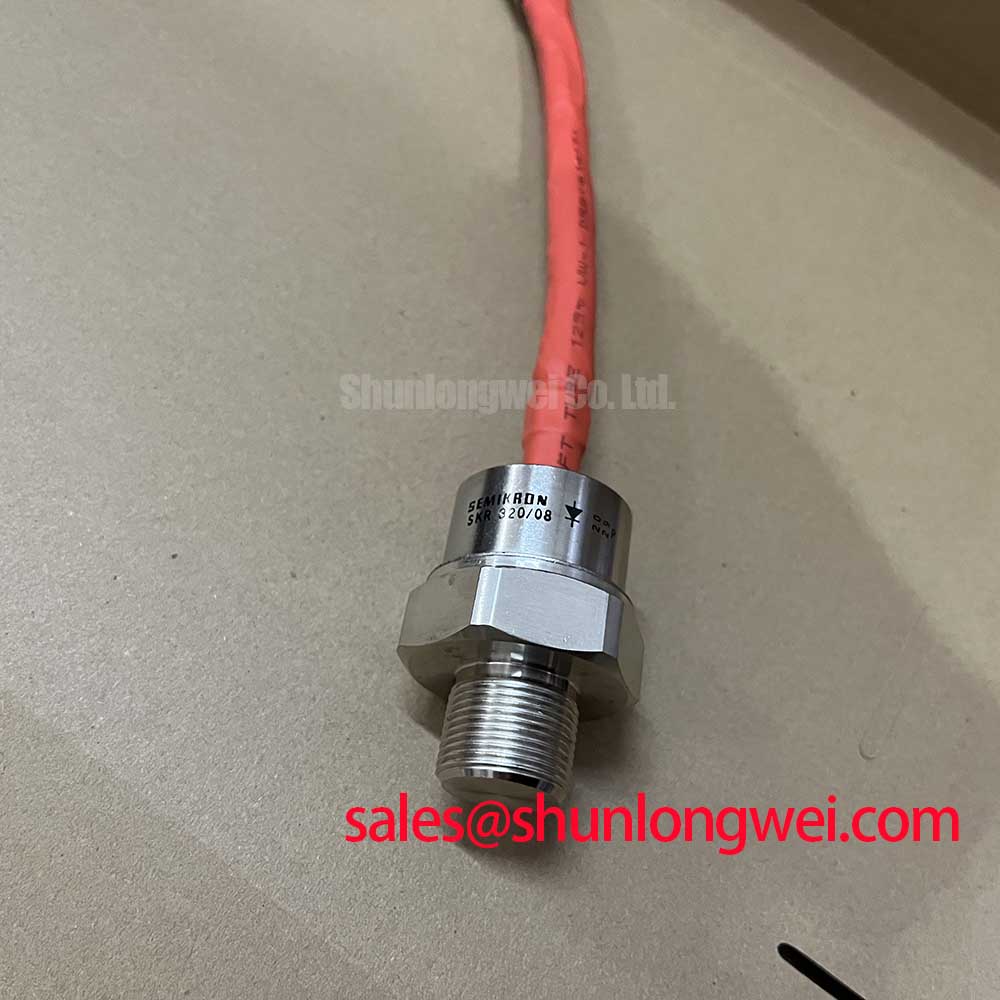
The Semikron SKR 320/08 is a stud-mount rectifier diode engineered for robust performance in high-power industrial applications. Its core value proposition is delivering reliable power conversion, supported by a hermetic metal and glass construction and exceptional surge current handling. This design ensures stable operation under demanding electrical and thermal loads, making it a dependable component for critical power systems.
- Core Specifications: 800 V | 320 A | 8000 A Surge (IFSM)
- Key Engineering Benefits:
- Superior fault tolerance due to high surge current immunity.
- Simplified and reliable mounting with a standard M24 threaded stud.
This module’s high average forward current capacity makes it an excellent building block for the front-end of high-power equipment. Download Official Datasheet (PDF)



Technical Analysis for System Reliability
The engineering focus of the SKR 320/08 is long-term reliability in high-current environments. A key parameter supporting this is its high surge forward current (IFSM) rating of 8000 A (at Tj=180°C, 10 ms). This capability is critical for system survivability. Think of the IFSM rating like a vehicle’s emergency braking system; it ensures the device can safely handle sudden, unexpected current spikes from events like motor startups or line faults without failing. This high thermal and electrical tolerance is a direct result of its robust internal construction, featuring glass passivated silicon.
Effective thermal management is fundamental to the reliability of any power semiconductor. The SKR 320/08 features a junction-to-case thermal resistance (Rth(j-c)) of 0.16 K/W. This value represents the efficiency of heat transfer from the active silicon die to the module’s case. A lower thermal resistance is like a wider pipe for heat; it allows thermal energy to flow away from the junction more easily, keeping the device within its safe operating temperature range. The standard stud-type housing facilitates a direct and secure connection to a heatsink, simplifying the overall thermal design process.
Optimized Application Scenarios
The specifications of the SKR 320/08 make it a strong candidate for several power rectification applications:
- High-Power Rectifiers: Its 320 A continuous current rating enables its use in front-end rectifiers for large AC drives, industrial power supplies, and welding equipment.
- Battery Charging Systems: The excellent surge current handling (IFSM) provides the necessary robustness to manage the high inrush currents often encountered in large-scale battery charging applications.
- Non-Controllable and Half-Controllable Bridges: The device is designed as an all-purpose rectifier, making it suitable for cost-effective and reliable bridge rectifier circuits where control is not required.
This module is best matched for industrial systems requiring a robust 800V rectifier stage with high surge survivability and simplified mechanical assembly.
Key Specifications of the SKR 320/08
| Maximum Ratings (Tj = 25 °C unless otherwise specified) | |
|---|---|
| Repetitive Peak Reverse Voltage (VRRM) | 800 V |
| Average Forward Current (IFAV) | 320 A (Tc = 125 °C, sine 180) |
| Surge Forward Current (IFSM) | 8000 A (Tj = 180 °C, 10 ms) |
| I²t Value | 300,000 A²s (Tj = 180 °C, 10 ms) |
| Electrical & Thermal Characteristics | |
| Forward Voltage (VF) | max. 1.35 V (at IF = 1000 A, Tj = 25 °C) |
| Threshold Voltage (V(TO)) | 0.8 V (Tj = 180 °C) |
| Slope Resistance (rT) | 0.45 mΩ (Tj = 180 °C) |
| Thermal Resistance, Junction to Case (Rth(j-c)) | 0.16 K/W |
| Operating Junction Temperature (Tvj) | -40 to +180 °C |
| Mounting Torque (Ms) | 60 Nm |
Engineer’s FAQ
Q: How should the Rth(j-c) value be used for heatsink selection?
A: The Rth(j-c) of 0.16 K/W is the thermal resistance from the semiconductor junction to the module’s case. To select a heatsink, you must first calculate the total power dissipation (PD). The required total thermal resistance from junction to ambient (Rth(j-a)) is (Tj,max – Ta) / PD. The heatsink’s resistance must be less than Rth(j-a) – Rth(j-c) – Rth(c-s), where Rth(c-s) is the case-to-heatsink resistance (typically ~0.015 K/W with thermal grease).
Q: What is the benefit of the “glass insulator” feature mentioned in the datasheet?
A: The “hermetic metal case with glass insulator” refers to the glass passivation of the silicon die. This process seals the sensitive junction area from moisture and contaminants. This significantly improves long-term reliability and voltage blocking stability, preventing degradation over the product’s operational life, a key factor in preventing premature failures.
Q: What is the correct mounting torque for the SKR 320/08?
A: The recommended mounting torque for the M24 stud is 60 Nm. Applying the correct torque is crucial. Insufficient torque leads to poor thermal contact and overheating, while excessive torque can damage the stud or internal components.
Q: Can this device be used as a freewheeling diode in a high-frequency PWM inverter?
A: While the datasheet mentions “free-wheeling diodes” as a typical application, this refers to line-frequency applications. The SKR 320/08 is a standard recovery diode and lacks the fast reverse recovery characteristics (high Qrr) needed for efficient operation in high-frequency switched-mode applications, where it would exhibit significant switching losses.
Design and Reliability
By integrating a high current rating with exceptional surge tolerance and a design that simplifies thermal management, the Semikron SKR 320/08 offers a dependable foundation for industrial rectification circuits. Its robust construction ensures long-term operational stability, empowering engineers to build resilient and powerful systems.