Sharp LJ64ZU31: A Technical Review of the High-Performance EL Display
Sharp LJ64ZU31 8.9-inch Electroluminescent Display Unit
High-Contrast, High-Speed EL Display for Industrial Instruments
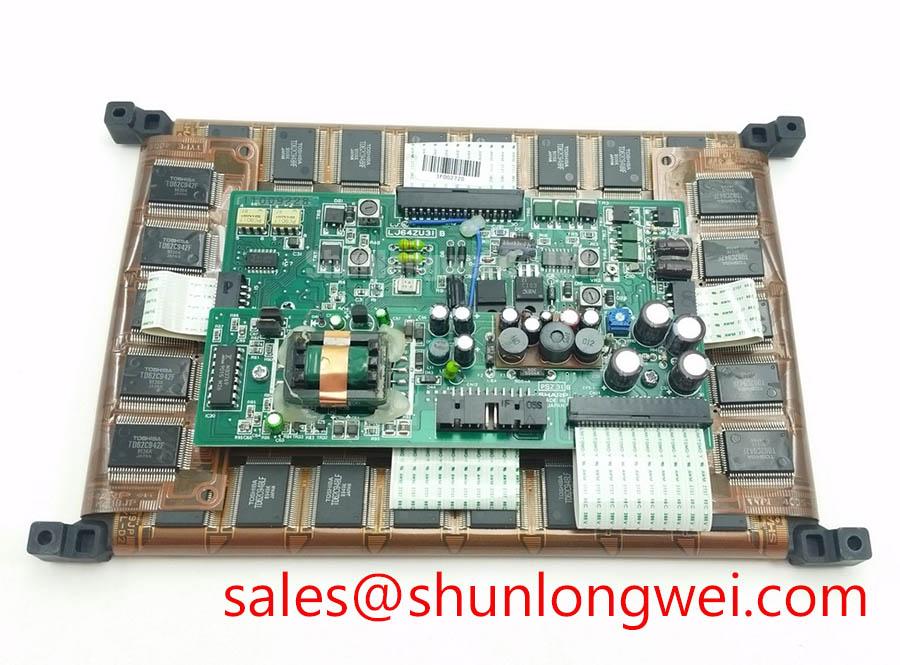
The Sharp LJ64ZU31 is an 8.9-inch electroluminescent (EL) display unit engineered for applications requiring exceptional visual clarity and rapid data representation. Leveraging self-emissive EL technology, it delivers a superior image free from the viewing angle and response time limitations of conventional LCDs. This makes it a prime component for sustaining and upgrading legacy industrial systems where performance and reliability are paramount.
* **Core Specifications:** 640 x 400 Resolution | 60 cd/m² Brightness | >20:1 Contrast Ratio
* **Key Advantages:** Ultra-fast 10µs response time for blur-free imaging. Slim 9mm profile for compact system designs.
* **Intended Application:** Excels in test equipment and industrial HMIs due to its inherent high contrast and wide, consistent viewing angle.
Download the Official LJ64ZU31 Datasheet (PDF)


Technical Analysis for System Integration
The Electroluminescent Advantage
Unlike TFT-LCD panels that require a separate backlight, the LJ64ZU31 utilizes electroluminescent technology where each pixel generates its own light. This self-emissive property is the source of its primary engineering advantage: a high contrast ratio greater than 20:1. Think of it as having over a quarter-million individual light bulbs, each precisely controlled. The result is a sharp, clear image with deep blacks, ensuring excellent readability from any angle on the factory floor or in a lab environment. This is a critical feature for applications where misinterpreting data is not an option.
Unmatched Clarity for Dynamic Data
The datasheet specifies a typical response time of just 10 microseconds (µs). This is significantly faster than most industrial LCDs. This rapid response time is crucial for applications displaying fast-changing information, such as monitoring equipment, oscilloscopes, or CNC machine tool paths. It eliminates the motion blur and ghosting artifacts that can obscure critical details on slower screens, providing operators with a true, real-time representation of system status. For more information on managing display clarity, see our guide on achieving motion clarity.
Optimized Application Scenarios
The LJ64ZU31’s specific feature set makes it a strong candidate for several industrial and specialized fields:
- Test and Measurement Equipment: Its ultra-fast response time ensures accurate rendering of high-frequency waveforms and digital signals without visual lag.
- Industrial Control Panels & HMIs: The high-contrast, wide-angle viewing is ideal for at-a-glance readability in challenging ambient light conditions.
- Medical Instrumentation: Provides the clarity and precision required for displaying critical patient data and diagnostic information.
- Legacy System Retrofits: The 640×400 resolution and 4-bit parallel logic interface offer a potential drop-in replacement path for aging systems, a topic further explored in our guide to LCD EOL navigation.
Its combination of a slim profile and robust visual performance makes it a best match for compact instruments that demand uncompromised image quality.
Key Specifications of the LJ64ZU31
| Display & Optical Characteristics (Ta = 25°C) | |
|---|---|
| Display Technology | Electroluminescent (EL) |
| Active Area | 191.9 (W) x 119.9 (H) mm |
| Resolution | 640 x 400 pixels |
| Luminance (Brightness) | 60 cd/m² (Typical) |
| Contrast Ratio | >20:1 (Typical) |
| Response Time | 10 µs (Typical) |
| Electrical & Interface Characteristics | |
| Logic Supply Voltage (VL) | 5V ±5% |
| Driver Supply Voltage (VD) | 24V ±10% |
| Logic Signal Level | LSTTL Level (4-bit parallel data) |
| Power Consumption | 12 W (Typical, 50% checkerboard pattern) |
| Mechanical & Environmental | |
| Outline Dimensions | 228.5 (W) x 158.5 (H) x 9.0 (D) mm (Max) |
| Weight | 450 g (Typical) |
| Operating Temperature | 0°C to +50°C |
| Storage Temperature | -25°C to +70°C |
Engineer’s FAQ for the LJ64ZU31
1. What are the key power and logic voltage requirements for interfacing with the LJ64ZU31?
The unit requires two separate power supplies as stated in the datasheet: a 5V (±5%) source for the logic board (VL) and a 24V (±10%) source for the high-voltage drivers (VD). All logic signals, including the 4-bit data bus (D0-D3) and timing controls (CP, L/S, FRM), are LSTTL compatible.
2. How does the electroluminescent technology affect performance versus a standard LCD?
The primary difference is that this EL display is self-emissive, providing a much higher contrast ratio and an almost instantaneous response time (10µs). Unlike LCDs, it requires no backlight and offers a consistent view from any angle. However, its power consumption is typically higher than a non-backlit LCD of a similar size.
3. Is the brightness of the LJ64ZU31 adjustable?
The datasheet does not specify a direct brightness control input. Luminance is rated at a typical 60 cd/m² under standard operating conditions. Brightness will vary with the input voltage (VD) and the content being displayed, with power consumption peaking at an all-pixels-on state.
4. What are the main mechanical mounting considerations for this display?
The datasheet provides a mechanical drawing with four mounting holes, one at each corner of the unit’s bezel. Given its slim 9mm profile and 450g weight, it is critical to ensure it is mounted securely on a flat plane to avoid mechanical stress on the glass panel. For further reading, consult our guide on vibration and shock resistance.
Enabling Clarity in Demanding Environments
The technical attributes of the Sharp LJ64ZU31 confirm its role as a specialized display for systems where data integrity is non-negotiable. Its electroluminescent technology provides a foundation for superior visual performance, ensuring that engineers can deliver instruments and control systems with exceptional readability and response, even in applications where standard display technologies may fall short.